Last updated: October 2026
Water washable resin pros and cons come down to one trade: you swap isopropyl alcohol for tap water and lose nothing at the wash station, but the cured plastic is a little less tough and picks up moisture faster. That makes it a great fit for miniatures, figurines and display models, and a poor fit for load-bearing or water-contact parts.
That is the honest summary. Most of the marketing around water washable resin talks about the wash, and the wash is genuinely better: no alcohol bottle, no fumes hanging around the house, and parts that come out of an ultrasonic cleaner looking clean. The catch shows up later, when a fine detail snaps during support removal or a print that sat in a humid room starts to look dull.
I have run water washable resins next to standard ones often enough to be specific about where the difference matters and where it is just noise. This guide walks the chemistry, the workflow, the safety rules and the buyer’s checklist so you can decide whether it earns a place on your shelf.
Table of Contents
- 1What Is Water Washable Resin?
- 2How Does Water Washing Work?
- 3Water Washable Resin Pros and Cons at a Glance
- 4What Are the Main Advantages of Water Washable Resin?
- 5What Are the Main Drawbacks of Water Washable Resin?
- 6Do newer water washable resin formulas still crack?
- 7Is Water Washable Resin Safe to Use?
- 8How Do You Wash and Cure Water Washable Resin Prints?
- 9Is Water Washable Resin Stronger or Weaker Than Standard Resin?
- 10Water Washable Resin vs. Standard Resin: Which Should You Choose?
- 11How Do You Choose the Best Water Washable Resin for Your Printer?
- 12Frequently Asked Questions
- 13Can you wash water washable resin with water only?
- 14Is water washable resin stronger than regular resin?
- 15Does water washable resin need to be washed in a separate container?
- 16Can I use water washable resin in any resin 3D printer?
- 17How long does it take to wash and cure water washable resin?
- 18What happens if I put water washable resin down the sink?
- 19What I Would Do First
What Is Water Washable Resin?
Water washable resin is a photopolymer resin that carries water-soluble chemistry inside the liquid. The printing process is the one you already know: liquid resin sits on a build plate, a UV or LCD mask cures layer by layer, and you end up with a solid part attached to the plate.
What changes is what happens to the liquid resin that never cured. In a standard resin, that leftover liquid is a hydrophobic polymer, and alcohol is the solvent that lifts it off the part. Water cannot touch it. In a water washable resin, part of the uncured formulation is made of water-soluble components, commonly described as hydrophilic oligomers or polyvinyl alcohol type chemistry. Those dissolve in plain water and rinse away, while the cured polymer network stays solid and insoluble.
Two terms get mixed up constantly. Water washable describes the uncured liquid on the print. It does not describe the finished part. A cured water washable print will not dissolve in a sink or a fish tank no matter how long it sits there, though it can absorb more water than a standard cured print does.
Printers are another consideration. Because these formulations tend to run at a lower viscosity than standard resin, they work on most LCD and DLP machines, but exposure time and lift speed settings usually need adjusting. Check that your printer’s LCD covers the waveband the resin manufacturer lists before you commit.
How Does Water Washing Work?
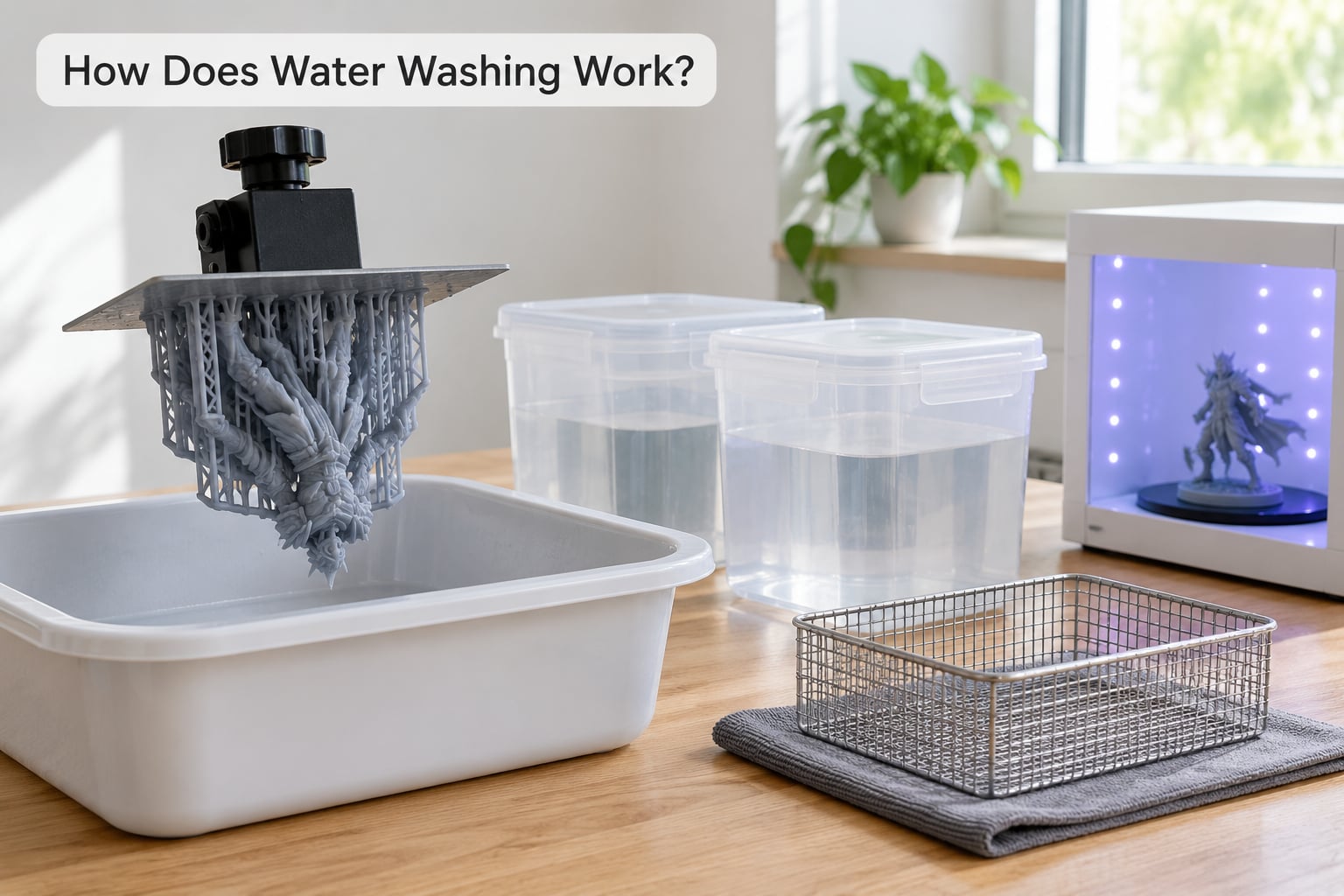
The process is straightforward once you accept that washing and curing are two separate jobs. First the print comes off the plate, then you wash, then you dry, then you cure. Skipping the dry stage is the most common reason a water washed print ends up tacky.
- Remove the print. Flex the build plate or use the plate’s release angle to pop the part off. Water washable resin usually releases more easily than standard resin.
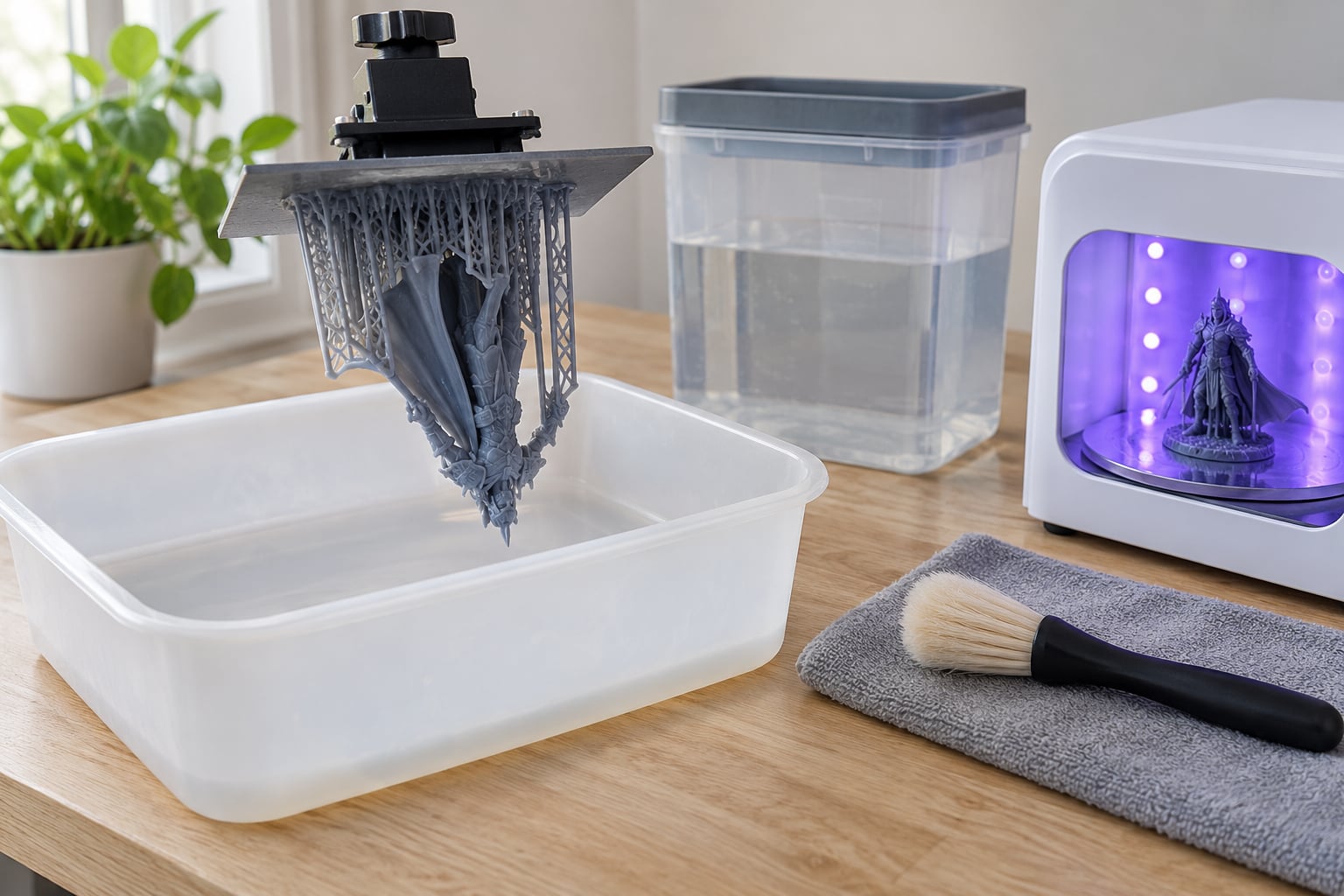
- Wash in room temperature water. A 5 to 10 minute soak in a plastic basin or wash and cure station loosens most of the surface resin. Most manufacturers quote a wash window in the 45 to 60 second range for a quick rinse, with longer soaks for heavily printed surfaces.
- Rinse under running water. Hold the part in the stream and brush the layer lines with a soft toothbrush to clear hollows and blind spots.
- Let it dry completely. Water sits in micro-cracks and between layers. Give it 30 minutes minimum before curing, longer in a cool room.
- Cure under UV. Ten to 15 minutes in a curing station, or a few minutes under a UV lamp, locks the surface hard. Follow the resin’s own cure recommendation since UV intensity varies a lot between units.
Warm water works faster, but some formulas thicken above 25°C, and warm water speeds up the drying anyway. Room temperature water keeps viscosity predictable. I keep two separate containers, one for the initial soak and one for the final rinse, so a bath full of grey resin never gets a second part dipped in it.
Water Washable Resin Pros and Cons at a Glance
This table covers the water washable resin pros and cons side by side so you can scan the trade before reading the detail.
| Criterion | Water washable resin | Standard resin |
|---|---|---|
| Wash medium | Tap water | Isopropyl alcohol or dedicated wash solution |
| Odor in the room | Low, no alcohol vapor | Pronounced during washing and curing |
| Flammability of wash liquid | None | Alcohol is flammable, store and handle carefully |
| Surface detail | Very good, some report slightly softer highlights | Very good, harder surface after full cure |
| Toughness | Middling, thinner features can snap | Standard to high depending on formulation |
| Moisture uptake | Higher, long-term humidity can dull or crack parts | Lower |
| Post-processing time | Wash is short, drying adds 30 minutes or more | Wash is short, curing still required |
| Disposal | Contaminated wash water must be cured and filtered, not drain-safe | Slurry cured then disposed of, IPA is flammable waste |
| Cost per bottle | Usually higher per kilogram | Generally lower |
| Best use | Miniatures, figurines, display models, quick prototypes | Functional parts, mechanical parts, production |
What Are the Main Advantages of Water Washable Resin?
The benefits cluster around convenience and indoor air quality. Most people switching to this material notice the same handful of things first.
- No alcohol on the wash station. Water replaces IPA entirely, which removes the need to buy, store and dispose of a flammable solvent.
- Milder odor in a home workspace. Standard resin washing leaves a sharp vapor smell in the room for hours. Water washable resin largely removes that, which matters in a spare room or an apartment.
- Ultrasonic cleaners work well. The soluble surface resin lifts in an ultrasonic bath without the aggressive scrubbing some people use to get alcohol resin clean.
- Easier support removal. Water washable resins tend to peel off supports with less force, which is kinder to delicate antlers, weapons and wing edges on miniatures.
- Beginner friendly. Fewer consumables to buy and less chance of getting the wash wrong. A first-time printer is not balancing an alcohol bath by hand.
- Smoother support pitting. Because washing is gentler, small support scars on a surface often finish cleaner after a light sand.
- Lower fire and storage risk. Water does not burn, so the wash station is not a flammable storage problem.
For a tabletop player printing dozens of minis a month, the time and smell savings are the argument. Printers in shared forums consistently point at ultrasonic cleaner compatibility and the missing vapor smell as the two benefits that keep them on this resin.
What Are the Main Drawbacks of Water Washable Resin?
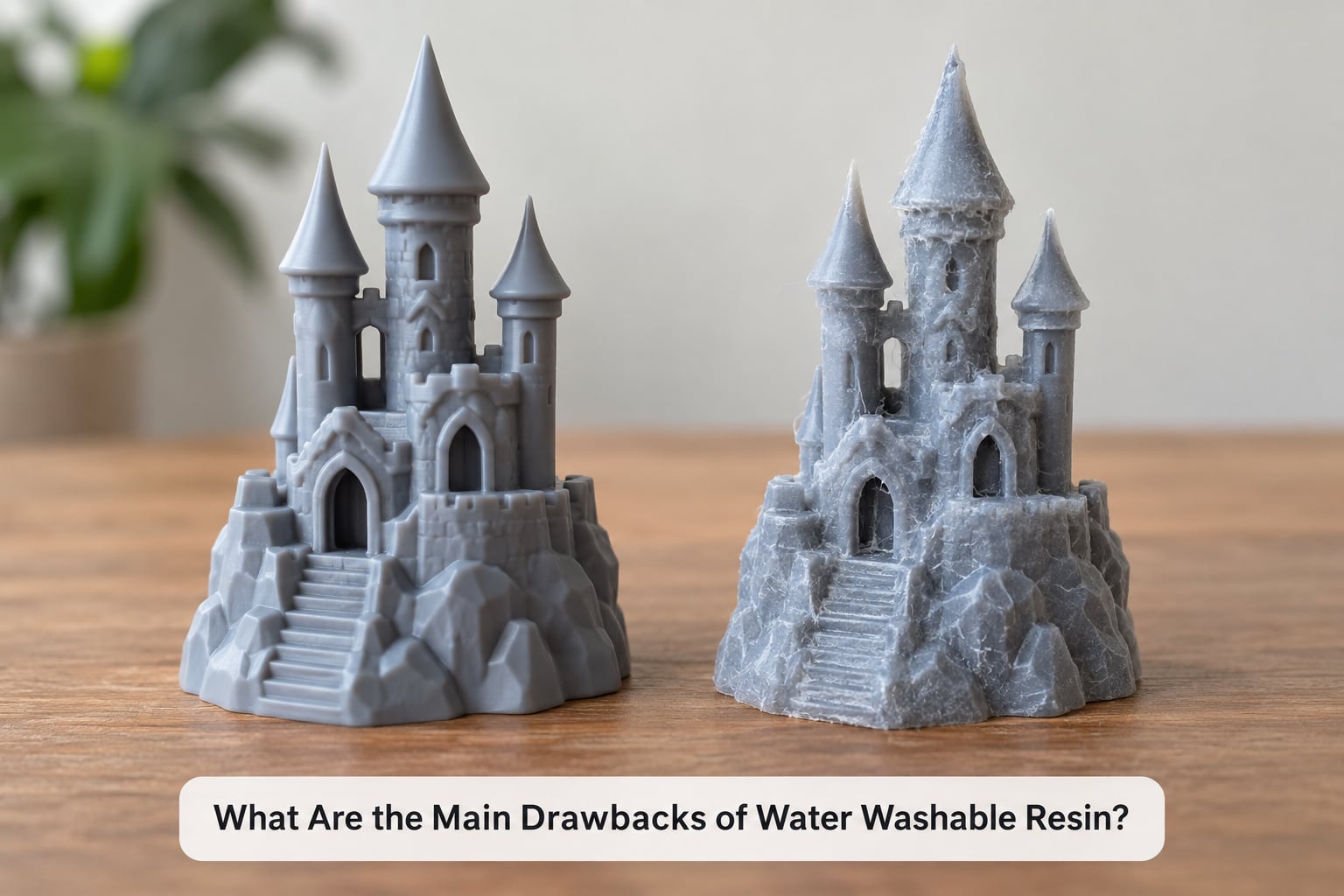
The drawbacks are less visible in a brochure and more visible in month two of owning the bottle.
- More brittle than standard resin. Printers in resin-printing communities describe it as a bit more brittle, and thin features are where it shows first. A sword edge or an antler can snap during support removal, and dropped miniatures tend to break rather than bend.
- Higher moisture absorption. The cured part absorbs water faster than standard resin. Long-term storage in a humid room can dull the surface and, in the worst cases, lead to fine cracks.
- Not drain-safe despite the name. The name describes the wash, not the waste route. Contaminated wash water still needs to be handled as resin waste.
- More water and more time. Washing is quick but soaking longer is common, and the mandatory drying step adds 30 minutes or more that alcohol resin does not need.
- Higher price per kilogram. You give up the cheap-resin option, so the material cost per print is usually higher.
- Still a sensitizer. This is the big one. Water washable resin is uncured photopolymer, and it still contains acrylates that can trigger skin sensitivity and respiratory irritation.
- Not ideal for functional parts. Lower toughness means load-bearing or impact-prone parts are a bad match, and the moisture profile rules out long-term water contact in most cases.
Do newer water washable resin formulas still crack?
Better, but not gone. Second-generation water washable and tough water washable formulas have closed much of the gap. Manufacturers now market these as roughly twice as tough as the first generation, and independent testers report fewer snapped details. The chemistry also affects surface hardness: fully cured water washable parts can feel slightly softer under a fingernail than a hard-cured standard print, which some people read as a softer print overall.
Older forum posts calling this material terrible resin reflect first-generation bottles more than current stock. Read them for the mechanism, not for the verdict.
Is Water Washable Resin Safe to Use?
Water washable resin is safer to wash with, not safer to print with. Treat it with the same respect you give any uncured photopolymer: it is a sensitizer before it is anything else.
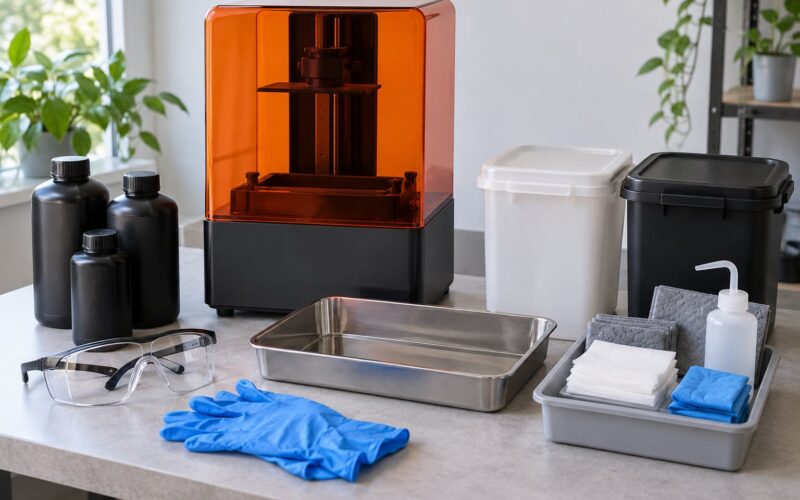
- Gloves, always. Nitrile gloves, changed often. Bare hands pick up acrylate and you will notice weeks later as an itchy patch on the hands.
- Eye protection. Splash goggles during pouring and when you rinse a print under a tap.
- Ventilation. A resin fume extractor with a carbon filter, or at minimum a workshop with a fan pulling air away from your face. The vapor burden drops with water washing but does not hit zero.
- Cover your vat. Dust and skin flakes settle into resin and end up in the next print.
- Storage. Bottles upright, in the original carton, away from heat and direct sunlight. Keep pets and children out of the room while you print and wash.
- Wash hands before eating. Simple, and it removes most of the risk from a shared kitchen.
Water washable does not mean drain-safe. This is the most repeated warning on manufacturer pages and in printing forums, and it is still worth saying plainly. Do not pour contaminated wash water down the sink, into a storm drain, or onto a lawn. Resin wash water carries acrylates, photoinitiator and dissolved polymer.
The usual route is to let the water sit in the container until the dissolved resin settles, pour off as much clear water as your local rules allow, then expose the remaining sludge to sunlight or a UV lamp until it solidifies so it can go into solid resin waste. Filter the residue before it reaches the bin. Follow your local hazardous waste guidance, since rules differ by region.
A cured water washable part is chemically stable and generally fine to handle. Skin contact with a fully cured, washed part is not the risk that uncured liquid is.
How Do You Wash and Cure Water Washable Resin Prints?
Yes, resin prints have to be washed and cured, and the water washable workflow is short enough to do properly every time.
- Pop the print off the build plate. Flex the plate carefully if the part is delicate.
- Soak. Submerge in room temperature water for 5 to 10 minutes. A wash and cure station with a heated bath speeds this up, but check the resin’s temperature guidance first.
- Scrub while soaking. A soft toothbrush on layer lines and around supports removes residue that soaking alone leaves.
- Rinse. Run under fresh water until it stops looking cloudy.
- Dry. Air dry for at least 30 minutes, preferably in a warm, ventilated spot. A fan or a hairdryer on cool works too. Rushing this step is what produces a sticky or tacky surface later.
- Cure. 10 to 15 minutes in a UV curing station, or 2 to 5 minutes under a strong UV lamp, turning the part once. Follow your resin’s stated cure time over any generic number.
- Remove supports. Do this after curing, when the part is at full hardness. Water washable supports usually pop or peel by hand.
A few habits help. Wash a part within a day of printing rather than a week later. Keep a dedicated pair of gloves for washing only. And check the resin bottle for a manufacturer cure time, because exposure and lamp strength vary enough that a fixed number is a starting point rather than a rule.
Is Water Washable Resin Stronger or Weaker Than Standard Resin?
Generally weaker in toughness, comparable in detail, and worse for anything that has to survive handling or carry load.
Strength at break is not the number that matters for most prints. Elongation at break is, because it tells you how much the part flexes before it fails. Water washable formulations typically sit lower on that measure than a comparable standard or tough resin, which is why thin features fracture instead of bending.
Detail resolution is close to standard resin because layer behavior and viscosity are what drive surface quality, not the wash medium. The visual difference on a display model is small. The mechanical difference on a tool handle or a phone cradle is not.
Two more factors sit on top of the formulation. Cure time matters more here, because water washed parts that go to the curing station slightly under-cured will feel weak no matter what the resin bottle promises. And long-term moisture exposure does real damage to this material, so a part stored in a humid garage for two years is a worse bet than the same part in a dry office.
Functional parts, gears, aquarium equipment and anything load-bearing belong to a tough or engineering resin category, not this one.
Water Washable Resin vs. Standard Resin: Which Should You Choose?
Choose water washable when your prints are miniatures, figurines, display pieces, cosplay props and quick prototypes, and when you work somewhere without strong extraction. Choose standard resin when you need toughness, water contact, or you already have a clean alcohol workflow.
- Miniatures and tabletop models. Water washable. Gentler on delicate details, no vapor smell, easy clean.
- Display models and figurines. Water washable. Detail holds up and nobody loads these parts.
- Rapid prototyping. Either. Water washable wins if you sketch parts on the same day you print them.
- Functional mechanical parts. Standard tough resin. Impact and load decide this, not convenience.
- Water contact or outdoor parts. Standard engineering resin. Higher moisture resistance, better long-term stability.
- A small hobby room with no extraction. Water washable. Fewer fumes is a genuine safety gain.
- A well-ventilated workshop with an IPA station. Standard resin is cheaper per kilogram and tougher. There is no reason to switch.
There is a third path worth naming. Modern non-flammable wash detergents now clean standard resin well enough that plenty of printers skip IPA entirely. If your main complaint about standard resin is the alcohol, a detergent wash on a tough resin may serve you better than water washable resin does.
How Do You Choose the Best Water Washable Resin for Your Printer?
Check these before you buy a bottle, because the wrong match wastes a lot more than the price difference.
- Printer approval. Some manufacturers list specific printer models they have validated. If your machine is not listed, you are on your own with exposure settings.
- LCD waveband. Cheap LCD panels can under-cure some formulations. Check the waveband spec against your printer’s screen.
- Viscosity. Lower viscosity prints faster and shows less tray wear, but may need slower lift speeds to stop drips.
- Color. Tinted and grey resins hide layer lines but need thicker curing. Clear resins cure fastest and show defects fastest.
- Cure requirements. Check whether the resin needs a heated wash bath or a specific UV wavelength for a proper cure.
- Wash method match. Confirm the resin suits your wash and cure station, or that it works in a manual basin if you have no machine.
- Storage and shelf life. Water washable resins separate more readily than standard resin. Look for bottles that need shaking before pouring and check the shelf life on the label.
- Intended application. If you plan any water contact or load-bearing use, skip it regardless of how good the detail looks.
Buying one bottle before committing to a case is sensible. Print a small test model with a thin feature and a flat panel, then judge brittleness and surface finish on your own printer rather than on a forum post.
Frequently Asked Questions
Can you wash water washable resin with water only?
Yes, for the uncured surface resin, and that is the point of the formulation. Soak and rinse in room temperature water, brush the layer lines, let the part dry fully, then cure under UV. You will still need a brush, a basin and curing time. Water is not a substitute for curing, and skipping the dry step is what leaves prints tacky.
Is water washable resin stronger than regular resin?
Usually a little weaker in toughness, with lower elongation at break, which is why thin details can snap during support removal. Detail resolution is comparable because layer behavior drives surface quality. If you need strength, toughness or water contact, choose a tough or engineering resin instead. For miniatures and display models the difference is not one you will notice.
Does water washable resin need to be washed in a separate container?
Keep at least two containers. Use one for the initial soak, where the water turns grey with dissolved resin, and a clean one for the final rinse. Reusing the same basin across several prints is the fastest way to leave a film on the surface and to re-dirty an otherwise clean print. Rinse containers with warm water and a little dish soap after each session.
Can I use water washable resin in any resin 3D printer?
Most LCD and DLP printers will run it, but treat that as a starting point rather than a guarantee. Water washable resins usually sit at a lower viscosity, so exposure time and lift speed need adjusting. Check that your printer LCD covers the waveband the resin manufacturer lists, and expect a short test print before you commit to a full bottle.
How long does it take to wash and cure water washable resin?
Soak for 5 to 10 minutes in room temperature water, rinse until it runs clear, then allow at least 30 minutes to dry. Curing takes another 10 to 15 minutes in a UV curing station, or a few minutes under a strong lamp. Total hands-on time is roughly 10 minutes, with drying time on top. Follow the cure time printed on your specific resin bottle.
What happens if I put water washable resin down the sink?
Do not do it. The name describes the wash, not the waste route, and the water carries acrylates, photoinitiator and dissolved polymer into your plumbing and the water supply. Let the water settle, pour off clear water only as local rules allow, then cure the sludge in sunlight or under UV until it solidifies and dispose of it as solid resin waste. Filter before it reaches the bin.
What I Would Do First
Buy a single bottle of a water washable resin labelled for your printer, print one small model with a thin feature, and wash it with water. Judge the brittleness and the smell in your own space before switching a whole workflow.
If your prints are miniatures and display pieces, the swap is worth it and you will barely notice the toughness difference. If you print parts that carry weight or touch water, keep your standard tough resin and solve the alcohol problem with a dedicated detergent wash instead. Either way, treat the material as what it is: still an uncured photopolymer, and still not a thing you pour down the sink.