Dense resin print? That thin film of cured-looking plastic sitting in your wash bath is uncured resin that the isopropyl alcohol dissolved instead of removing. Learning how to clean isopropyl alcohol for resin reuse means settling the bath until the solids drop to the bottom, decanting the clear layer off the top, filtering what you poured, and testing it before you trust it with a good print. Whole job: 20 minutes on a Sunday afternoon plus however long you let it sit.
I’m not going to pretend the recovered alcohol is as good as a fresh jug. Sometimes it is close. Sometimes it’s cloudy, still a bit tacky on a test print, and headed for the hazardous waste bin anyway. The point of the workflow below is that you make that call from evidence instead of guesswork.
First, the terminology, because most forum answers mix these up. Dirty IPA is simply isopropyl alcohol that has picked up uncured liquid resin from prints. Saturated IPA is dirty IPA that has absorbed as much resin as it can hold; Formlabs puts the replacement point at roughly 10-12% dissolved resin. Milky IPA is the visual warning sign, and it usually arrives before saturation does.
Table of Contents
- 1What You Need
- 2Step-by-Step: Recover and Clean Resin-Wash IPA
- 3How to Clean Isopropyl Alcohol for Resin Reuse — and What Each Step Fixes
- 4Let the Solvent Settle and Decant It Carefully
- 5Filter the Decanted IPA
- 6Clean the Original IPA Container
- 7Check Clarity, Odor, and Reuse Suitability
- 8Label and Store the Recovered IPA
- 9Common Mistakes
- 10Frequently Asked Questions
- 11Can I reuse IPA after washing resin prints?
- 12Why is my IPA milky after washing resin prints?
- 13Can isopropyl alcohol be distilled at home to clean it?
- 14How often should I replace resin wash IPA?
- 15Can I use recovered IPA for other cleaning jobs?
- 16How should I store recovered solvent?
- 17Conclusion
What You Need
The required list is short, and most of it you may already own.
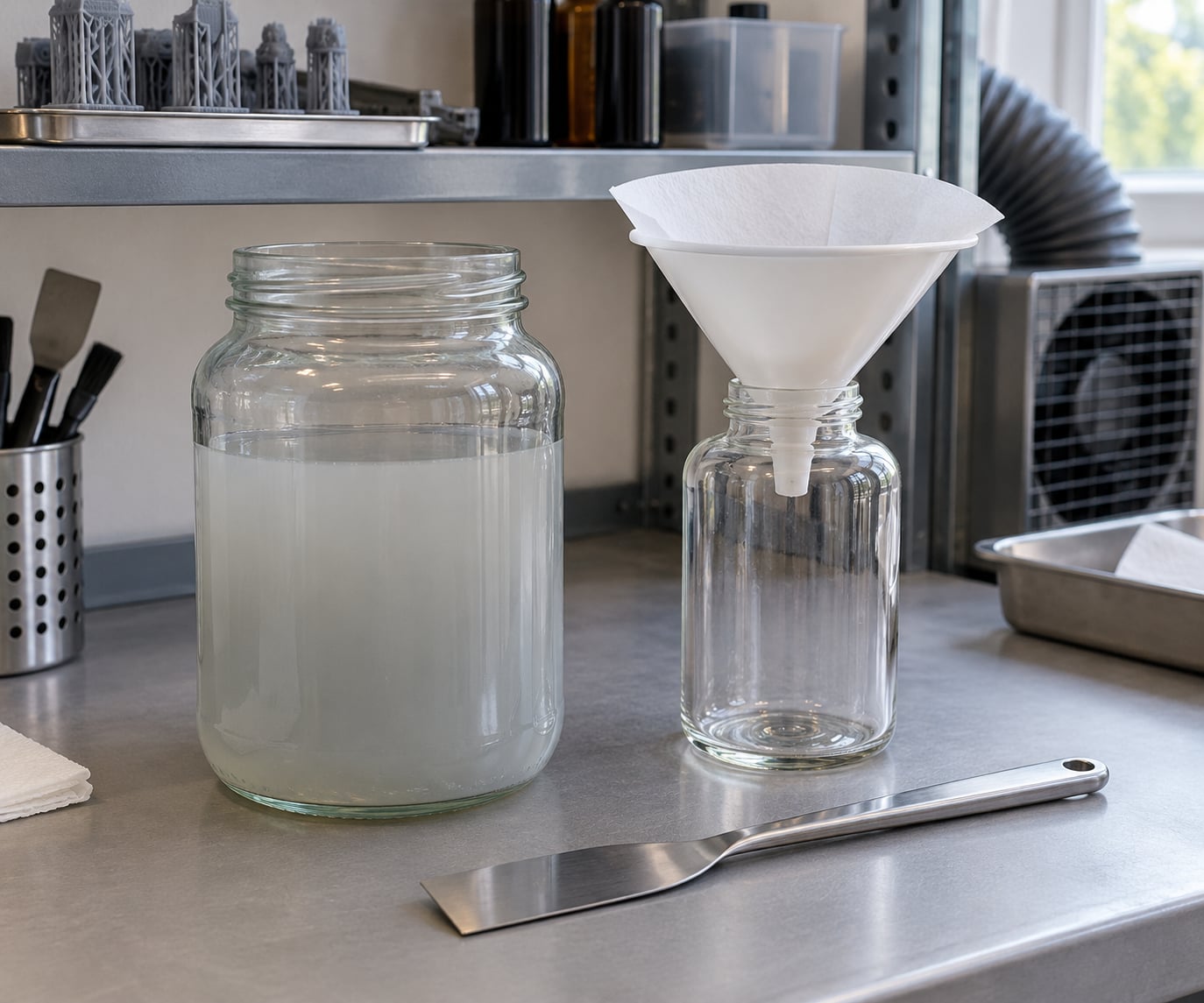
- A compatible collection container. A glass jar or a solvent-rated plastic bottle with a tight lid. Never use a container that held water-based cleaner, and skip anything that is not marked for alcohol. Keep a second container ready for the liquid you decant off.
- A funnel in glass, stainless steel or solvent-resistant plastic. Many plastics swell or turn brittle in alcohol, and a funnel that fails mid-pour is a mess you do not want on the bench.
- Filter media in a range of sizes: coarse lint-free paper towel for the first pass, a paint strainer or mesh strainer for medium solids, and a finer filter for a second pass if you need it.
- Stainless steel or compatible plastic tool for dislodging settled pigment and cured chunks from the bottom of the vessel. No metal instruments that are not rated near flammable solvent, and nothing wooden.
- Nitrile gloves and eye protection. Gloves, because uncured resin is a skin sensitiser and your hands will end up in the bath eventually.
- A label and a marker so next month’s you knows exactly what is in the jar.
- A ventilated workspace away from anything that makes a spark or a flame. Isopropyl alcohol vapour is heavier than air and ignites easily from a distance, so a garage with a hot-water heater or a pilot light is a bad spot.
Optional but useful: a squirt bottle for rinsing, a small funnel brush, a spare clean jar in case the first recovery fails, and nitrile gloves you can throw away after a spill rather than reuse.
Step-by-Step: Recover and Clean Resin-Wash IPA
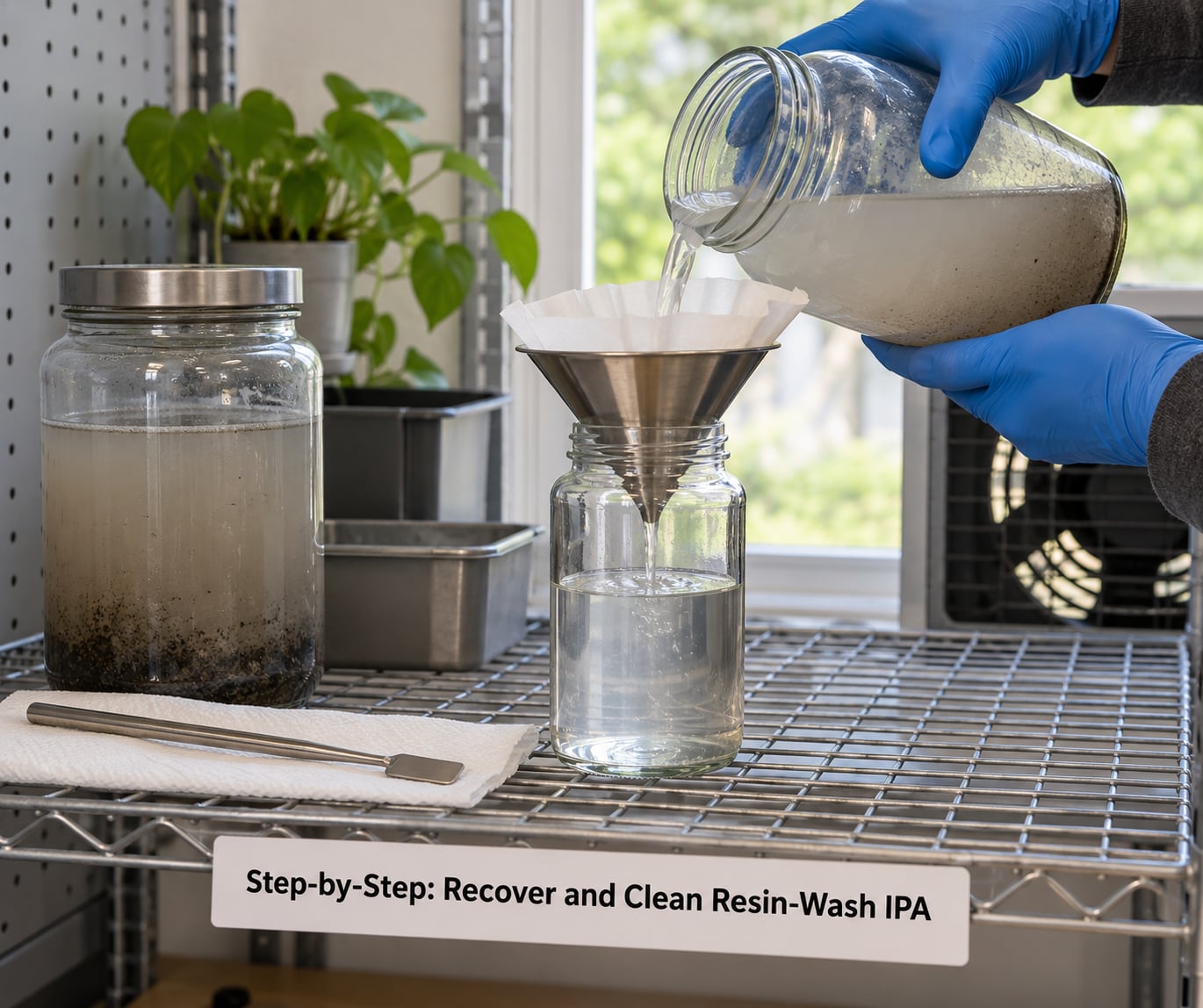
How to Clean Isopropyl Alcohol for Resin Reuse — and What Each Step Fixes
There are four different jobs hiding inside this question, and mixing them up is why people end up with a clear jar that still ruins prints.
Cleaning the container is wiping or rinsing the vessel itself. That is housekeeping and it does not touch the solvent.
Removing settled pigment and solids is decanting. Uncured resin droplets and cured fragments that are physically sitting in the bath can be poured off the top or filtered out. This is the step most people mean, and it works on the majority of a normal wash bath.
Filtering dispersed contamination catches particles that are still suspended rather than settled. Coarse media first, finer media second.
Replacing chemically degraded solvent is the one step with no DIY fix. Once the bath has absorbed enough resin to stop dissolving fresh resin, or once water or an unknown contaminant got into it, no amount of filtering or UV exposure brings the alcohol back. Settling sediment out is not the same as cleaning solvent, and the difference is what this whole method is about.
Let the Solvent Settle and Decant It Carefully
Stop agitating the bath first. Every dip of a print, every swish, every topping up adds fresh resin and keeps the particles suspended.
Then leave it alone. Community practice is one to two weeks in a cool, dark, ventilated spot, and that is a reasonable starting point rather than a rule. The actual test is visual: hold a clean glass jar up to the light and look through a few centimetres of the liquid. When the bottom third is visibly clear and the sediment has compacted into a layer rather than drifting particles, it is ready. A thin haze will never fully resolve on its own, so don’t wait forever on a bath that stays uniformly cloudy.
Pour the clearest upper layer into your clean container slowly, down the side of the receiving vessel, so the liquid runs down the glass instead of splashing. Stop before you reach the sediment and pour off what is left separately as waste. Small amounts, steady hands, and patience beat a fast pour and a mopped bench.
Whatever is left in the sink of the original container gets dealt with at the end. Never pour solvent down a household drain, even a few tablespoons; users on resin forums report gumming up their pipes, and the resin will cure inside the trap.
Filter the Decanted IPA
Filtering catches what did not settle. Work from coarse to fine so you do not clog a fine filter in the first minute and end up with a half-full jar and a ruined sheet of media.
Fold a lint-free paper towel into the funnel, wet it with a little of the clear solvent so it seats, and pour slowly. One pass handles suspended solids and a surprising amount of fine cured resin. If the towel clogs before the container is full, swap it rather than forcing solvent through, because forcing it just pushes the problem up through the sides of the funnel.
A paint strainer or mesh strainer is faster for larger volumes and catches chunks that would blind paper instantly. A second pass through a finer filter gives you a clearer result. One caution worth repeating: check that the media and the funnel are compatible with alcohol, because a plastic part that has gone cloudy or soft is contaminating what you are trying to clean.
Filtering removes suspended solids. It does not remove dissolved resin, and it does not restore the solvent’s ability to dissolve fresh resin. Keep that distinction in your head while you pour.
Clean the Original IPA Container
Once the clear liquid is gone, a layer of settled cured resin is left at the bottom. Loosen it with a stainless steel spatula or a compatible plastic tool and pour the sludge into your waste container.
For stubborn residue, add a small splash of fresh 95% or 99% IPA, swirl it around the base, and pour that off too. Use only the manufacturer’s approved cleaning method for your wash station or jar; Formlabs and other printer makers publish specific guidance for their strainers and gaskets, and those parts can be damaged by the wrong solvent.
Do not add water, dish soap, household oil, or any chemical additive you have not verified. Water does not evaporate quickly enough at room temperature and can rust metal parts of a wash station; soap leaves a film that shows up on your next print as a chalky haze. Check the safety data sheet for anything you are considering, and if it is not listed there, do not put it in your bath.
Check Clarity, Odor, and Reuse Suitability
Run three checks before the recovered solvent goes back into service.
Clarity. Pour a small amount into a clear glass jar and look through it against a light background. Fresh 95% IPA is water-clear. A faint haze is acceptable if your prints still come out clean; a distinctly milky liquid is not.
Odor. Compare it against a known-good bottle you have kept sealed. Fresh isopropyl alcohol has a sharp, clean smell. If the recovered batch smells sweet, musty, or resinous, that is dissolved organic load you cannot filter out. Replace it.
Swab test. Dip a cotton swab in the recovered liquid and rub it on a clean piece of glass. Let it dry for a minute. A greasy or tacky mark means there is still dissolved resin in solution. A print washed in that bath will come out tacky and may cure cloudy.
Appearance alone is not proof of purity, which is why the swab test exists. Do not taste the solvent, and do not try to test it with a flame. If the bath went into a spill, went near an unknown chemical, or has been sitting in a hot room, treat it as contaminated and replace it rather than hoping a filter saves it.
Label and Store the Recovered IPA
Label the container with four things: contents, the approximate recovery date, the source (which printer, which bath), and a clear note that this is recovered solvent, not fresh IPA. That last line is the one that stops someone a month from now from pouring it into a clean vat assuming it is top-grade.
Store it cool, ventilated, and away from sunlight, heat, sparks, and incompatible materials, in a container approved for flammable solvent. Keep the lid tight. Do not store it in a cabinet above a bench where the bench has a hot plate, a 3D printer heater, or a power supply that runs warm, and do not put it in a cabinet next to the epoxy or superglue you use for other jobs.
Where you can top the bath back up to volume with fresh 95% or 99% IPA afterwards, do it in small increments and retest. Adding fresh solvent to recovered solvent improves the cleaning performance but does not undo what was wrong with the recovered part.
Common Mistakes
Pouring IPA down the drain. It is the most common and the worst. Even a small amount carries cured resin that will set in your plumbing. Fix: collect every drop of spent solvent for hazardous waste disposal.
Boiling or evaporating IPA to clean it. Distillation of alcohol at home is a fire and explosion risk, and the boiling point you need is far from the one you can manage on a kitchen hob. Fix: use a commercial solvent recycler if you truly want fractionation, and let it run with proper equipment. One point in favour of distilling is that resin is not volatile, so it stays behind; one against is that doing it safely at home is not a weekend job.
Leaving the bath in direct sunlight. This is the method repeated across every resin forum, and it does work, because UV polymerises the dissolved resin so it precipitates. The problem is that an open jar of IPA sitting in sun is a jar of flammable vapour with no ignition control, and people report the method visibly failing and leaving the bath just as milky. Fix: use a controlled UV cure box in a ventilated area, or settle it in the dark instead.
Filtering with incompatible media. Some plastics and some filter papers leach into alcohol or dissolve in it. Fix: choose glass, stainless steel, or media specifically rated for solvent use.
Adding water or detergent. Water slows evaporation, encourages rust on metal wash-station parts, and can cause the print surface to go cloudy. Soap leaves a film. Fix: never add anything that is not on the manufacturer-approved list.
Assuming clear means clean. A recovered bath can look perfectly clear and still hold enough dissolved resin to leave a tacky surface. Fix: run the swab test and a cheap mini print before committing a valuable part.
Skipping ventilation. Fix: work outdoors or with a local exhaust fan, and keep bottles capped whenever you are not pouring.
Reusing solvent after a spill or an unknown event. Fix: suspect contamination is not recoverable. Dispose of it.
A few final safety habits: nitrile gloves, goggles, no flames or hot plates within reach, no cotton rags left crumpled on the bench (damp IPA-soaked cotton can hold enough heat to self-ignite), and a printed safety data sheet on the shelf so you know the flash point and first-aid guidance before you need it.
Frequently Asked Questions
Can I reuse IPA after washing resin prints?
Yes, in most cases. Resin-wash IPA carries uncured resin in solution, and if the bath has not reached saturation it can be recovered: let it settle, decant the clear layer, filter it, and swab-test it. Replace it as soon as the fluid goes milky and stops dissolving fresh resin, or once a swab leaves a tacky mark on glass. Treat recovered IPA as good enough for rinsing, not as good as a fresh jug for a final wash.
Why is my IPA milky after washing resin prints?
Milky IPA means dissolved resin has reached a high enough concentration that light is scattering through it, usually well before the bath has given up entirely. It is the visual signal to stop washing prints in that bath and start recovery. Settling and decanting removes the particles that have already precipitated, but the milkiness itself comes from resin still in solution. A swab test on glass tells you whether what is left is still dirty.
Can isopropyl alcohol be distilled at home to clean it?
Technically the chemistry works, because resin does not boil with the alcohol and stays in the pot. In practice, distilling flammable alcohol at home is a serious fire and explosion risk, and isopropyl vapour is heavier than air, so ignition sources can be triggered from below and away from the flame. If you want fractionation, buy or use a purpose-built solvent recycler. Filtering and UV curing are far safer and cheaper for a home workshop.
How often should I replace resin wash IPA?
Replace it when it stops cleaning, not on a calendar. The practical triggers are: it turns milky, a swab leaves a tacky residue on glass, prints come out with a chalky or tacky surface, or a mini test print fails to clean fully. Formlabs puts the replacement point around 10-12% dissolved resin, and its wash stations track this level. A two-stage wash, where prints go through a dirty bath then a clean one, stretches the life of both considerably.
Can I use recovered IPA for other cleaning jobs?
Yes, for solvent-compatible cleanup. Recovered IPA that passes a clarity check and a swab test is fine for wiping uncured resin off a build plate, the vat rim, mixing cups, spatulas, and your wash station exterior. Keep it away from anything that must be surgical-grade clean. If you are cleaning tools that touch a biocompatible or dental-grade print, use fresh 96%+ IPA instead and reserve the recovered solvent for hardware.
How should I store recovered solvent?
In a sealed, solvent-rated container, labelled with contents, recovery date, source, and a note that it is recovered rather than fresh IPA. Keep it in a cool, well-ventilated place away from sunlight, heat, sparks, and flammable incompatible materials. Do not store it in a cabinet above a heated bench or beside epoxy and cyanoacrylate glues. Never leave it in a decanting vessel open on the bench, because vapour accumulates faster than most people expect.
Conclusion
Start by stopping. If the bath is milky, stop washing prints in it, take the cover off the stirring, and let it settle somewhere cool and ventilated instead of topping it up again.
Then decant the clearest liquid, filter it coarse to fine, and swab-test it on glass before you commit a good print. Anything that fails the clarity check, the smell check, or the swab test goes to hazardous waste, not down the sink and not back into the vat.
None of this overrides your resin or solvent manufacturer’s instructions. Follow the safety data sheet on your IPA, follow the cleaning guidance for your wash station, and when the two disagree, follow the manufacturer.