HIPS supports for ABS printing explained: HIPS is high impact polystyrene, a rigid filament printed at the same temperatures as ABS and dissolved afterward in D-limonene, which leaves the finished ABS part untouched. You need a printer with two material channels, and you soak the cooled print in solvent for anywhere from a few hours to two or three days. It is the standard way to hold up overhangs, bridges and internal channels that FDM would otherwise destroy.
Most people find HIPS harder than it sounds, and the hard parts are not the printing. They are getting the support to bond to the ABS, keeping the nozzle clean between materials, and setting up ventilation for the bath. This guide walks through the whole process, from model preparation to the moment you pull a clean part out of the jar.
Table of Contents
- 1What Are HIPS Supports and Why Use Them for ABS?
- 2How HIPS Supports for ABS Printing Explained in Practice
- 3How to Choose the Right HIPS Filament
- 4How to Prepare the Model and Slicer Profile
- 5What Print Settings Work Best for ABS and HIPS?
- 6HIPS Supports for ABS Printing Explained Step by Step
- 7How to Dissolve HIPS Supports Safely
- 8How to Inspect and Finish the ABS Part
- 9What Problems Can Go Wrong?
- 10When Should You Use HIPS Instead of Other Supports?
- 11Frequently Asked Questions
- 12Can you use normal HIPS filament as a dissolvable support for ABS?
- 13What temperature should the HIPS support interface use when printing ABS?
- 14Does printing ABS on HIPS require an enclosed printer?
- 15What solvent dissolves HIPS supports without damaging ABS?
- 16How long does it take to dissolve HIPS supports?
- 17Can HIPS support material be reused after printing?
- 18Conclusion
What Are HIPS Supports and Why Use Them for ABS?
HIPS is polystyrene with rubber grafted into it, which makes it tougher than standard polystyrene while keeping a similar chemical family. That family matters because D-limonene dissolves it completely, and ABS sits in a different chemical family that limonene leaves alone. Acetone, by contrast, attacks ABS and does nothing useful to HIPS. Swap the solvent and the whole idea collapses.
Because HIPS melts within a few degrees of ABS, both plastics fuse to each other cleanly at a shared nozzle temperature. The support holds the ABS during the print, then disappears in the bath and takes its interface marks with it. That last part is the reason to bother. Manual ABS supports leave witness lines you sand, and deeper ones you chase with a tool, which on a thin wall means you cut through the surface.
| Support type | Removal method | Surface left behind | Works with ABS | Ease of use |
|---|---|---|---|---|
| HIPS soluble support | Dissolves in limonene | Clean, no tool access needed | Yes, designed for it | Hardest upfront setup, easiest cleanup |
| PVA soluble support | Dissolves in water | Clean | Not recommended, needs very high melt temps | Hard on most filaments and hardware |
| Standard PLA support | Plucked or peeled by hand | Scarring, nub left to sand | Poor, PLA cannot fuse reliably to ABS | Easy to print, risky result |
| Same-material ABS support | Manual removal with tools | Witness marks and scars | Yes | Easiest print, worst finish |
| Break-away support | Snapped off along a thin layer | Good if engineered, poor if not | Yes | Easy if the geometry cooperates |
One thing the community points out repeatedly, and most short guides miss: HIPS is not only a soluble support. On a well-tuned interface it peels straight off by hand. Users on the 3D Printers Forum UK report that HIPS sticks well enough to ABS and ASA during the print, then releases cleanly without any solvent at all. Treat the bath as your fallback rather than a mandatory step.
How HIPS Supports for ABS Printing Explained in Practice
The full workflow runs in a fixed order, and every stage has a moment where it can quietly go wrong. Knowing which stage failed saves hours of reprints.
- Dry both spools before anything else. ABS and HIPS are hygroscopic enough that wet filament gives you bubbles, popping and poor layer adhesion.
- Assign the materials correctly in the slicer. ABS is the model, HIPS is the support, and the extruder mapping must match your physical nozzles.
- Print the support interface first and watch the first few layers for bonding, then continue the full print.
- Let the assembly cool completely on the bed before you touch it. Warm ABS deforms when you remove it.
- Submerge the cooled print in limonene, agitate gently, and give it time.
- Rinse, air-dry, and inspect every interface the support touched.
Most failures cluster at two points. The first is the transition layer where the extruder switches materials mid-print, which is where stringing, blobs and poor bonding show up. The second is removal, when the solvent either has not had long enough or the ABS flexes in the bath. Diagnose before you reprint.
How to Choose the Right HIPS Filament
Natural, unmodified HIPS is the safest default because dyes and additives can change how cleanly it dissolves. Pigmented HIPS often leaves a coloured tint in the bath and can dissolve more slowly, though many printers keep their coloured spools on a shelf for years without trouble.
Modified HIPS blends are formulated to break down faster or to release more easily from the interface. They are worth trying if your first natural spool was slow to dissolve, or if you mostly want peel-off behaviour. Check the diameter matches your printer, 1.75 mm or 2.85 mm, since a mismatch will not feed consistently through either channel.
Storage matters as much as the brand. HIPS is non-hygroscopic compared with nylon but it still absorbs moisture over time, and support structures fail from stringing and layer separation long before the ABS does. Keep it sealed with desiccant, and run a dry cycle if you have the equipment.
Recycled content is the one to be cautious about. Regrind in a support structure usually shows up as inconsistent flow and weak layer adhesion, which matters here because the support has to hold real weight during the print.
How to Prepare the Model and Slicer Profile
Getting the slicer to keep HIPS away from finished faces comes down to three settings. Enable support material assignment so the second channel prints only where support exists. Set a support interface with its own lower Z-gap, typically around 0.2 mm, which is what makes the interface either peel away cleanly or dissolve away completely. And set the support XY distance to roughly twice the layer height, a number users repeatedly recommend because it opens a channel for solvent and for pliers.
Then confirm the extruder mapping before you slice. A mismatch sends HIPS to the nozzle carrying ABS and you will get a failed filament swap halfway through the first support layer. Print a small two-material tower and watch the purge behaviour before committing to a full part.
| Hardware | Channel type | Temperature ceiling | Purge handling |
|---|---|---|---|
| AMS style multi-material unit | Enclosed drying, standard melt zone | Usual ABS range, check your unit | Automatic purge, expect stringing at swaps |
| High-temperature AMS variant | Enclosed drying, heated melt zone | Raised ceiling, also handles PA and PC | Automatic purge, more stable on sticky materials |
| Tool changer systems | Parked hot toolheads | Per-tool, each keeps its own nozzle | Dock and purge between tools |
| IDEX dual extruder | Two live nozzles | Standard, both channels hot | No parking, requires wipe or retraction tuning |
| Single extruder | Manual swap only | Standard | You change filament by hand and control the interface yourself |
On a single-extruder machine you can still do this, but you are swapping filament mid-print by hand, which means the interface has to be printed separately as its own operation. It works for a simple part and it is miserable for anything complex.
What Print Settings Work Best for ABS and HIPS?
There is no single universal profile, and anyone who gives you one is selling something. What you can do is start in a known range and adjust from there. The table separates starting points from the variables your machine decides for you.
| Setting | HIPS support starting point | ABS model starting point | Notes |
|---|---|---|---|
| Nozzle temperature | 230 to 240 C | 245 to 260 C | Keep them close enough to fuse at the interface |
| Bed temperature | 90 to 100 C | 100 to 115 C | Follow the ABS filament’s own guidance |
| Layer height | 0.15 to 0.2 mm | 0.2 to 0.28 mm | Thinner support layers dissolve faster |
| Support density | 15 to 25 percent | n/a | Lower density dissolves faster and drains better |
| Print speed | 25 to 40 mm/s | 40 to 60 mm/s | Slower on the support interface improves bonding |
| Part cooling | Low to off | Off inside an enclosure | Cooling warps ABS and hurts the interface |
| Retraction and wipe | Tuned per hardware | Tuned per hardware | Set the wipe tower or combing for the swap |
| Chamber control | Machine dependent | Enclosure plus heated chamber if available | ABS warping is the main cause of ripped supports |
HIPS Supports for ABS Printing Explained Step by Step
Dry both spools at the recommended temperature for four hours or overnight. Print the support interface and watch how the HIPS meets the ABS: a slightly compressed, continuous seam means good bonding, and separate, gappy lines mean you need more heat or slower speed at the interface.
Complete the print, then leave the part on the bed until the bed and the part are at room temperature. Removing warm ABS from the plate bends it, and a bent part will never recover.
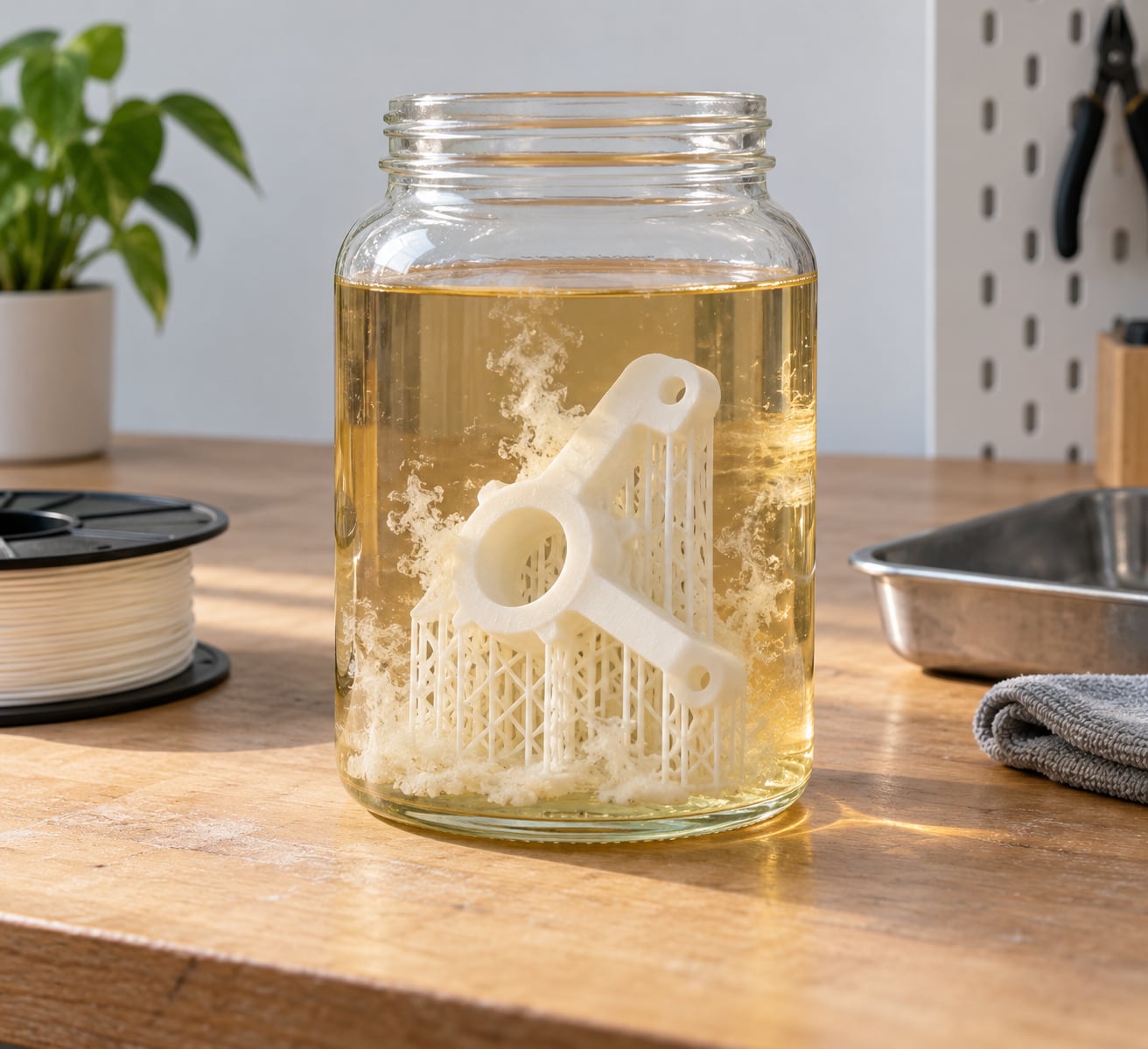
Flex the plate away from the part if you can, or use a spatula under the edge of the build plate at a shallow angle. Pop the print off, then submerge it fully in removal solution. Agitate the container every few hours so fresh solvent reaches trapped pockets.
When the support is gone, rinse the part in clean solvent or warm soapy water, let it air-dry fully, and inspect every surface the support touched.
How to Dissolve HIPS Supports Safely
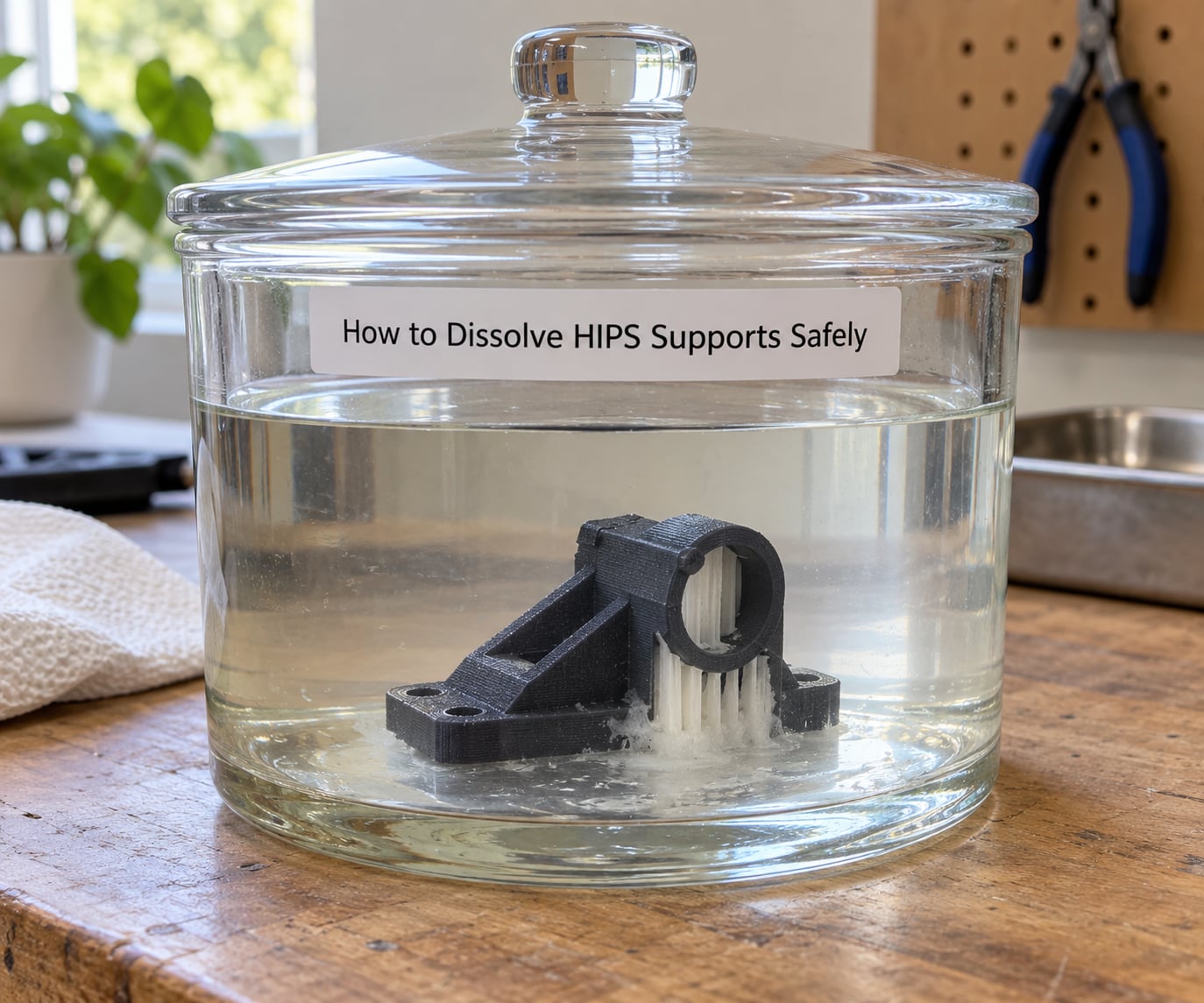
D-limonene dissolves HIPS and leaves ABS alone. Isopropyl alcohol does not dissolve HIPS, acetone does not dissolve HIPS, and general-purpose cleaners do nothing at all. Acetone is the reverse case: it dissolves ABS and will haze and craze your part, so keep it away from the bath entirely.
Work in a ventilated space with a lid on the container. Limonene has a strong citrus smell that gives away exactly what you are doing, and the fumes deserve respect. Nitrile gloves and eye protection are cheap and worth it. Keep the container covered when it is not in use, and keep it away from food preparation areas.
Stay near room temperature. Warming the bath speeds dissolution, but pushing it much past 40 C can soften the ABS surface and leave a slightly wavy finish, and it drives more solvent vapour into the room. Leave it at ambient and use time instead of heat.
Plan on hours, not minutes. Users report everything from a few hours for thin, open supports to two or three days for dense blocks buried inside an assembly. Shaking the container periodically makes a real difference on anything with internal channels.
For disposal, let solids settle, pour the used solvent into a sealed container for hazardous solvent waste, and never down a drain. One more caution that catches people: limonene damages many other filaments, including PLA and PETG, so keep printed spares away from the work surface while a bath is open.
How to Inspect and Finish the ABS Part
Run a fingertip over every surface the support touched. A faint witness line that your nail does not catch is a normal support mark and most people never notice it. A groove you can feel with a fingernail means residue is still there, which means another few hours in the bath.
Rough spots that will not dissolve are usually a support interface printed too hot, where HIPS smeared onto the ABS face. A light pass with fine sandpaper over a radius or a fillet fixes them. On flat panels, a heat gun at low airflow and a little patience can reflow the surface, though go easy, ABS goes glossy and shiny fast and then warps.
What is not normal: cracks running along a layer line, corners that lifted away from the plate, or a surface that feels dull and slightly tacky after drying. Those mean the part warped during the print or the bath was too warm. Neither comes off with sanding.
What Problems Can Go Wrong?
HIPS will not dissolve at all. Wrong solvent, or the bath never got warm enough and stayed still for too long. Confirm you used limonene, agitate the container, and give dense regions more time.
Support drops away before the part is finished. The interface did not bond. Slow the interface layers, raise nozzle temperature slightly, or thin the interface so it cannot peel under load. One user on a Bambu system ran ABS at 230 C with a bed at 110 C and HIPS at 240 C and still had the support release early, which is usually a purge or contamination problem rather than a temperature problem.
HIPS strings badly between materials. This is the most common complaint and it shows up as blobs on finished faces. Shorten travel distance, raise retraction, enable combing, and make sure the wipe tower or nozzle wipe is running. On the Ultimaker Community, printers printing HIPS on top of ABS reported it only working when the support was connected down to the bed, not floating over the model.
ABS warps and tears the supports off. Enclose the printer, drop the fan to off, raise the bed temperature, add a brim, and recalibrate flow so the first layers are not starved. A large part that shifts mid-print takes its supports with it.
Layer separation in the support itself. Support density and layer height too high, or the filament is damp. Drop density to 20 percent, thin the layers, and dry the spool.
Blocked or contaminated nozzles. Run a purge and a cold pull between materials, and always park and wipe before idle. HIPS residue left on a nozzle can cause poor retraction later.
Trapped cavities never clear. Solvent cannot reach them. That is what the XY distance setting is for. Double the layer height value and re-slice.
Poor bed adhesion with HIPS loading. Clean the plate, keep the chamber above 40 C, and consider a light adhesive or a PEI sheet. HIPS itself is not the problem here; the chamber temperature is.
When Should You Use HIPS Instead of Other Supports?
Use HIPS when the part has overhangs beyond roughly 50 degrees, bridges, or internal channels you cannot reach with tools, and when the surface quality matters enough that you do not want witness marks. It also makes sense for cosplay helmets, ducting and enclosures where a scarred finish shows.
Skip it for simple parts with gentle angles. Plain same-material supports that break away cleanly will be faster and cost less effort. If your geometry allows a designed break-away interface, tune that instead of buying a solvent.
If you cannot handle solvents safely or have no ventilation, HIPS is still usable as a peel-off support, and many users never dissolve it at all. Consider that route before ruling the material out.
Two alternatives worth knowing. PVA dissolves in plain water and needs no ventilation, but it demands very high melt temperatures, wicks moisture aggressively and clogs most hardware; it is a poor match for ABS. PLA on ABS is a common shortcut that sometimes works and sometimes fails, because the two plastics do not fuse reliably and the interface can delaminate under load. Neither trades evenly with HIPS.
Frequently Asked Questions
Can you use normal HIPS filament as a dissolvable support for ABS?
Yes. Standard natural HIPS is the material most people buy for this, because it dissolves in D-limonene and prints within a few degrees of ABS. Pigmented and modified versions also work, but natural tends to dissolve faster and leaves less colour in the bath. Match the filament diameter to your printer and dry it before use.
What temperature should the HIPS support interface use when printing ABS?
Start around 230 to 240 C for the HIPS channel, with the ABS side a little higher. What matters most is that the two temperatures are close enough for the plastics to fuse where they meet. Print the interface slowly, around 25 mm/s, and check the seam early in the print to confirm it bonded.
Does printing ABS on HIPS require an enclosed printer?
An enclosure helps a great deal but is not strictly required for the support itself. What an enclosure really protects is the ABS, which warps badly from cooling drafts and layer separation. If your printer is open frame, expect to fight warping more, and consider whether you can use ASA, which tolerates open printing much better.
What solvent dissolves HIPS supports without damaging ABS?
D-limonene is the answer. It dissolves HIPS completely and leaves ABS chemically untouched. Isopropyl alcohol and general-purpose cleaners do nothing to HIPS. Acetone dissolves the ABS instead, hazing and potentially damaging the finish, so it belongs on the finished surface, never in the bath.
How long does it take to dissolve HIPS supports?
Thin, open support can go in a few hours. Dense blocks and internal channels inside an assembly routinely take two or three days, and users report a full range in between. Keeping the container covered, agitating it every few hours, and staying at room temperature all speed things up without softening the ABS.
Can HIPS support material be reused after printing?
No. Once dissolved in limonene it becomes part of the waste stream and cannot be extruded again. The ABS part itself can of course be reprinted or reused, and any HIPS that peeled off mechanically rather than dissolving can be kept, though it is rarely worth the effort.
Conclusion
HIPS is the right support material for ABS and ASA because the two print at nearly the same temperature and a different solvent separates them afterwards. Start by choosing verified soluble HIPS in your printer’s diameter, confirm the ABS and HIPS assignment in your slicer before you slice anything real, and print a small test interface to check bonding and purge behaviour.
Tune the removal step before you commit to a complex part. Once a small part dissolves cleanly, you can print with confidence in 2026.