Here is what to ask a 3D printing vendor before ordering, in the order that saves you the most money: whether they manufacture the part in-house, which process and material actually fit your geometry, what tolerance they can hold as-printed, and who absorbs the cost when a part fails. Get answers to those four and the rest of the order is bookkeeping.
A 3D printed part is cheap to quote and expensive to undo. Until your model is sliced, nobody knows how long it takes to print, how many supports it needs, or which way it should sit on the plate. That single fact explains why two well-run shops can quote the same file at wildly different numbers, and why a tolerance that looks reasonable on a drawing may be unreachable in the process you picked.
Ask ten vendors for a 3D printing price and you will get ten “about this much” answers, for the same reason. The useful conversation happens before the quote, not after it.
Table of Contents
- 1What You Need
- 2Step-by-Step: What to Ask a 3D Printing Vendor Before Ordering
- 31. Can You Produce My Part in the Recommended Material and Process?
- 42. What Tolerances and Layer Heights Can You Reliably Meet?
- 53. Can You Provide Samples, Proofs, or a First Article?
- 64. How Will You Inspect and Document the Parts?
- 75. What Is the Complete Price, and What Is Not Included in a Quote?
- 86. What Are Your Lead Times and Production Update Options?
- 97. What Happens If the Part Fails or Misses Specification?
- 108. How Do You Handle Design Feedback and File Changes?
- 119. Can You Keep My Design and Project Information Confidential?
- 1210. What Packaging and Shipping Options Do You Offer?
- 1311. Will You Notify Me About Material, Machine, or Process Changes?
- 1412. Can You Put the Order Terms in Writing?
- 15Good Answers and Red Flags
- 16Common Mistakes
- 17Frequently Asked Questions
- 18Do I need to send the 3D model to every 3D printing vendor?
- 19How many prototypes should I order before a production run?
- 20Can a 3D printing vendor guarantee exact tolerances?
- 21Should I ask for a material sample before ordering?
- 22How do I compare quotes from different 3D printing vendors?
- 23Can a vendor use my 3D model for prototypes or training?
What You Need
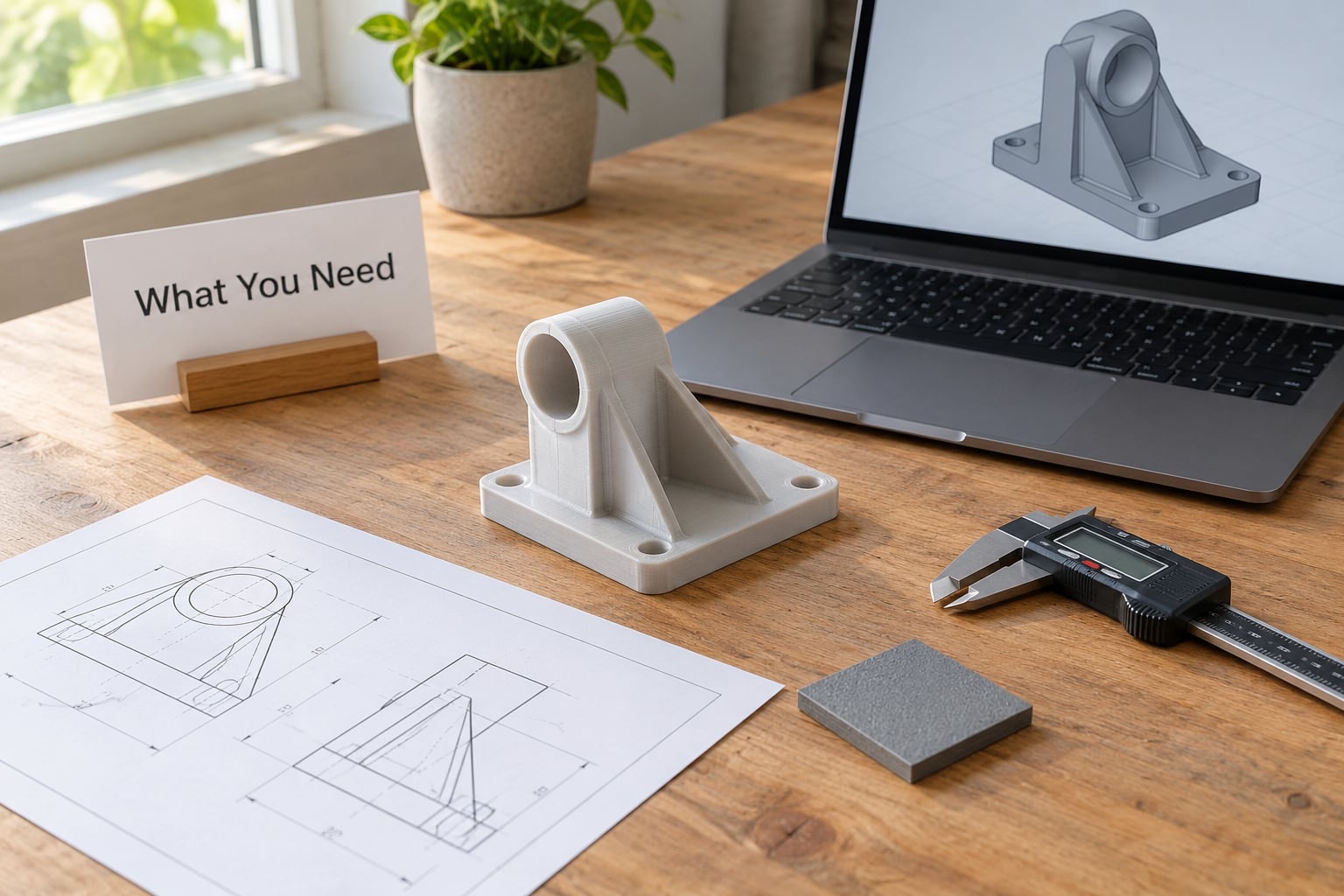
Assemble this before you send the first email. A vendor who answers a vague question gives a vague answer, and you end up comparing four different scopes instead of one part.
- The model file. STEP or STP for anything that must hold a fit, STL for visual work. Send STEP if you have it, and say which version is authoritative.
- Dimensions that matter. List the three to five features that actually affect assembly, with the tolerance you need on each. Mark them on a drawing, not in an email paragraph.
- Quantity. One piece, a pilot run of 20, a production run of 500. Quantity breaks change which process makes sense and which minimum order quantity the shop has.
- The application. “Concept model for a trade show” and “bracket that holds a load in a 60 degree enclosure” are different orders. Environment, temperature, load, and contact with skin or food all change the material conversation.
- Finish requirements. As-printed, tumbled, sanded, vapor smoothed, powder coated, painted, or machined. Post-processing is often a bigger line item than the print.
- Your deadline and what it costs you. A missed demo date and a missed internal test date are not the same conversation.
Step-by-Step: What to Ask a 3D Printing Vendor Before Ordering
Send these twelve questions to at least three vendors, in the same order, in the same wording. Identical questions make answers comparable, which is the whole point of this list. Twelve questions on a 20-part order takes under an hour and routinely saves a reprint.
1. Can You Produce My Part in the Recommended Material and Process?
Start with the machines and the material grades they run in-house, then ask whether they will tell you if additive is the wrong process for your part. Good vendors answer with a recommendation and a reason, not a catalogue.
You usually end up preferring the shop that says “for this geometry and load, use nylon PA12 in SLS rather than resin SLA, because your walls are thinner than our minimum” over the one listing everything they own. A vendor who never argues with you is not thinking about your part.
2. What Tolerances and Layer Heights Can You Reliably Meet?
Ask for their normal achievable tolerance, then ask which features on your drawing are actually achievable as-printed versus which need machining. Typical as-printed expectations: SLA resin around ±0.1 mm, MJF around ±0.2 mm, SLS around ±0.3 mm, and engineering-grade FDM in the ±0.2 to ±0.5 mm range depending on geometry and print orientation.
Also ask how they will report results, whether the quote refers to nominal dimensions or measured parts, and what happens to tolerance when the part is large. Big flat panels warp; that is physics, not careless work.
3. Can You Provide Samples, Proofs, or a First Article?
Ask whether they will print one piece, or a first article, before the full run, and how approval gets documented. On a production order, first article inspection is the checkpoint where you approve a measured sample before the rest of the batch runs.
This is the cheapest question on the list. One sample plus a few hours of your time is far less than discovering the part does not fit after 200 pieces arrive.
4. How Will You Inspect and Document the Parts?
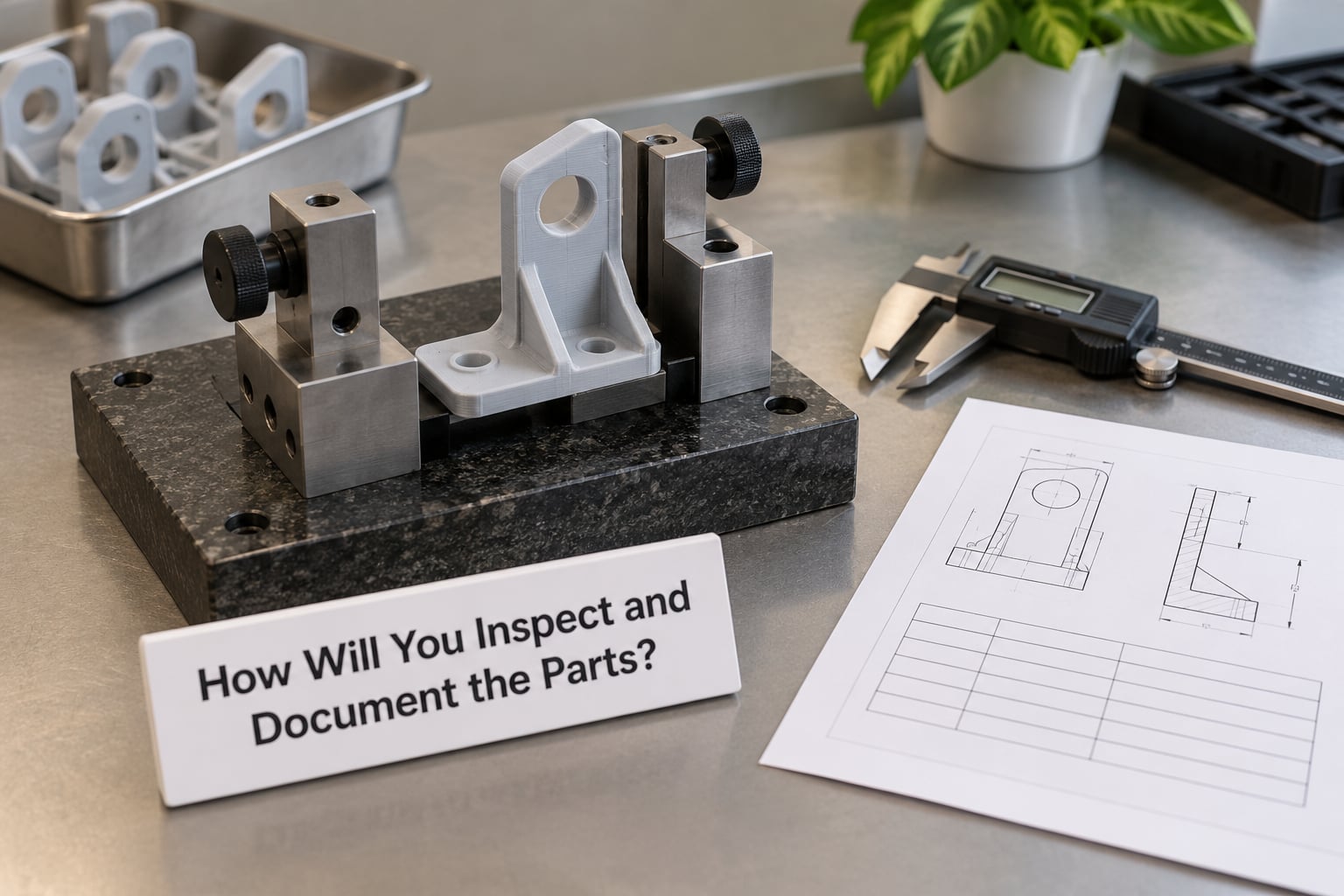
Ask which dimensions they check, with what equipment, and whether you receive a report, a certificate of conformance, or nothing at all. Calipers catch gross errors; a coordinate measuring machine catches real ones. Ask what their acceptance criteria are for scrap.
If the answer is “we eyeball them and they look fine,” you now know how much inspection you are getting for the money in the quote.
5. What Is the Complete Price, and What Is Not Included in a Quote?
Ask for an itemized quote: machine time, material, supports, support removal, post-processing, inspection, packaging, tooling or setup, and delivery. Also ask who repairs your mesh if it is not watertight, and whether that repair is billed to you. Several shops treat file repair as a free courtesy; others charge an engineering hour.
A quote with one total and no breakdown is not comparable to a quote with nine lines. Ask for the binding quote in writing, with a validity period, so the number does not move after you approve it.
6. What Are Your Lead Times and Production Update Options?
Ask whether the quoted date is a committed lead time tied to your order or a typical queue estimate. Then ask who updates you during production and how often. A good answer names a person or a status page and tells you what happens if the date slips.
Include the print time for your part separately if you know it. A queue estimate is a guess; build time is a fact, and mixing the two is how dates get missed.
7. What Happens If the Part Fails or Misses Specification?
Ask who pays for a reprint when a print fails mid-run, how quickly they replace it, and what evidence you need to file a nonconformance claim. Get the policy in writing before you order, not after a rejected batch lands on your dock.
Vendors rarely cover this clearly in their marketing, which is exactly why you should ask. A shop with no reprint policy is telling you the cost lands somewhere, and it is rarely with them.
8. How Do You Handle Design Feedback and File Changes?
Ask whether an engineer reviews your model before printing, whether they will flag thin walls, overhangs, poor orientation, or features that will trap powder, and whether that review is free. Design for additive manufacturing advice is often the most valuable thing a good shop gives you.
Then ask how a revision works. You want a revision number on every file, a locked baseline once you approve it, and a written process for what happens if you change a dimension after production starts.
9. Can You Keep My Design and Project Information Confidential?
Ask whether they will sign an NDA, who inside the company can open your files, how long files are retained, and whether your geometry is ever used as marketing material or added to a training dataset. Ask whether the same answer holds when production is brokered to a third-party shop.
If your part is a patent-pending enclosure or an unreleased consumer product, this is the question to ask first. Ask for the answer in writing from a named contact, not a form.
10. What Packaging and Shipping Options Do You Offer?
Ask how the part is packed for its material and geometry: resin parts need support protection and careful curing, powder-bed parts need support removal and cleaning before they are handled, thin walls need rigid boxing. Ask about carriers, tracking, insurance, and who pays when a package arrives damaged.
Small buyers also ask whether local pickup is an option. Shops that ignore this question often add delivery and packing as a large share of the order, which matters when you are ordering two parts.
11. Will You Notify Me About Material, Machine, or Process Changes?
Ask what happens if a machine goes down for maintenance, a material lot changes, or they upgrade a process mid-order. You want to be told before your batch is affected, and you want the right to reject a substitution or require re-quoting.
Without change control, a reorder six months later may arrive in a different material with the same part number stamped on it. Your test results then describe a part you no longer have.
12. Can You Put the Order Terms in Writing?
Finish by asking for the specifications, revisions, quantity, price, payment terms, delivery date, acceptance criteria, and named contacts captured in a purchase order or vendor quotation, and ask which document wins if they disagree. Most buyers skip this step and rely on an email thread that half the shop has never read.
It takes one message to send and it removes the most common source of argument: two people in the same company who assumed different things.
Good Answers and Red Flags
The wording of an answer tells you as much as the answer itself. These are the phrases to listen for.
- Material and process. A good answer sounds like “Use PA12, not resin, because your walls are 1.2 mm,” with a reason attached. A red flag sounds like “We can do any material you want.”
- Tolerance. Good: “±0.2 mm as-printed on these features; machine them if you need ±0.05 mm.” Red flag: “We can hit any tolerance for the right fee,” with no method named.
- First article. Good: “We will send one measured sample and hold the batch until you approve.” Red flag: “We always get it right the first time.”
- Inspection. Good: “We check these four features on a CMM and send the report.” Red flag: “Our parts are always within spec.”
- Price. Good: itemized lines plus a validity period. Red flag: one total, no breakdown, quote valid for hours.
- Lead time. Good: a committed date tied to your order, with a named contact. Red flag: “Usually two weeks” with no owner.
- Reprint policy. Good: free replacement, defined timeline, in writing. Red flag: “That rarely happens,” or silence.
- File repair. Good: “We run a mesh check and tell you before we charge anything.” Red flag: “Just send it and we will see.”
Common Mistakes
Mistake one: accepting a generic tolerance. “Standard tolerance” means nothing until a vendor tells you which features it applies to and how they are measured. Fix: list the three to five dimensions that matter, with a number on each, and ask which of them are achievable as-printed in the process they proposed.
Mistake two: comparing quotes that are not the same scope. One quote includes post-machining and inspection; the other is as-printed in a box. Fix: send an identical request to every vendor, including finish, tolerance, quantity, and packaging, and ask for line items.
Mistake three: skipping the sample. A first article costs a fraction of a batch and answers fit, finish, and function questions that a rendering cannot. Fix: order one piece first, and make approval of it a written gate before the rest runs.
Mistake four: leaving inspection undefined. Without agreed critical dimensions and acceptance criteria, “the part was out of tolerance” becomes an argument. Fix: name the measurements, the equipment, the report format, and who resolves a disagreement.
Mistake five: assuming file repair is free, or that the vendor’s engineer will quietly fix your design. It may be free, and it may be billed, and it may change what you receive. Fix: ask who checks the mesh, what they look for, and what the repair costs before you approve.
Mistake six: leaving IP and revisions informal. Email is not a confidentiality agreement, and a file without a revision number is a file that can be quietly updated. Fix: get the NDA, the file retention answer, and a locked revision in writing before uploading anything sensitive.
One more habit that pays off: score your vendors instead of vibing. Weight quality and lead time where they matter for your order, score each answer one to five, and keep the sheet. Weights shift by project, but the discipline does not.
If you are ordering a single part as a maker rather than qualifying a production supplier, use the same list but trim it to questions 1, 2, 5, 8 and 10, and skip the certificate and nonconformance language. Add one more: ask for photos of comparable work in your material, which is often more informative than a capability brochure.
Frequently Asked Questions
Do I need to send the 3D model to every 3D printing vendor?
Send at least two, ideally three, and send the identical file each time. Different shops slice, orient and support the same model differently, which is part of why quotes and lead times differ so much. Send STEP rather than STL if you have it, state which version is final, and keep your own copy of the file with a revision number. Vendors you have not chosen yet should receive it under an NDA if the design is sensitive.
How many prototypes should I order before a production run?
One to three. A single sample confirms fit, finish and function for most parts. For anything that must hold a load, survive temperature cycling, or survive a customer demo, order a small batch of three or more so you can compare parts to each other, not just to your CAD. Then treat one of them as the first article, measure it, and approve it in writing before the production run is released.
Can a 3D printing vendor guarantee exact tolerances?
Not in the sense of every dimension on every part. Vendors guarantee ranges: as-printed expectations are typically around ±0.1 mm for SLA resin, ±0.2 mm for MJF, ±0.3 mm for SLS, and ±0.2 to ±0.5 mm for engineering-grade FDM. If a feature needs tighter control, ask for machined surfaces on those features only. Ask which measurements they verify and what report you receive.
Should I ask for a material sample before ordering?
Yes when the material choice is doing real work: a hot enclosure, a load, a chemical exposure, or a part that will be handled often. A small swatch or coupon confirms colour, stiffness and finish faster than any datasheet, and it lets you test fit before committing to a run. On visual pieces, skip it. Also ask whether the material is a branded grade with a datasheet, or a generic equivalent.
How do I compare quotes from different 3D printing vendors?
Normalise the scope first. Make sure every quote covers the same process, material, finish, tolerance targets, quantity, inspection, packaging and delivery, then compare line items rather than totals. Ask each vendor for a binding quote with a validity period. Finally, score the answers on a weighted sheet covering quality, communication, lead time and transparency, so the cheapest bid does not win by default.
Can a vendor use my 3D model for prototypes or training?
They should not, and you should ask in writing before you upload anything. Request an NDA, ask who inside the company can access the file, how long it is retained, and whether your geometry appears in case studies, marketing, or any model or training dataset. Ask the same question about third-party shops when a vendor brokers production, since your file may reach a facility you have never audited.
Start with question one and question seven. Whether they print in-house tells you who actually controls your part, and what happens on a failed print tells you who carries the risk. Put the rest in writing, in a purchase order, and send the same twelve questions to every vendor on your shortlist. Nothing on this list surprises a good supplier, which is another way of reading it: if an answer makes them hesitate, you want to know why before you pay.