If you’re wondering whether 3D printing is bad for the environment, the honest answer is: it depends, and usually it’s not the printer but the part. Additive manufacturing uses far less raw material than milling or molding, but it runs on electricity, discards supports and failed prints, and ships you plastic that is hard to recycle. Print one replacement bracket instead of ordering a new appliance, and you probably came out ahead. Print forty decorative prototypes in virgin PLA and throw them away, and you probably didn’t.
The key is to compare the full life cycle of a specific part against the alternative it replaces. That’s a different question from asking whether 3D printing is “green” in general, and it’s the one that actually tells you something.
Table of Contents
- 1Is 3D Printing Bad for the Environment?
- 2How Does 3D Printing Affect Energy Use?
- 3Is 3D Printing Bad for the Environment Compared With Injection Molding?
- 4What 3D Printing Materials Have the Biggest Environmental Impact?
- 5How Much Waste Does 3D Printing Create?
- 6When Can 3D Printing Be Better for the Environment?
- 7What Are the Health and Chemical Concerns?
- 8How Can You Reduce the Environmental Impact of 3D Printing?
- 9Frequently Asked Questions
- 10Is PLA actually biodegradable if I put a 3D-printed part in a home compost?
- 11Is resin 3D printing more harmful to the environment than FDM printing?
- 12Do home 3D printers use a lot of electricity?
- 13Can I recycle failed 3D prints and support material?
- 14Is 3D printing greener than injection molding?
- 15What is the most sustainable material for 3D printing?
- 16Conclusion
Is 3D Printing Bad for the Environment?
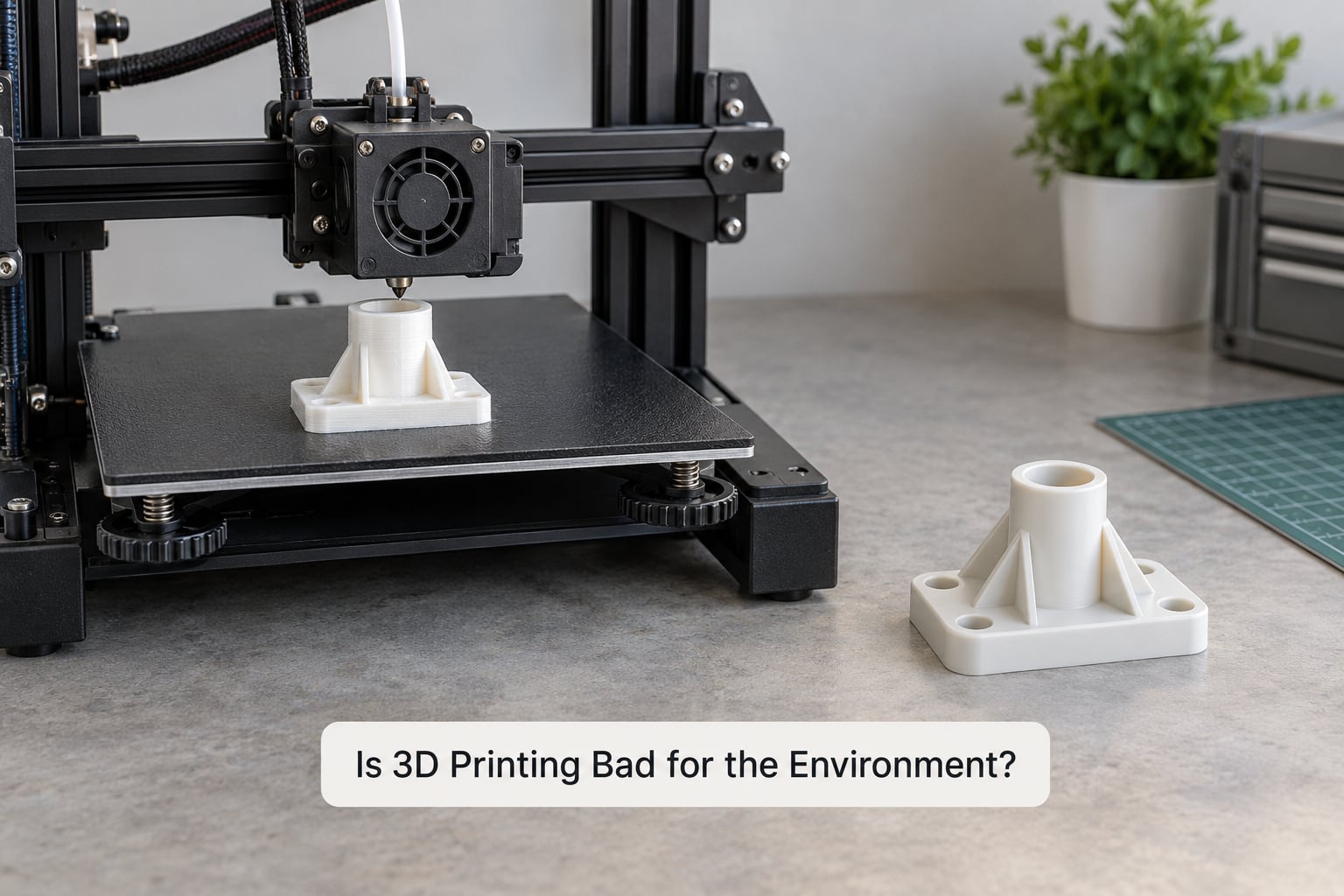
Not by itself. The environmental impact of 3D printing comes from four places: the electricity the machine draws, the plastic or metal it consumes, the material lost to supports and failed builds, and what happens to the finished part years later. Compare those against the process the part would otherwise have used, and the answer changes case by case.
Three things make the honest version of this conversation more nuanced than the marketing on either side suggests.
- Less material waste is real. A printed part uses close to the material that ends up inside it, where CNC machining often sends 60 to 80 percent of a solid block out as chips.
- The energy is not nothing. A home printer pulls roughly the same electricity as a kettle while it works, and industrial powder-bed or metal systems run far hotter.
- “Biodegradable” mostly isn’t. PLA is bio-based, not home-compostable. Most printed parts will sit in a landfill for centuries regardless of the label on the spool.
Here is how the main printing processes compare, process by process.
| Process | Energy per part | Material waste | Air emissions | Typical end of life |
|---|---|---|---|---|
| FDM /FFF (filament) | Low, tens to low hundreds of watts | Supports, purge, failed builds | VOCs and ultrafine particles at high temps | Landfill, hard to recycle |
| SLA / DLP (resin) | Low to moderate, plus post-curing | Failed resin, supports, wash waste | Uncured resin, acrylates, fumes | Landfill, hazardous waste streams |
| SLS (powder) | Moderate, powder handling and sieving | Unsintered powder refresh, some loss | Fine powder, low volatility | Reusable powder, part is recyclable |
| Metal AM (LPBF, DMLS) | High, lasers, vacuum pumps, chillers | Unsupported powder, support structures | Metal powder, argon waste | Recyclable if powder is segregated |
How Does 3D Printing Affect Energy Use?
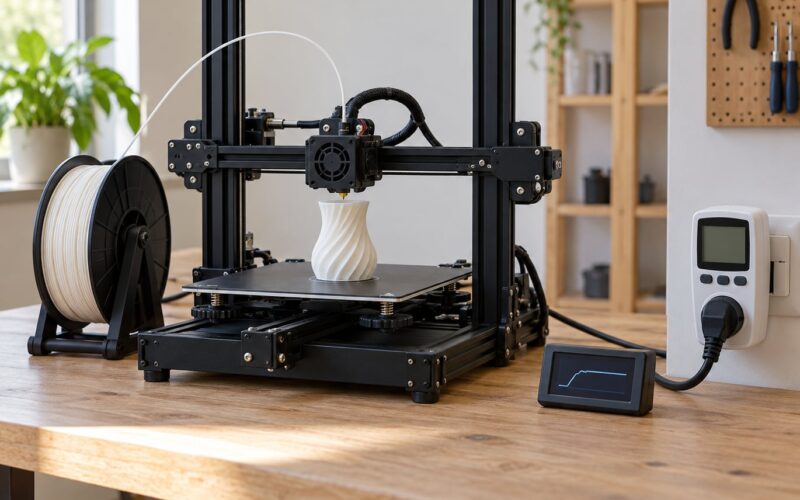
Energy is the part of the footprint people underestimate, because it looks small next to manufacturing. A typical desktop FDM machine averages somewhere around 80 to 150 watts while printing and more during heating, which works out to a few kilowatt-hours for a modest print. That’s less than a clothes dryer cycle. Run that machine for a few hundred prints a year and it adds up, but it rarely dominates.
Industrial additive manufacturing is a different story. Powder bed fusion systems run lasers or electron beams, hold an inert atmosphere, and run chillers and vacuum pumps at the same time. Metal powder has to be dried and sieved between builds. Labs have put the energy for some titanium aerospace parts an order of magnitude above cast and machined equivalents for that reason, though those studies usually compare small-batch production against mature volume processes.
Several line items hide in the machine’s power draw:
- Heating. Melting thermoplastic filament takes far less energy than keeping a chamber hot for resin or powder.
- Idle time. A printer left on at 200 degrees overnight burns through idle hours doing nothing.
- Ventilation and filtration. Running an extraction fan or HEPA filter adds continuous load. It is worth it for your lungs and it shows up on the meter.
- Failed builds. A print that fails at hour 20 of a 24-hour job wastes 20 hours of electricity and the material already extruded.
- Support removal and cleanup. Breaking supports off by hand, or washing a resin part, adds water, solvent and time.
Which electricity you use changes the math more than most people expect. A printer running on a coal-heavy grid looks very different from the same printer running on renewable power, and that is a lever you can actually pull.
Is 3D Printing Bad for the Environment Compared With Injection Molding?
Compared with injection molding, low-volume 3D printing usually wins, and at high volume injection molding usually wins. That is the whole answer, and most arguments on this topic fail because they quietly compare a prototype run against a million-part production order.
At low volume, injection molding carries a heavy fixed cost: a steel tool, a long setup, and a machine that must make hundreds of thousands of identical parts to justify itself. Print five brackets in a geometry that would need soft tooling and you avoid all of that, along with the flash and runners that molding produces.
At high volume, molding amortizes beautifully. The tool is paid off, the cycle is seconds, and the plastic going in is nearly all part. A printer cannot match that per-part energy or cost once you’re making thousands of identical items.
Two other comparisons matter. Against CNC milling, printing usually uses less material, because milling starts from a solid block and throws most of it away. Against shipping a finished part from overseas, printing locally can win on transport and packaging, especially for heavy, bulky or low-value parts where freight dominates the footprint.
The trap is comparing only the printer’s wattage. That measures the machine, not the job. The part that mattered was already molded and already shipped before you started the comparison.
What 3D Printing Materials Have the Biggest Environmental Impact?
Material choice is where most of the footprint lives, and the labels on the spool rarely tell you the whole story. Feedstock, additives, colorants and dyes all shift the picture.
| Material | Where it comes from | Home compost | Industrial compost | Recyclable | Notes |
|---|---|---|---|---|---|
| PLA | Corn starch, sugarcane | No | Yes, at high heat | Difficult | Brittle, low heat resistance |
| PETG | Petroleum, sometimes recycled content | No | Slowly, in some facilities | Easier than PLA | Tougher and more heat resistant |
| ABS / ASA | Petroleum | No | No | In theory | Emits styrene and fumes when printed |
| PHA | Bacterial fermentation, vegetable oils | Slowly | Yes | Difficult | Moisture sensitive, shorter shelf life |
| Nylon | Petroleum | No | No | In theory | Hygroscopic, needs drying |
| TPU | Petroleum | No | No | In theory | Flexible, hard to grind for reclaim |
| Standard resin | Acrylate, mostly petroleum | No | No | No practical route | Toxic uncured; needs careful disposal |
| Recycled filament | Reground scrap, variable quality | No | Varies | Yes, again | Shortens the chain; still ends up as waste |
Two distinctions get blurred constantly. Bio-based and biodegradable are not the same thing: PLA is made partly from plants and still needs an industrial composting facility running near 140F to break down. Home compost bins do not get there, and neither does a landfill, where PLA persists like any other plastic.
The other is that bioplastics have a durability trade-off. The more a biopolymer is engineered to break down, the more fragile and moisture-sensitive the printed part tends to become. One operator who ran a compostable filament business wrote publicly about searching for “water-resistant materials that dissolve in water,” which is the whole tension in two phrases. Compostable filaments have had limited commercial traction for exactly this reason.
Recycled feedstock helps at the front of the chain and does not change the back of it. It displaces some virgin production, but the print still becomes waste at the end, and one community member pointed out that printed plastic bonds more weakly than molding does, which makes it flake into microplastics more readily.
How Much Waste Does 3D Printing Create?
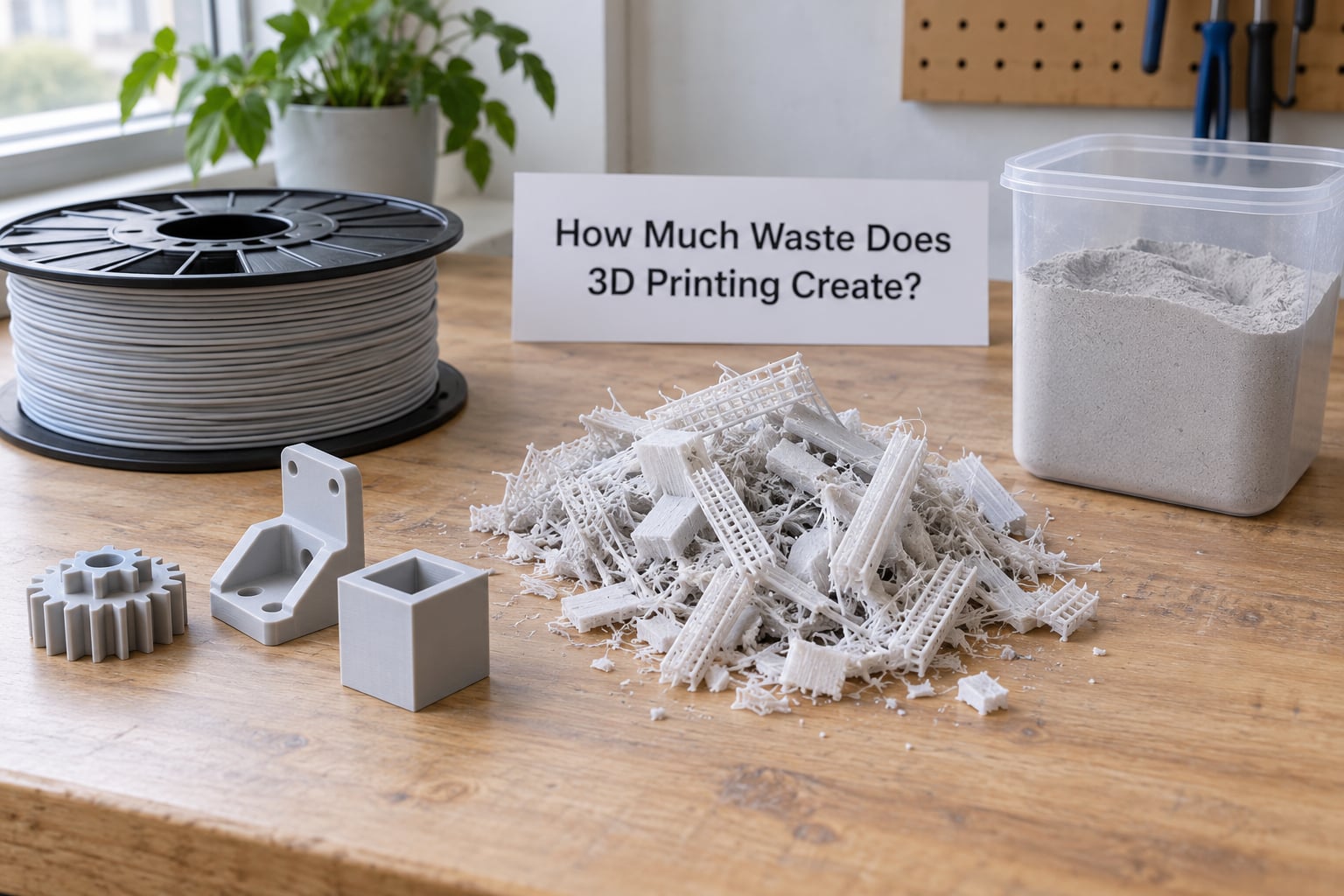
Waste is hard to quantify because nobody tracks it consistently, and makers report the problem honestly. Filament company buyers in communities describe accumulating “massive amounts of filament waste” from failed prints and prototypes with no practical route to dispose of it. That is the recurring frustration, more than the theory.
Where the waste comes from:
- Supports and rafts. Every overhang needs material that later gets cut away and thrown out.
- Purge and priming. Skirts, brims and the prime line at every start of a print.
- Failed builds. Bed adhesion problems, clogged nozzles, warped layers and power loss mid-print. This is the largest category for most hobbyists.
- Unused powder. SLS and metal systems recycle a good share of unsintered powder, but some fraction is always lost to sieving, contamination and mixed builds.
- Resin waste. Failed vat resin, wash water, alcohol, filters and support material from SLA. Hard to recover and awkward to dispose of.
- Prototypes. Designs that changed three times before the part was right. Real, and rarely counted.
Comparing waste rates across processes is genuinely difficult because the units differ. Failed filament is a weighed solid; failed resin is a liquid; SLS waste is powder with a reusability rate attached. Order-of-magnitude framing is honest here, precise percentages are not.
Four things move the number more than anything else: infill percentage, how much support geometry you design away, whether the build succeeds, and whether you pick the material to match the part. A 10 percent infill bracket wastes a fraction of what a solid decorative sphere does.
When Can 3D Printing Be Better for the Environment?
Several cases show a genuine advantage over the alternative:
- One-off and short-run parts. No tooling, no minimum order, no warehouse of inventory that later becomes obsolete waste.
- Repairs and replacements. A broken plastic hinge or a missing appliance bracket replaces the entire product. This is usually the biggest win a hobbyist will ever get.
- Complex geometry. Internal channels, lattice structures and organic shapes are hard to machine and often lighter as printed.
- Tooling and jigs. Short-lived shop fixtures that would be uneconomic to have molded.
- Lightweighting. Aerospace and automotive parts designed with topology optimization can cut mass enough to offset a higher production footprint over their life.
- Medical applications. Custom prosthetics and patient-specific implants avoid a long chain of off-the-shelf components and separate fittings.
- Avoided assembly and shipping. Printing a single integrated part locally can remove fasteners, packaging and a freight leg at once.
None of these are automatic. A replacement part made from virgin plastic that you then throw away in five years has only postponed the waste. Judge each project on its own life cycle.
What Are the Health and Chemical Concerns?
These are workplace and indoor air questions, and they overlap with environmental impact because the same emissions end up outside.
Resin is the one to take seriously. Uncured acrylate resin is a skin sensitiser, and prints release fumes during the print and the wash. Gloves, ventilation and proper curing are the baseline, not optional extras.
FDM prints emit volatile organic compounds, ultrafine particles and, for ABS and ASA, styrene. Enclosure plus HEPA and activated carbon filtration cuts exposure substantially. Makers who have run readings on their setups report that filtered numbers drop sharply, though they debate how much those readings really tell you about long-term exposure.
Powder handling has its own rules. Metal powders and SLS powders are respirable and should be handled under extraction with appropriate protection, and unsintered powder should stay segregated from other materials so it can be reused.
Disposal is the part that is genuinely environmental. Failed resin and wash water need a proper hazardous or specialist waste route in many areas. Failed filament is usually general plastic waste, which means landfill. Neither is a comfortable answer.
How Can You Reduce the Environmental Impact of 3D Printing?
If your print failed, you already know the fix. Prevention is most of the reduction available to an individual maker.
- Print only when printing is the right method. Ask what else would produce this part. For replacements, repairs and small batches, the answer is usually yes. For hundreds of identical simple parts, it is usually no.
- Cut failures before you cut energy. A dry filament, a clean nozzle path and a decent first layer remove more footprint than any other single change.
- Design supports out. Orient the part so overhangs are minimal, and lower infill where strength allows. Support material is pure waste.
- Choose the material for the part, not the marketing. Recycled filament where quality allows, PHA when the part needs genuine end-of-life breakdown, and skip the compostable label if you need the part to survive a year outdoors.
- Reclaim clean scrap. Filament extruders turn clean, unmixed offcuts and failed prints back into usable spool. Shred and sort your material first, because contaminated scrap ruins the batch.
- Use collection programs where they exist. Some hardware stores take back used spools and filament. Check your local options before it reaches the bin.
- Power down when idle. Turn the machine off between long jobs instead of leaving the hotend on.
- Pick a better power source. If your electricity comes from a renewable tariff or your local grid is decarbonizing, the machine’s impact drops with it.
- Design for reuse. A part you keep for a decade beats an identical part you replace annually, whatever the spool says.
One more filter for the “eco” claims on the shelf. Ask whether the manufacturer names the certification, the feedstock source and the actual end-of-life route. Anything that says compostable without naming a facility temperature has not told you anything you can act on.
Frequently Asked Questions
Is PLA actually biodegradable if I put a 3D-printed part in a home compost?
No. PLA breaks down in industrial composting facilities running near 140F with controlled aeration, which most homes cannot reach. In a home compost bin or a landfill, a PLA part behaves like ordinary plastic and will persist for centuries. If true end-of-life breakdown matters for your part, look for an industrial-compostable PHA and accept the durability trade-off, or choose recycled feedstock and plan to print fewer parts overall.
Is resin 3D printing more harmful to the environment than FDM printing?
Generally yes, on chemistry. Uncured SLA and DLP resin is a skin sensitiser, and failed resin, wash water, alcohol and support material create a waste stream that has no practical recycling route. FDM uses inert thermoplastic and its scrap can be ground down and re-extruded. Neither is harmless, but resin handling demands gloves, ventilation and responsible disposal, while filament handling is far simpler.
Do home 3D printers use a lot of electricity?
Not much. A desktop FDM printer typically draws roughly 80 to 150 watts while printing, plus higher power during heating, so an average print costs a fraction of a dollar in electricity. Run several hundred prints a year and it still rarely exceeds a few hundred kilowatt-hours. Industrial powder bed and metal systems use far more, because lasers, chillers, vacuum pumps and powder handling run at the same time.
Can I recycle failed 3D prints and support material?
Sometimes, and it depends on how clean it is. Single-material, single-colour scrap with no paint, glue or metal contamination can be shredded and re-extruded on a desktop filament recycler, though quality drops each cycle. Many hardware stores accept used spools and filament through collection programs. Mixed-colour, multi-material and resin waste generally has no household route, and resin waste often needs a specialist disposal service.
Is 3D printing greener than injection molding?
For low volumes, usually yes, because you skip the steel tool, the long setup and the flash and runners molding leaves behind. For thousands of identical parts, no, because molding amortizes its tooling and converts nearly all incoming plastic into finished part. Comparing a prototype run against a production order is the most common mistake in this argument. Compare the same part at the same quantity.
What is the most sustainable material for 3D printing?
There is no single winner, and the honest answer depends on the part. Recycled feedstock reduces virgin plastic demand at the front of the chain. PHA offers genuine end-of-life breakdown in industrial composting if durability is not critical. Choosing the least material-intensive process for the job, which is often a repair part you print once, beats any filament label you can buy.
Conclusion
3D printing is not automatically environmentally good or bad, and the arguments on both sides tend to skip the part that decides it. The right first move is to compare the intended part’s full life cycle against the process it would replace, at the same volume.
Where printing wins, it wins clearly: replacements, one-off parts, lightweighting and short-run production. Where it loses, the loss is mostly energy and plastic that never had to exist. Reduce failures, use less support material, reclaim clean scrap, and power the machine from a cleaner source. That is where the improvement actually lives.