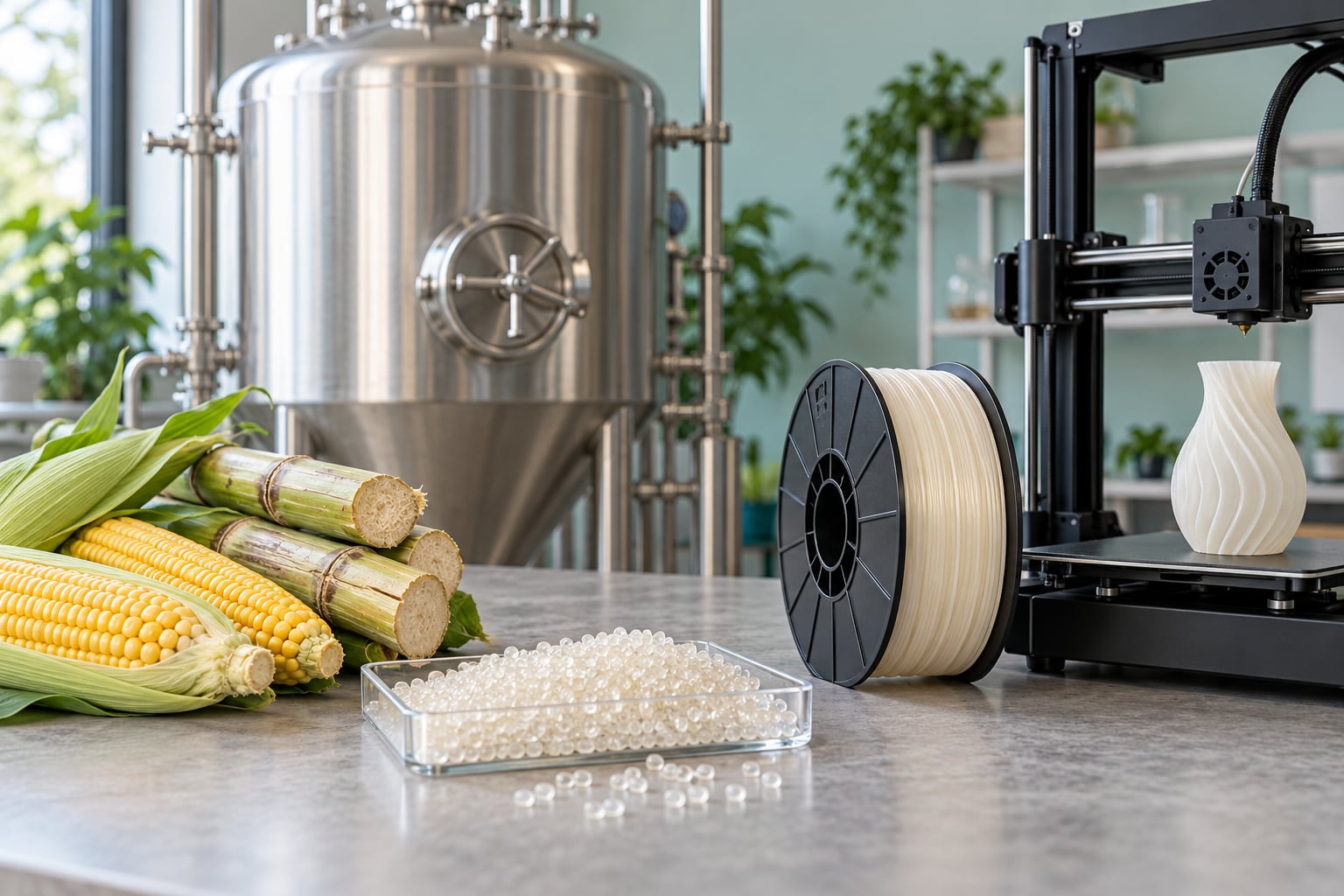
PLA is made from renewable plant sugars — usually corn starch, sugarcane or cassava — fermented into lactic acid and then built into a polymer called polylactic acid. It is biodegradable, but only inside a hot, moist, microbially active compost facility. A backyard bin, a landfill or the ocean will not do the job.
Both halves of that question matter more than the marketing usually admits. The feedstock answers where the carbon comes from. The conditions answer whether a used part ever disappears, and the honest answer for most makers is that it stays exactly where you put it unless you take it somewhere specific.
Table of Contents
- 1What Is PLA Made From and Is It Biodegradable?
- 2What Is PLA Made From?
- 3Bio-Based, Biodegradable, Compostable and Recyclable
- 4How Is Plant Sugar Turned Into PLA?
- 5Is PLA Biodegradable or Only Compostable?
- 6Does PLA Shed Microplastics?
- 7Does PLA Biodegrade in a Home Compost Bin?
- 8What Happens to PLA in Industrial Composting?
- 9Which Standards Actually Prove Compostability
- 10Do PLA 3D Prints Really Break Down?
- 11What About PLA Blends, Dyes, and Additives?
- 12How Should You Dispose of PLA Filament and Prints?
- 13Frequently Asked Questions
- 14Is PLA made from corn or sugarcane?
- 15Does PLA break down in a home compost bin?
- 16How long does PLA take to biodegrade?
- 17Can PLA filament be recycled?
- 18Does PLA dissolve or biodegrade in water?
- 19Can PLA-printed parts go in the ocean?
- 20Conclusion
What Is PLA Made From and Is It Biodegradable?
Short version: PLA is a bio-based thermoplastic polyester made from fermented plant starch, and it biodegrades only under industrial composting conditions. Everything below unpacks what that means for a spool on your desk and a bucket of failed prints.
What Is PLA Made From?
Most commercial PLA starts with a starch-rich crop. In North America that is usually corn; in Brazil and much of Asia it is sugarcane; in Thailand it is cassava; in Europe you will see sugar beet and wheat. Some plants build PLA from potato starch or from agricultural residues rather than a dedicated food crop.
What ends up on the spool is not plant material. It is a synthetic polyester chain made of repeating lactic acid units, chemically linked and extruded at a measured diameter. Nothing in the filament looks or behaves like corn, but the carbon in it largely came out of the ground as a fermentable sugar.
Chemically, PLA is a thermoplastic polyester with a glass transition around 60 °C and a density near 1.24 g/cm³. That low heat tolerance is the other thing to keep in mind — a printed part left in a parked car can sag long before any compost discussion becomes relevant.
Bio-Based, Biodegradable, Compostable and Recyclable
These four words get swapped for each other constantly, and they do not mean the same thing.
- Bio-based means the carbon came from a renewable source such as plant sugar. It says nothing about what happens after disposal. Paper is bio-based and it lasts in a landfill for decades.
- Biodegradable means microorganisms can break the material down into water, carbon dioxide and biomass. The catch is that almost every plastic is technically biodegradable given long enough and the right conditions, which is why the word on its own is close to meaningless.
- Compostable means it breaks down inside a defined composting system, at a defined rate, into something that is safe for soil. Industrial compostable and home compostable are separate certifications, and PLA only qualifies for the first.
- Recyclable means the material can be collected and reprocessed into something useful. PLA carries resin code 7, which household kerbside programs reject.
PLA is genuinely bio-based and genuinely biodegradable. It is industrial compostable when certified to a standard, and it is not recyclable through your household bin.
How Is Plant Sugar Turned Into PLA?
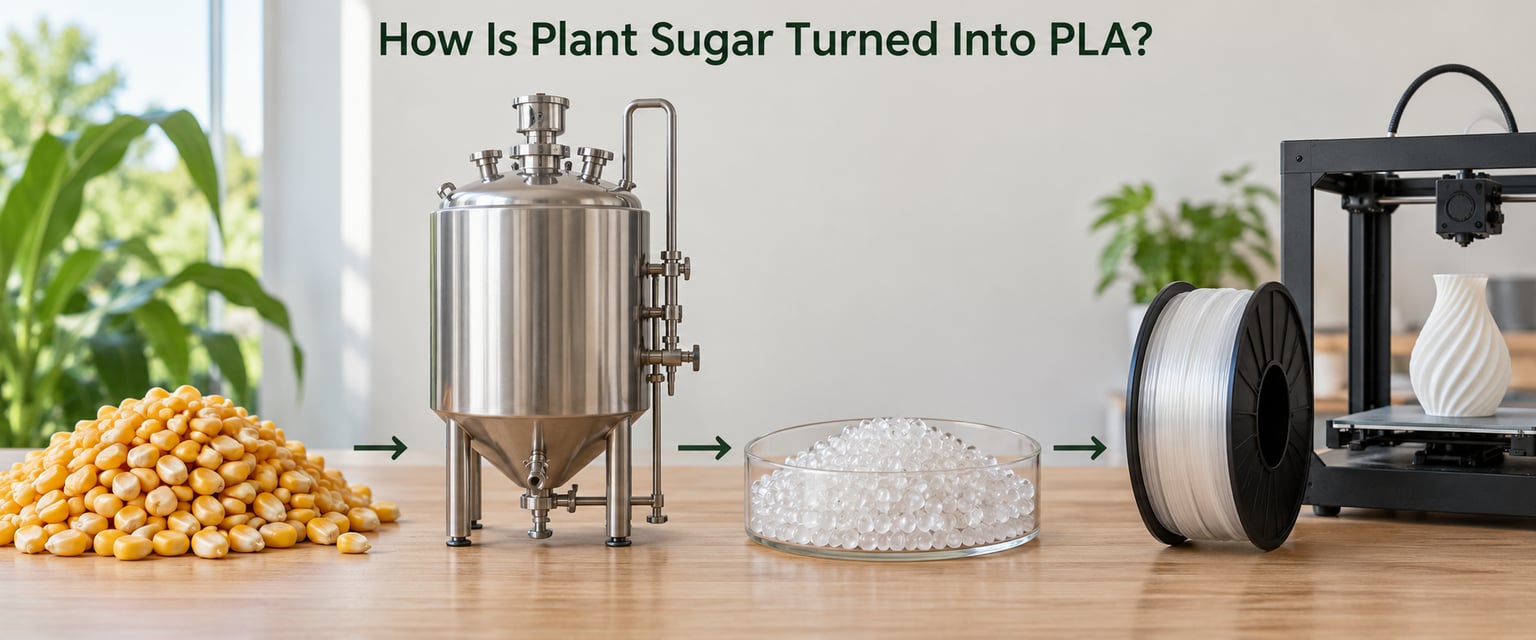
Manufacturers will not hand you the recipe, but the industrial chain is well documented and runs in six steps.
- Starch to sugar. The crop is milled and its starch is hydrolysed with enzymes into glucose.
- Fermentation. Lactobacillus bacteria consume the sugar and excrete lactic acid. This is the same molecule your muscles produce, just made in a tank instead of a body.
- Purification. The dilute lactic acid is filtered and concentrated, often using solvents and ion-exchange resins to reach pharmaceutical-grade purity.
- Lactic acid to lactide. Two lactic acid molecules are joined and dehydrated into a cyclic dimer called lactide, a solid that is easier to handle and purify than the acid itself.
- Polymerisation. Lactide is heated in the presence of a catalyst, and the ring opens and links into long chains of polylactic acid. Some grades use a solvent-free process with residual lactide removed afterwards.
- Pelletising and extrusion. The resin is dried, pelletised, then melt-extruded and drawn into 1.75 mm or 2.85 mm filament. Heat stabilisers, nucleating agents and impact modifiers are blended in at this stage, and those additives matter a great deal later.
That last point explains a lot of confusion. A spool labelled PLA may also contain colouring agents, UV stabilisers, dyes, pigments or up to several tens of percent of another material. The label describes the base polymer, not the whole recipe.
Is PLA Biodegradable or Only Compostable?
Both, but the distinction is doing real work. PLA does not rot. It hydrolyses first, then gets eaten.
In stage one, heat and water attack the ester bonds that hold the long polymer chains together, chopping them into shorter oligomers. In stage two, microorganisms metabolise those smaller molecules and convert them into biomass, water and carbon dioxide. Hydrolysis sets the pace; biology finishes the job.
Both stages need temperature, moisture, oxygen and an active microbial population at roughly the same time. Here is where each environment you might consider actually lands.
| Environment | Typical conditions | Does PLA break down? |
|---|---|---|
| Industrial composting | 55–60 °C, humid, aerated, months | Yes, when the grade is certified for it |
| Home compost bin | Ambient to warm, variable moisture | Not reliably; expect embrittlement, not disappearance |
| Municipal green bin | Often a cool, fast-turnaround process | Depends entirely on local acceptance rules |
| Landfill | Dry, cool, low oxygen, minimal moisture | No; it persists for a very long time |
| Soil | Cool, variable, microbial but no sustained heat | Extremely slow if anything |
| Ocean or river | Cool water, saltwater, no thermal input | No; it fragments into microplastic instead |
| Kerbside recycling | Mechanical sorting, ambient temperature | No; resin code 7 is rejected |
Does PLA Shed Microplastics?
Yes. PLA is not a zero-shed material, and this is the part of the story that rarely reaches the packaging copy. Weathering by ultraviolet light, salt and abrasion breaks the surface of PLA into fragments rather than metabolising them.
That is the honest drawback: a material marketed as biodegradable can still contribute to the microplastic problem in any environment where it cannot actually biodegrade. On r/Hydroponics you will regularly see people pick PLA specifically because they assume it breaks down harmlessly; that preference makes sense for compostable packaging and makes much less sense for a part that ends up in a river.
Does PLA Biodegrade in a Home Compost Bin?
Not in any way you should plan around. A backyard pile in most climates sits somewhere between ambient and mildly warm, dries out constantly, and rarely holds temperature for long.
What typically happens instead is weathering. Ultraviolet light and repeated wetting and drying embrittle the part, it cracks, powderises at the edges, and after a year you still have a recognisable object with the shape of what you printed. Makers describe exactly this pattern on r/3Dprinting: parts that look wrecked after months in a pile but are chemically no closer to gone. Some r/3Dprinting regulars go as far as building temperature-controlled composting drums rather than trusting a backyard heap.
The r/ZeroWaste community reaches the same conclusion from a different angle. Their read on “commercially compostable” is that it means heat and moisture are required, not merely bacteria and fungi, so home compost claims deserve scepticism by default.
Before you load the car, check whether your organics collection will actually take PLA. Acceptance depends on facility temperature and cycle length, and on whether the sorting line can tell compostable plastic apart from conventional plastic at all. Plenty of municipal programs will refuse it outright.
What Happens to PLA in Industrial Composting?
An industrial facility does what your pile cannot. It holds the material at thermophilic temperature, around 55 to 60 °C, keeps it uniformly moist and aerated, and turns it repeatedly so every surface sees heat.
That sustained heat is what accelerates hydrolysis. Enzymes produced by thermophilic bacteria and fungi attack the ester bonds, and the polymer chain is reduced over weeks to months. Certification standards usually require complete disintegration into fragments under a set size threshold within about 12 weeks, full conversion to carbon dioxide, water and biomass within about six months, and the finished compost to pass ecotoxicity and plant-growth tests so it can be used on food crops.
Which Standards Actually Prove Compostability
The word “compostable” on a spool means nothing on its own. A standard number means something.
| Standard | Region | What it covers |
|---|---|---|
| EN 13432 | European Union | Packaging recoverable in industrial composting and biodegradation |
| AS 4736 | Australia and New Zealand | Industrial compostable plastics |
| AS 5810 | Australia and New Zealand | Home compostable plastics, a harder test PLA does not pass |
| ASTM D6400 | United States | Compostable plastics in municipal solid waste composting |
| ASTM D6868 | United States | Compostable plastics labelled for commercial composting |
Two things worth remembering from the compostability literature. Certification applies to a specific product at a specific shape and thickness, not to a polymer in general, and a certified material still needs a facility that actually accepts it.
Do PLA 3D Prints Really Break Down?
A thick printed part behaves nothing like a certified packaging film, and the distinction matters more for makers than any other group reading about PLA.
Biodegradation happens at a surface. Certification samples are thin films with an enormous surface-area-to-volume ratio, designed so heat and moisture reach every millimetre of material. A functional print is the opposite: 2 mm walls, 40 to 60 percent infill, and a mass of material the water has to travel through.
As r/functionalprint puts it, PLA is not readily biodegradable outside of thin pieces in an industrial compost setting, because of additives and surface-area-to-volume ratio. That observation matches the chemistry. In practice, degradation shows up as the part weakening, embrittling and losing strength long before it disappears.
Local conditions finish the argument. Compost temperature, cycle length and how well the facility grinds material all vary. A claim that PLA always breaks down in 90 days is an oversimplification borrowed from a standard test, not a promise about any particular part in any particular pile.
What About PLA Blends, Dyes, and Additives?
Any of the following can change what happens to a print in compost:
- Pigments and dyes. Colour concentrates carry their own load, and certification rarely transfers to a coloured grade.
- Impact modifiers. Flexibility agents slow hydrolysis and add organic material the compost must also process.
- UV stabilisers and nucleating agents. Added for heat stability and print quality, and they are not on the compostability test list.
- Filled filaments. PLA-CF, silk, glow and wood-fill versions can run from a small filler percentage to something near half the weight by mass. A heavily filled filament is a composite, and the compostability claim on the base polymer no longer describes it.
- Blends. PLA mixed with ABS, PET or another conventional polymer is usually no longer compostable at all, because the second component is not biodegradable.
Additive-laden filaments are also the least understood category for recycling, since most specialist recyclers sort by polymer and cannot handle a filled composite.
How Should You Dispose of PLA Filament and Prints?
Work through these in order rather than guessing at the bin.
- Read the spool and the filament product page. Look for a standard number and a certification body. Plain “PLA” with no standard is not a compostability claim.
- Check whether PLA-CF, silk, glow or wood-fill is in the mix. Assume those are not compostable unless the manufacturer states it explicitly with a standard.
- Ask your local organics program before you haul anything. A short message asking whether they accept PLA or PLA-certified packaging gets you a real answer. Their website usually states accepted materials.
- Look for a specialist PLA recycler. Depolymerisation exists at small scale, and a few programmes accept clean PLA scrap directly.
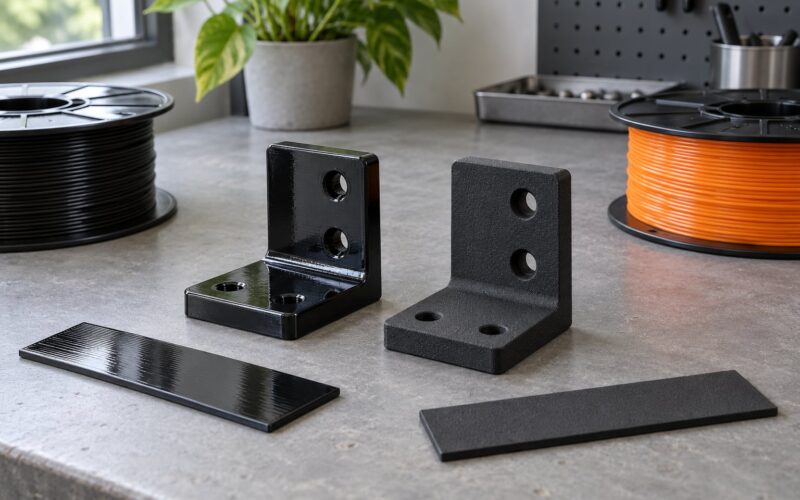
- Reuse before you recycle. Failed prints dry perfectly well as surface plates, jigs, dust protectors and shop clutter. Many prototypes only need a reprint.
- Reduce waste at the printer. Better first-layer adhesion, correct supports and a purge line you actually strip before slicing cut scrap more than any downstream scheme will.
Two extras. Do not put PLA in kerbside recycling; resin code 7 exists partly to make sorting decisions explicit. And if you want a drink out of a printed cup, PLA has no food-contact approval unless the filament maker says otherwise — the polymer is not the certification, the finished item is.
Frequently Asked Questions
Is PLA made from corn or sugarcane?
Both, depending on where it is produced. Corn starch dominates North America, sugarcane is the usual feedstock in Brazil and much of Asia, and cassava and sugar beet are used in Thailand and Europe respectively. Some grades use wheat, potato starch or agricultural residues. The finished filament contains no recognisable plant material; it is a synthetic polyester built from fermented sugars.
Does PLA break down in a home compost bin?
Not reliably, and you should not plan on it. A backyard pile rarely holds the sustained 55 to 60 °C, uniform moisture and active microbial population that PLA hydrolysis needs. Parts usually embrittle, crack and powderise at the edges while remaining recognisable. Some municipal organics programs will accept PLA and others will refuse it, so check before making the trip.
How long does PLA take to biodegrade?
Standards such as EN 13432 and ASTM D6400 require fragmentation into small pieces within roughly 12 weeks and full conversion to carbon dioxide, water and biomass within roughly six months, inside an industrial facility. In a landfill, soil or the ocean, treat the timescale as indefinite. A thick 3D-printed part can take far longer than a thin certified film even under good conditions.
Can PLA filament be recycled?
Partly. PLA carries resin code 7, which household kerbside programs reject, so it never goes in the household recycling bin. Specialist depolymerisation exists and a small number of programmes accept clean PLA scrap, but coverage is limited and filled filaments such as PLA-CF are the hardest to sort. Reusing prints and reducing purge waste remain the most practical options for most makers.
Does PLA dissolve or biodegrade in water?
No to both, in practical terms. PLA is insoluble in water and does not meaningfully biodegrade at ambient water temperatures, whether in a sink or the sea. Contact with water can slowly hydrolyse exposed ester bonds over long periods, but a printed part left in water simply stays there. Water is not a disposal route for PLA.
Can PLA-printed parts go in the ocean?
No. Cool saltwater provides no thermal input, so hydrolysis stalls and sunlight and abrasion instead fragment the surface into microplastic. PLA is not certified as marine biodegradable under any major standard. Taking printed parts to a beach or leaving them in a watercourse harms wildlife and removes a material that at least has a defined route elsewhere, such as an industrial composting facility that accepts it.
Conclusion
PLA comes from renewable plant sugars, fermented into lactic acid and polymerised into a polyester, and it is biodegradable under controlled industrial composting conditions only. That is a narrower claim than the packaging on most spools implies.
So the practical first step is small: look for a standard number on the filament rather than the word PLA, then check whether your local facility accepts that standard. Failing that, reuse the print and keep it out of the household recycling and the ocean.