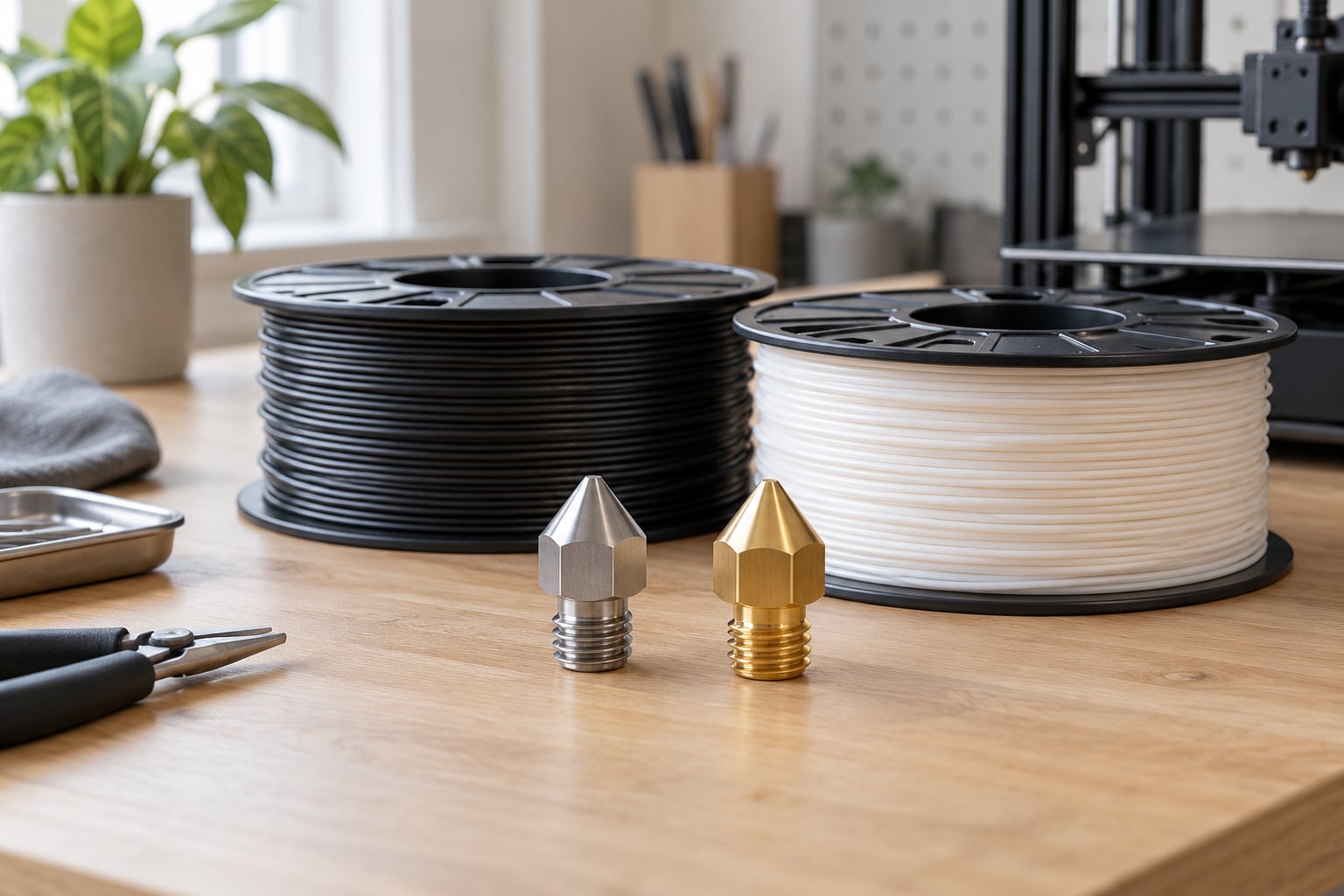
If you print plain PLA, PETG and TPU, a brass nozzle works and keeps working. The moment you load carbon fiber, glass fiber, glow-in-the-dark or stonefill filament, you need a harder tip. This comparison breaks down the hardened steel nozzle vs brass nozzle choice by heat resistance, wear life and what each material does to print quality.
Brass conducts heat roughly three times better than hardened stainless steel, which is why many owners nudge their nozzle temperature up about 5 to 10 C after a swap. Hardened steel survives abrasive filament many times longer and handles temperatures brass cannot. Pick based on the hardest filament you actually run, not the softest.
Table of Contents
- 1Hardened Steel Nozzle vs Brass Nozzle at a Glance
- 2Heat Resistance and High-Temperature Printing
- 3Why the cooler tip causes heat creep
- 4Wear Resistance and Abrasive Filaments
- 5Which filaments actually count as abrasive
- 6Cost and Total Value
- 7Print Quality and Material Compatibility
- 8The layer adhesion debate
- 9Stringing and sticky PLA
- 10Maintenance, Installation, and Safety
- 11Test for nozzle wear with a single-wall print
- 12Swapping a nozzle without leaking or clogging
- 13Which Should You Choose?
- 14Where stainless steel and other options fit
- 15Frequently Asked Questions
- 16Is a hardened steel nozzle better than brass for normal PLA and PETG printing?
- 17Can I use a hardened steel nozzle with carbon fiber and glass fiber filaments?
- 18Does a brass nozzle melt when printing high-temperature materials?
- 19How often should I replace a hardened steel nozzle compared with brass?
- 20Are hardened steel nozzles compatible with all 3D printers?
- 21Conclusion
Hardened Steel Nozzle vs Brass Nozzle at a Glance
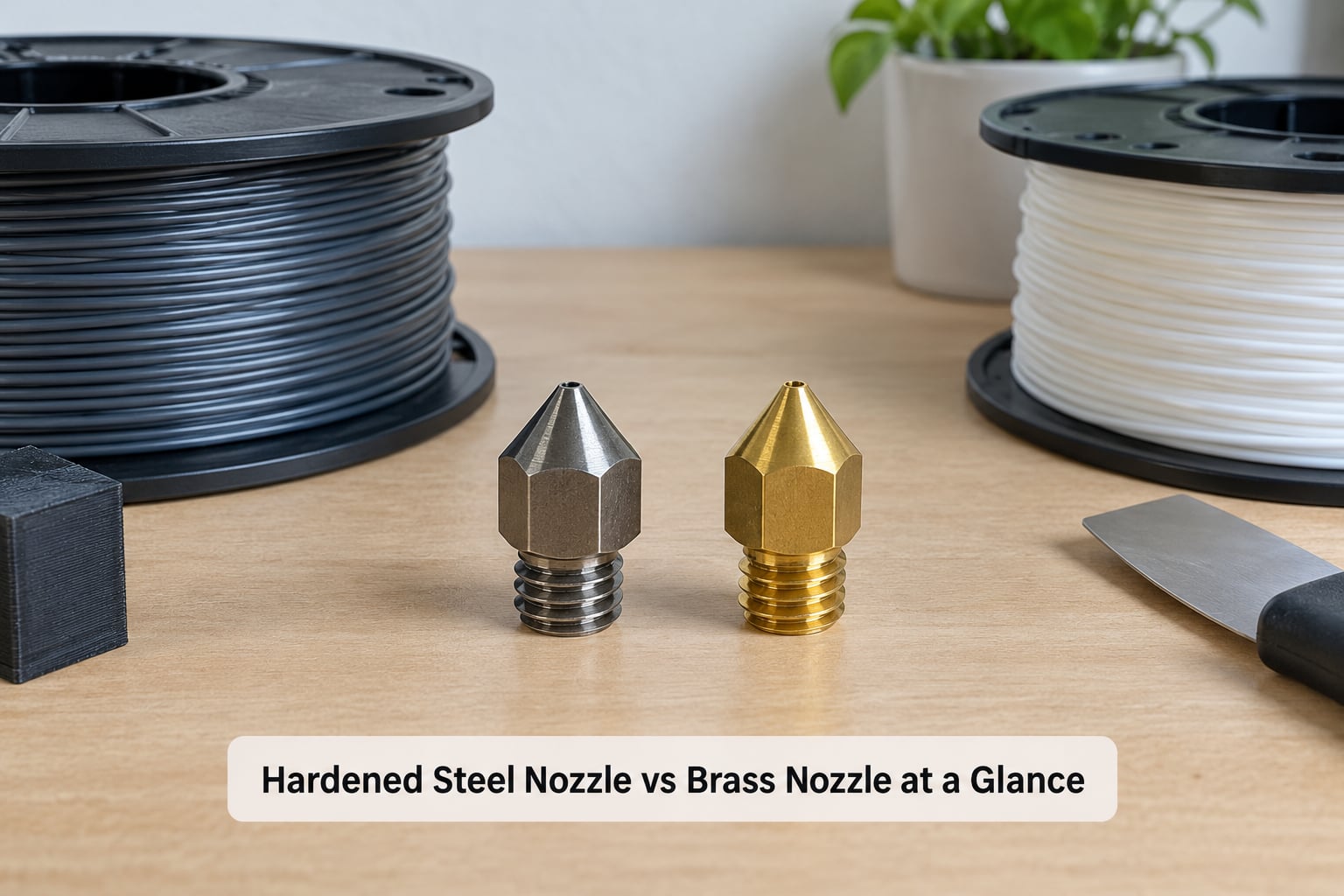
This table compares hardened steel and brass on the factors that decide which nozzle belongs in your hotend. Both materials extrude the same filament in the same machine. What changes is how they behave under heat and under load.
| Criterion | Brass nozzle | Hardened steel nozzle |
|---|---|---|
| Material type | Copper-zinc alloy, soft and malleable | Stainless steel, tip heat-treated to high hardness |
| Thermal conductivity | Close to 109 W/mK, excellent heat transfer | Roughly a third of brass, slower to transfer heat |
| Typical temperature rating | About 240 C on most nozzles | Up to around 300 C on many models |
| Wear life on carbon fiber | Roughly 1 to 2 kg before the orifice widens noticeably | Roughly 30 to 50 kg on the same filament |
| Filament compatibility | PLA, PETG, TPU, ABS, ASA, non-filled filaments | Everything brass handles, plus carbon fiber, glass fiber, glow, stonefill and metal-filled |
| Layer bonding | Better heat transfer into the previous layer | Slightly cooler melt zone, sometimes lower adhesion |
| Heat creep risk | Lower, because the tip stays closer to block temperature | Higher, since the tip runs cooler than the heater block |
| Max practical flow rate | Higher ceiling, good for high-speed printing | Lower ceiling at the same set temperature |
| Maintenance | Replace often once abrasives are in the mix | Occasional cleaning, rarely replaced |
| Best fit | Everyday plastic printing, budget and education setups | Abrasive filaments, high-temperature materials, production work |
Heat Resistance and High-Temperature Printing
Brass moves heat from the heater block to the melt zone faster than hardened steel, and that single property drives most of the differences people notice. A brass nozzle tip sits closer to the temperature your slicer asked for. A hardened steel tip lags behind it, so plastic exits slightly cooler and the flow rate drops at any given setting.
Temperature ratings separate the two materials clearly. Standard brass nozzles are usually rated to about 240 C. Many hardened steel nozzles carry a rating of up to 300 C, which puts nylon, PC blends and other high-melt polymers within reach on a hotend that can reach them.
That rating is a hard limit, not a suggestion. Running a brass nozzle above its rating softens the tip, and a softened tip deforms permanently under the pressure of extrusion.
Why the cooler tip causes heat creep
Heat creep starts when molten plastic creeps up the outside of the heat break. A tip that runs cooler than the heater block leaves a longer stretch of nozzle exposed to soften while plastic is still moving inside it. The softened section grabs the filament and causes under-extrusion, lost steps and a jam that usually clears only after a full cool-down.
Owners running a hardened steel nozzle report higher chance of heat creep on tall, thin parts with heavy infill. Raising the temperature a few degrees and improving hotend cooling covers most cases. If you hit repeat jams, a silicone sock on the heat break is usually the first fix to try.
Here is the practical offset: after switching from brass to hardened steel, add roughly 5 to 10 C to your nozzle temperature in the slicer profile and re-run a temperature tower. Take it the other way when you go back to brass. The Reddit r/3Dprinting thread on running only hardened nozzles is where most owners first mention the bump, and the same range comes up repeatedly on forum.prusa3d.com.
Wear Resistance and Abrasive Filaments
Brass is soft. Measured on the Rockwell or Vickers scales, common brass sits far below hardened stainless steel, and hardened tool steel sits far above both. When glass or carbon particles pass through a 0.4 mm orifice, they act like a grinding compound and cut the hole wider. A soft metal hole gives way quickly; a hardened hole barely notices.
The difference in practice is large. Printed on brass, carbon fiber filament is usually quoted at roughly 1 to 2 kg before the orifice opens up enough to affect line width and dimensional accuracy. On a hardened steel nozzle, the same filament is quoted at roughly 30 to 50 kg. Treat those as community ranges rather than lab figures, since real life depends heavily on retractions, nozzle diameter and how dry your filament is.
A widened orifice shows up as a thick, uneven line, stringing between distant features, blobs at corners and undersized holes that no longer fit their pins. On a small part, that is an annoyance. On a fixture or a press fit, it wastes the whole print.
Hardened steel is not the ceiling. Tungsten carbide and ruby sit far harder again and hold a precise orifice through the toughest composites, at the cost of a much higher unit cost and no softness to fall back on. Bimetal nozzles put a hardened tip on a brass body, which keeps the conductivity of brass while protecting the wear surface. That design is common on machines that ship with abrasive capability from the factory.
Which filaments actually count as abrasive
- Carbon fiber filled PLA, PETG and nylon (PLA-CF, PETG-CF, PA6-CF)
- Glass fiber filled PETG, PLA and nylon
- Glow-in-the-dark filament, whose phosphorescent pigment is gritty
- Stonefill and other mineral-filled PLA
- Metallic and sparkle PLA with coarse glitter particles
- Wood-fill PLA and other pigment-loaded decorative filaments
If none of those are in your filament rotation, a brass nozzle is not being asked to do a job it cannot do.
Cost and Total Value
Hardened steel nozzles cost more per unit than brass ones, and we are not going to quote figures that change weekly. Judge the purchase by what it replaces. A brass nozzle running carbon fiber becomes a consumable that wears out every kilogram or two. A hardened nozzle on the same material is something you install and mostly forget.
The useful calculation is cost per kilogram of abrasive filament printed. Divide the nozzle’s cost by the kilograms you expect from it. On PLA and PETG, brass wins that calculation outright because neither material wears quickly enough to matter.
There is a second, quieter cost. A nozzle that wears gradually produces slightly wider lines long before anyone notices, so parts that should be identical drift out of tolerance across a batch. That inconsistency costs far more in scrapped fixtures than a nozzle ever does.
Where brass stays the cheaper option: a single printer doing PLA and PETG only, an education printer that will be retired in a year, or a spare machine that never sees fiber. Where hardened steel pays for itself quickly: any spool of carbon fiber, glass fiber, stonefill or glow filament entering the rotation.
Print Quality and Material Compatibility
Nozzle material does not change the geometry in your slicer, but it changes what the printer can hold. This matrix matches common filaments to the nozzle each one deserves.
| Filament | Brass nozzle | Hardened steel nozzle |
|---|---|---|
| PLA | Recommended | Works, little benefit |
| PETG | Recommended | Works, little benefit |
| TPU 95A | Recommended | Works, slower to melt |
| ABS and ASA | Works within its rating | Works, more temperature headroom |
| PLA-CF and PETG-CF | Short life, avoid | Recommended |
| PA6-CF nylon | Not recommended | Recommended, needs a high-temp rating |
| GF-PETG and GF-PLA | Short life, avoid | Recommended |
| Glow-in-the-dark | Wears quickly | Recommended |
| Stonefill PLA | Wears quickly | Recommended |
| Metallic sparkle PLA | Wears slowly but visible | Recommended |
The layer adhesion debate
Because brass conducts heat better, more energy reaches the layer below. Several users in the r/3Dprinting hardened nozzle thread repeat a claim from CNC Kitchen that brass delivers noticeably better layer adhesion on PLA parts, particularly on tall thin sections where layer bonding matters most. Owners running hardened steel nozzles on ordinary PLA often report no visible difference at all.
If you are printing functional PLA parts and have never tried the swap, measure something. Print the same tall, thin test piece with each nozzle and compare failure strength. That settles it for your geometry, which is worth more than either general claim.
Stringing and sticky PLA
Owners also report more stringing and harder retraction behavior after moving to hardened steel, most likely because the cooler melt zone leaves less slack in the retraction distance. A cleaner retraction test usually fixes it in a few minutes of tuning.
The other reported quirk is stickiness. Molten PLA clings to hardened steel tips more than to brass, and residue builds around the outside of the orifice over time. Wipe the tip while hot with a brass or steel brush every few spool changes and it never becomes a problem.
Maintenance, Installation, and Safety
Treating the nozzle as a wear part rather than a permanent component is what separates people who get consistent prints from people who chase defects. These two checks keep you ahead of the wear curve.
Test for nozzle wear with a single-wall print
- Slice a 10 mm tall single-wall test with a known 0.4 mm extrusion width.
- Print it in your normal material, not something abrasive.
- Measure the wall thickness with callipers at three points and average them.
- Compare against your nominal extrusion width. A consistent overshoot of roughly 0.02 mm or more across all three readings means the orifice has opened.
- Replace the nozzle and re-run the same test to confirm you are back on target.
Swapping a nozzle without leaking or clogging
- Heat the hotend to printing temperature and loosen the set screw or unthread the M6 nozzle while everything is hot and plastic is soft.
- Wipe the threads and the heater block faces clean with a lint-free cloth while hot.
- Fit the new nozzle, hand-tighten the set screw at an angle so the nozzle seats flat, then tighten firmly.
- If it threads in, tighten it snug at temperature. Thread sealant can be added to the threads, never to the seating face.
- Print a single line and a purge block to confirm flow, then check the first layer for height and squish.
Never force a cold nozzle out of a hot block. Let the assembly cool to room temperature first. Thermal shock between a cold steel nozzle and a hot aluminum block cracks heater blocks, and that failure costs far more than a stuck nozzle.
Follow your printer manufacturer’s instructions for which thread and seat type your hotend uses. V6-style hotends, Nextruder mounts and the direct-extruder mounts found on enclosed printers all differ, and a wrong assumption there means a leak inside the machine.
Which Should You Choose?
Match the nozzle to your hardest filament. Start with what is actually in your filament rack right now, not what you might buy later.
- Everyday PLA and PETG: stay on brass. Better heat transfer, better layer bonding on tall parts, and you lose nothing.
- TPU and soft filaments: brass again. TPU needs reliable melt and retraction, and a cooler nozzle makes both harder.
- Any carbon fiber or glass fiber filament: hardened steel, no exceptions. This is the whole point of the comparison.
- Glow, stonefill, metallic and wood-fill: hardened steel. The wear is slower than with fiber, but the eventual failure is the same widened hole.
- Nylon, PC and other high-temperature engineering materials: hardened steel rated to the temperature you need, and check that your heater block and silicone sock also support it.
- Budget or education printers on PLA only: brass, and replace it whenever you swap to fiber.
- Production and batch work: hardened steel. Stable line width across a long run matters more than the small temperature bump.
- Mixed filament rotation: keep both nozzles on hand. Swapping takes a few minutes and buys back the melt quality on the soft materials.
Where stainless steel and other options fit
Stainless steel is a separate category from hardened steel. A stock stainless steel nozzle is tougher than brass but still soft enough to wear out on fiber, which is why replacing one is a common and worthwhile upgrade. Hardened steel is the step after that. Tungsten carbide and ruby go further for serious composite work, and bimetal keeps brass conductivity with a hardened tip for shops that print both materials daily.
Frequently Asked Questions
Is a hardened steel nozzle better than brass for normal PLA and PETG printing?
No, not for ordinary PLA and PETG. Brass conducts heat better, so it flows smoothly at a given temperature and bonds tall parts well, and neither material wears meaningfully on unfilled plastic. Hardened steel becomes the better nozzle the moment fiber or mineral fillers enter the picture.
Can I use a hardened steel nozzle with carbon fiber and glass fiber filaments?
Yes, and that is exactly what it is designed for. Owners quote roughly 30 to 50 kg of carbon fiber through a hardened nozzle, against roughly 1 to 2 kg through brass. Make sure the nozzle rating covers the temperature your filament needs, and that your hotend can reach it.
Does a brass nozzle melt when printing high-temperature materials?
Not literally melt, but it softens permanently. Most brass nozzles are rated around 240 C, and running near or above that figure lets the tip deform under extrusion pressure, which widens the orifice and ruins line width for good. Above that rating you need a hardened steel nozzle rated to 300 C or more.
How often should I replace a hardened steel nozzle compared with brass?
Brass on abrasive filament lasts roughly 1 to 2 kg, while a hardened steel nozzle is often still going after tens of kilograms. On plain PLA, PETG and TPU both materials last so long that replacement is driven by clogs and damage rather than wear. Check wear with a single-wall extrusion width test before you replace anything.
Are hardened steel nozzles compatible with all 3D printers?
Almost all of them, because the M6 thread and standard heater block seat cover the majority of FDM machines. The details that matter are thread length, seat style and temperature rating, which differ across V6-style hotends, Nextruder mounts and enclosed direct-extruder printers. Check your printer manual before buying.
Conclusion
The hardened steel nozzle vs brass nozzle decision comes down to one question: does your filament contain anything hard enough to grind the hole wider? Brass wins on heat transfer, flow rate and layer bonding for PLA, PETG and TPU. Hardened steel wins on wear life and temperature rating for anything filled with fiber, mineral or glow pigment.
Before buying, check three things. Find your hardest filament and match it to the table above. Check the maximum nozzle temperature your hotend and heater block can reach. Confirm the thread type and seat style your printer uses. If the answer to the first question is PLA or PETG only, brass is the right nozzle, and the difference will not show up in your prints.