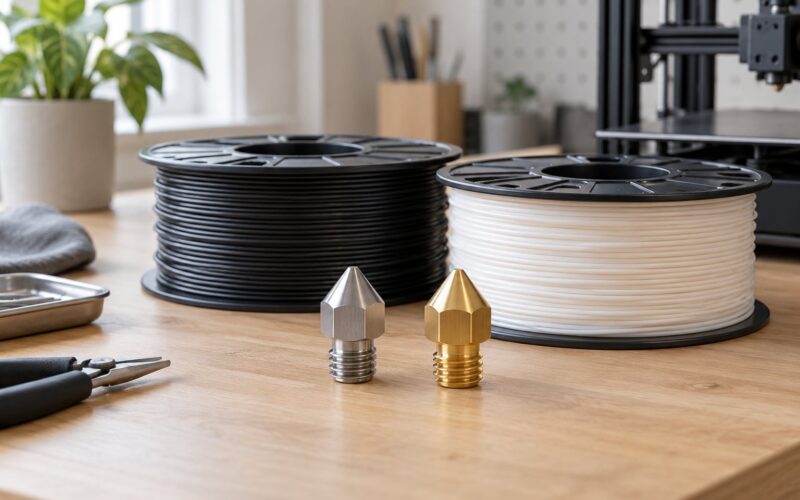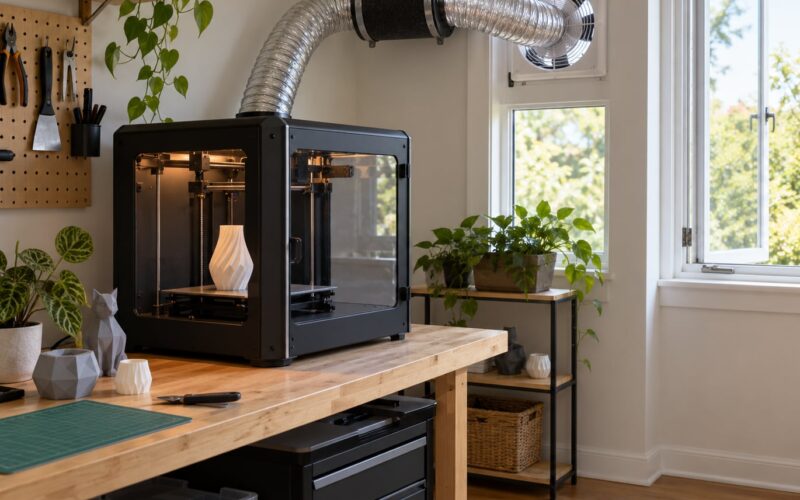
If you are asking whether are 3D printing fumes dangerous to breathe, the honest answer is: sometimes, and the variable is mostly you and your setup rather than the printer. A hotend melts thermoplastic at roughly 180 to 260 degrees Celsius, and that heat drives off gases and fine particles into the air. Short, occasional prints of PLA in a ventilated room are low risk. Long, unattended prints of ABS in a closed bedroom are a different conversation entirely. This guide covers what those emissions are, which materials produce the most, and what to change first.
The short version that surprises most people: odour is a poor guide to risk. The mild sweet smell of PLA marks a much smaller hazard than the harsh sting of ABS, and some genuinely concerning compounds are close to odourless. Judge the setup by material, containment, ventilation and duration instead.
Table of Contents
- 1What Are 3D Printing Fumes?
- 2Are 3D Printing Fumes Dangerous to Breathe?
- 3Which Materials Produce the Most Concerning Emissions?
- 4Is resin 3D printing a separate risk category?
- 5What Health Effects Can Exposure Cause?
- 6What Factors Increase the Risk?
- 7How Can You Reduce Exposure Safely?
- 8Are Enclosed 3D Printers Safer Than Open Printers?
- 9Are 3D Printing Fumes Dangerous to Breathe at Home?
- 10How Do You Know When to Stop Printing?
- 11Frequently Asked Questions
- 12Can you smell dangerous fumes from a 3D printer?
- 13Are PLA fumes safe to breathe while printing?
- 14Is an enclosed 3D printer safer for fumes?
- 15Do ordinary dust masks protect against 3D printing fumes?
- 16What should I do if I get dizzy or cough near a 3D printer?
- 17Is resin 3D printing more dangerous than filament printing?
- 18Conclusion: Start With Ventilation and the Material SDS
What Are 3D Printing Fumes?
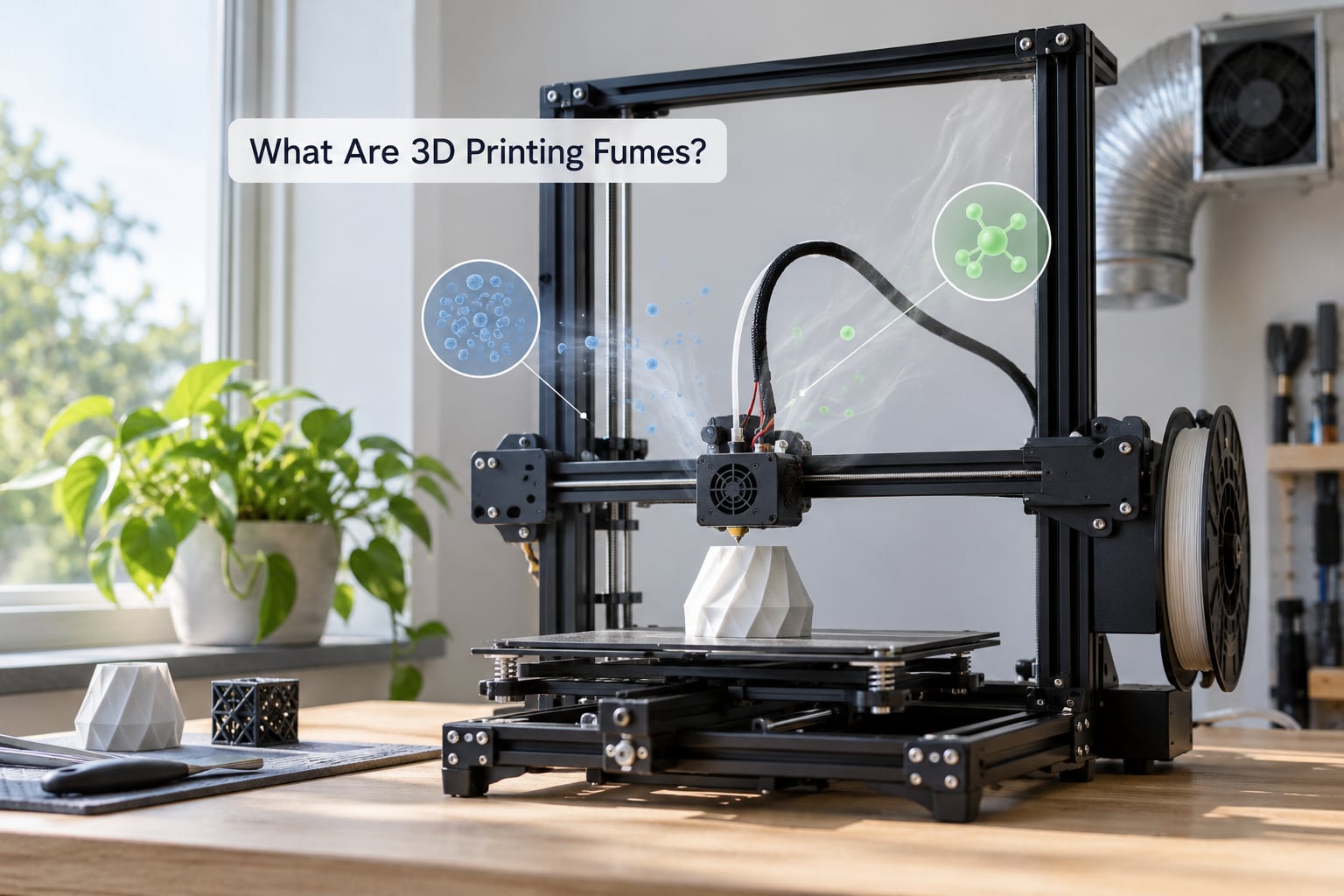
“Fume” is a loose word here. What escapes a printer is a mixture of gases and airborne particles, and it helps to know which is which.
Volatile organic compounds are gases released when a material is heated. As polymer is melted, the lighter molecules and leftover processing aids boil off first. Depending on the resin, that can mean styrene from ABS and ASA, caprolactam from nylon, or acrylic compounds from photocurable resin.
Ultrafine particles are solid droplets and fragments small enough to be breathed deep into the lungs, where they can cross into the bloodstream. They form when hot polymer is pushed through a nozzle and sheared, or when a part overheats and chars. Many are under 0.1 microns, which is why ordinary dust masks and household vacuums do little with them.
Underneath both is thermal degradation: the polymer breaking down because it got too hot for too long. That is also where formaldehyde, phenol, ammonia and, in older research on fused plastics, benzene and hydrocyanic acid come from. Keep the nozzle at the temperature the manufacturer recommends for the filament and you keep degradation down.
Resin and filament printers differ here. Filament printing degrades a solid thermoplastic and releases gases. Resin printing cures liquid photopolymer with UV light, which off-gasses uncured monomer and acrylate, plus whatever your wash station and ventilation do with the liquid waste. Combustion-related processes such as laser sintering or cutting a different set of emissions entirely, including metal-containing dust.
Are 3D Printing Fumes Dangerous to Breathe?
Yes, they can be, and the amount of harm tracks material, ventilation and how long you are exposed. Emissions can irritate the eyes, nose, throat and lungs, and frequent long exposures to certain materials raise longer-term respiratory concerns. None of that means a weekend of PLA prints in a ventilated room is dangerous. It means the exposure is real, measurable, and controllable.
Three factors decide almost everything:
- Material. PLA and PETG emit far less than ABS, ASA, nylon, polycarbonate or uncured resin.
- Containment and ventilation. An open-frame printer in a small closed room is the worst case; an enclosed printer with filtration and outdoor exhaust is close to the best.
- Duration and distance. Ten minutes across the room is not the same as eight hours sitting beside the machine.
One study by 3Dsafety.org with the Italian manufacturer WASP measured ABS emitting roughly three to thirty times the nanoparticles of PLA under the same conditions, and found particles clearing the air within 10 to 30 minutes after extrusion stops. That clearance figure is encouraging only if your room actually has enough airflow to deliver it.
Which Materials Produce the Most Concerning Emissions?
Filaments differ mainly in polymer chemistry and required print temperature, and both drive how much gets released. Higher-temperature materials degrade more readily, and filled filaments add a second source of dust.
| Material | Typical emissions | Relative concern | What helps |
|---|---|---|---|
| PLA | Lactide and other low-level degradation products | Lowest of the common filaments | Ventilation is usually enough |
| PLA+ | Same as PLA plus additives | Low | Ventilation, no enclosure needed |
| PETG | Low-molecule esters and glycols | Low to moderate | Ventilation; enclosure for long prints |
| TPU | Similar to PETG, sometimes stickier residue | Low to moderate | Ventilation; watch nozzle temps |
| ABS | Styrene, acrylonitrile, degradation products | High | Enclosure plus outdoor exhaust |
| ASA | Styrene and acrylonitrile, similar to ABS | High | Enclosure plus outdoor exhaust |
| Nylon | Caprolactam and ammonia | High | Sealed enclosure, filtration, exhaust |
| Polycarbonate | Aromatic degradation products; high heat demand | High | Sealed enclosure, filtration, exhaust |
| Filled filaments | Added resin, carbon fibre or mineral dust | High, and dusty | Filtration, local extraction, handling care |
| Photopolymer resin | Acrylates, uncured monomer, wash waste | High, and acute | Dedicated ventilated work area, gloves, controlled handling |
Two caveats on that table. Nobody has published a universal risk ranking for every brand and formulation, so treat it as a strong general pattern rather than a certified list. And spools of the same material from different suppliers can emit very different loads; the WASP work found meaningful variation between otherwise identical material. Always read the safety data sheet (SDS) shipped with your filament, and treat the SDS as the authority for the product in your hands.
Is resin 3D printing a separate risk category?
Yes. Uncured liquid resin is a skin sensitiser and an eye irritant before it ever reaches a printer, and the wash stage creates its own vapour load from alcohol solvents and residual acrylate. Gloves, a dedicated room or cabinet, and careful waste handling matter more here than any filter. If you are new to this, filament printing is a far gentler place to start.
What Health Effects Can Exposure Cause?
Short-term, at hobby exposure levels, the reported effects are mostly irritant: burning eyes, a scratchy throat, dry cough, headache, nausea and that lingering chemical smell after a print. Symptoms usually appear during or shortly after a print and settle once the room is aired out.
Longer-term exposure is where the evidence thins out. Occupational studies on workers with sustained exposure to polymer fume, thermal-degradation products and metal dust have documented airway irritation, bronchitis and symptoms consistent with sensitisation. A NIOSH study exposed lung cells to emissions from ABS and polycarbonate and reported cell death and inflammatory markers after roughly three hours of exposure. That is cell culture work, not proof that printing at home causes lung damage, and the honest reading is that the hazard is real while the threshold for everyday use remains unsettled.
| Common claim | What the evidence supports |
|---|---|
| Strong smell means high toxicity | Odour intensity does not track toxicity. PLA smells sweet and emits less; some hazardous compounds are nearly odourless. |
| Any fumes mean permanent damage | No study demonstrates that casual hobby printing causes lasting harm. Long, frequent, unventilated exposure is a different question, still under study. |
| A HEPA filter handles everything | HEPA traps particles. It does almost nothing for gases or VOCs. You need activated carbon for those. |
| An enclosure alone is enough | An enclosure concentrates emissions in a small volume. Without filtration or exhaust, you have stored the fumes, not removed them. |
| A dust mask protects you | Common dust masks do not filter gases and fit poorly against ultrafine particles. |
If you notice persistent cough, wheezing, chest tightness or shortness of breath that does not settle after leaving the room, or irritation that lasts more than a few days, stop printing in that space and see a clinician. Say what you were printing and for how long. For an acute exposure, contact your local poison control centre. Nothing here is a diagnosis or a treatment plan.
What Factors Increase the Risk?
Beyond material, a handful of setup details move the exposure more than most people expect.
- Nozzle temperature. Running 20 degrees hotter than the profile needs increases degradation. Overheated or blocked nozzles char material and spike emissions.
- Print duration. An eight-hour ABS print is not eight short bursts. Longer is worse than shorter at the same machine.
- Room size and air changes. A small closed room concentrates emissions. The WASP study suggested moving three times the room’s air volume per hour as a working target, roughly 300 cubic metres per hour for a 100 cubic metre room.
- Enclosure quality. A leaky or improvised enclosure with a big gap at the door is barely better than open frame.
- Distance. Emissions rise away from the chamber but drift. Sitting beside the machine all evening is worse than standing in the doorway once.
- Machine maintenance. Clogged or failing extraction fans, saturated filters, and dirty ducts all reduce airflow without any obvious sign.
- Several machines at once. Print farms multiply emissions and remove the option of just stepping out of the room.
Print in the same room you sleep in and every one of those factors is working against you.
How Can You Reduce Exposure Safely?
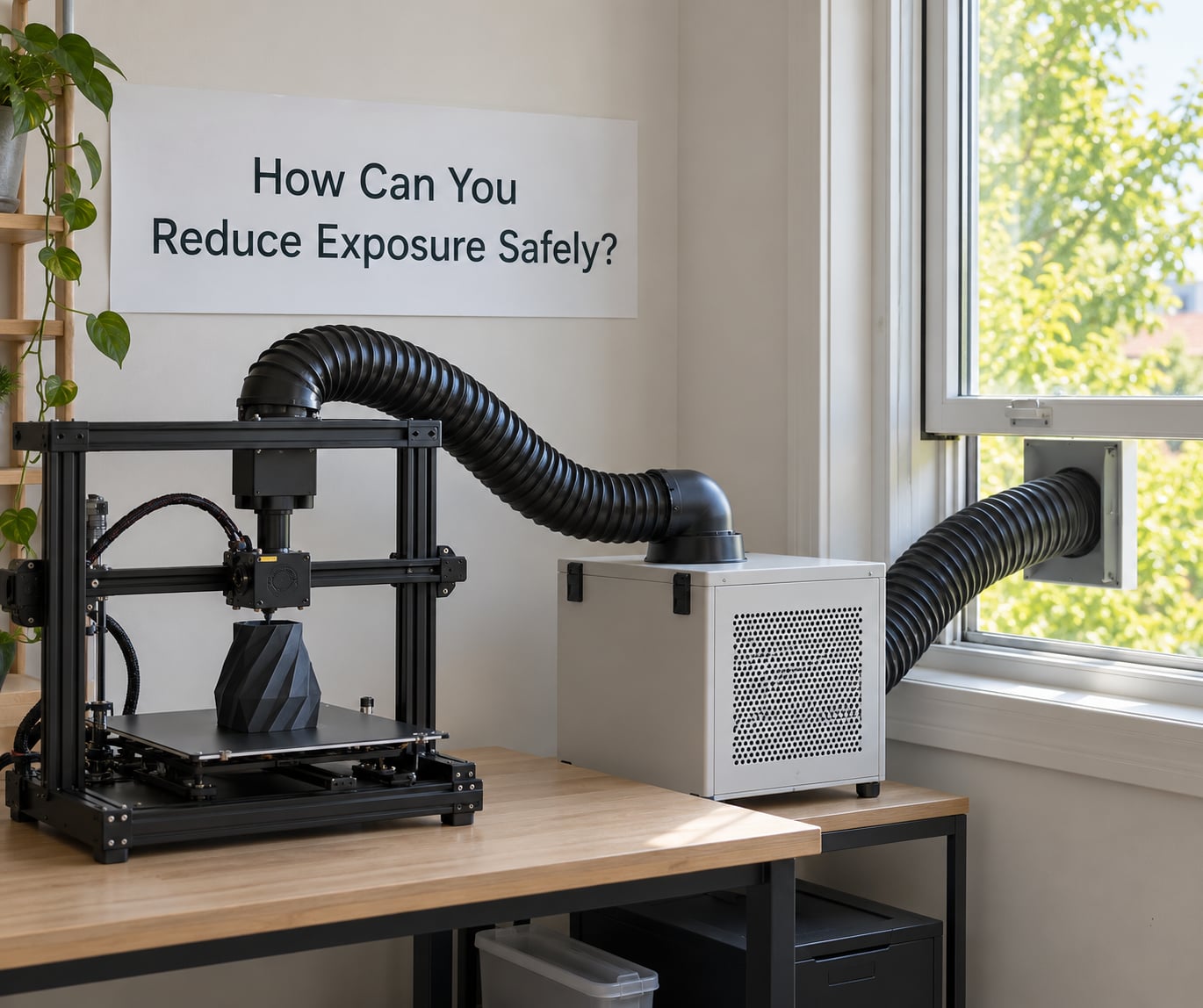
Work down this list in order. The early steps cost nothing and remove more exposure than anything you can buy later.
- Read the SDS for every material you use. It tells you what is actually in the spool and how the manufacturer expects it to be handled.
- Choose a lower-emission material when the part allows it. PLA or PETG instead of ABS, ASA, nylon or polycarbonate is the single biggest reduction available to most people.
- Run the lowest effective temperature and dry damp filament before printing. Wet filament frays into fine particles and smells worse.
- Keep the machine maintained. Clear nozzle clogs, replace saturated filters on schedule, confirm fans actually move air.
- Ventilate the room properly. Cross-flow, or an extract fan ducted outside. Opening a window in a still room does surprisingly little.
- Route enclosure exhaust outdoors when you print regularly or use high-emission materials.
- Handle resin under extraction with gloves and a dedicated wash area.
- Move the printer out of your breathing zone and away from bedrooms where you can.
- Use respiratory protection last, and only when a qualified assessment supports it. Fit-tested respirators are for specific hazards, not a general precaution.
That ordering matters. Swapping to PLA does more than a filter does. A filter handles emissions you should not have produced in the first place.
Are Enclosed 3D Printers Safer Than Open Printers?
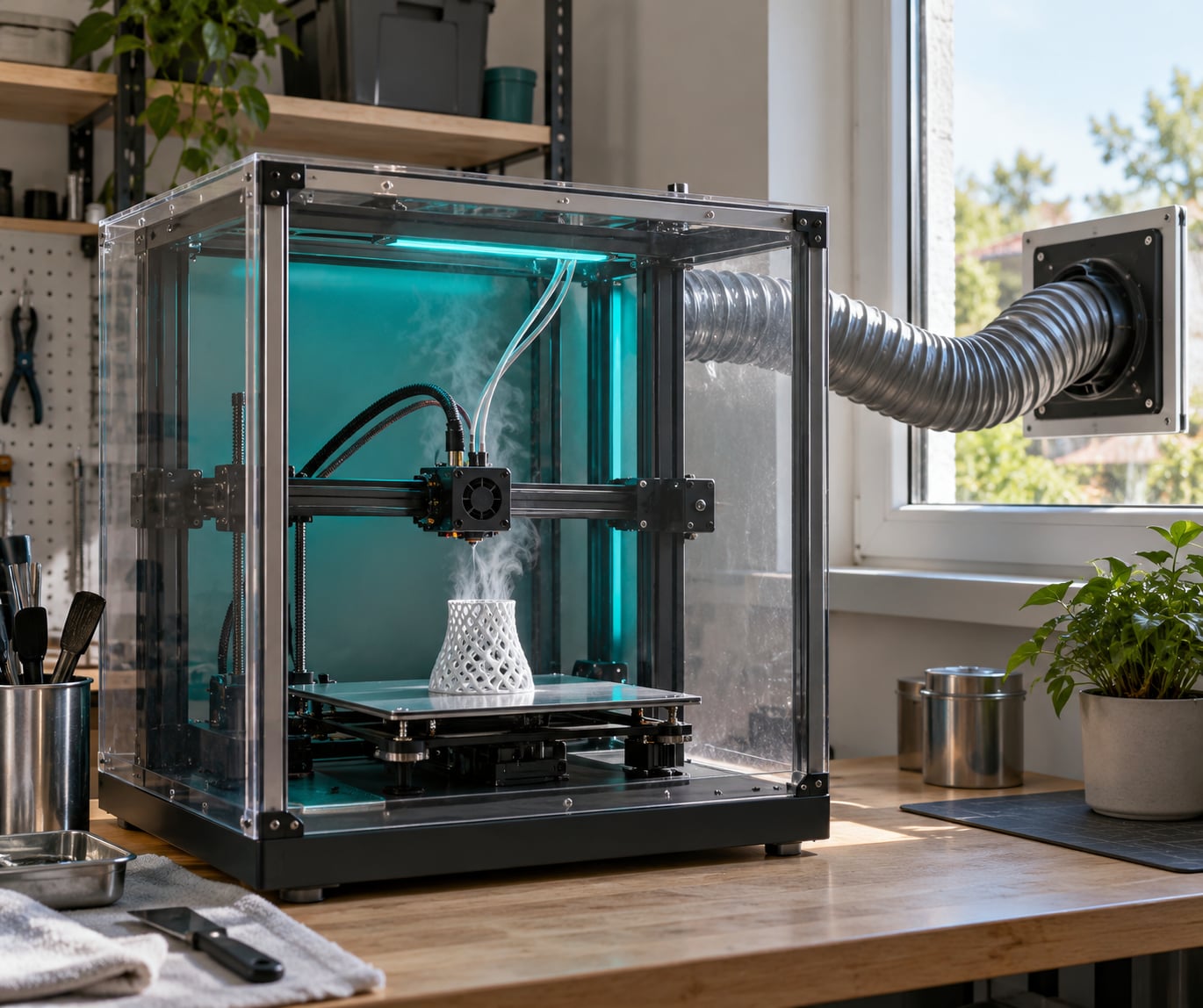
Yes, meaningfully, but only as part of a system. An enclosed chamber stops emissions entering the room. It does not destroy them. Unless the air is filtered or exhausted, the fumes accumulate inside a small volume and eventually leak out around the door, the spool holder and the cable slots.
Filtration solves two separate problems, and confusing them is the most common mistake:
| Control | What it captures | What it misses |
|---|---|---|
| HEPA filter | Particles, including most ultrafine particulate | VOCs and gases |
| Activated carbon | Many organic vapours, with a finite capacity | Particles |
| UV stage | Some organic compounds, partial | Particles and most VOCs |
| Outdoor exhaust | Nearly everything, permanently | Nothing, but it needs a safe discharge route |
That is why serious setups run both a HEPA and a carbon stage. On carbon filter claims, ask two things: what media is it, and what is the stated replacement interval. Activated carbon saturates, and once it does it keeps airflow while quietly stopping removal. Follow the manufacturer’s schedule rather than waiting for the smell to return, because the smell returns long after the useful capacity is gone.
Are 3D Printing Fumes Dangerous to Breathe at Home?
For most households, no, as long as the setup follows the sequence above. The complication is that homes rarely have a spare room, so people compromise on ventilation and end up with the worst combination: a long print and no airflow.
A workable home checklist:
- Print in a room you can ventilate, ideally with a door that stays open to the rest of the home.
- Keep the machine out of the bedroom and away from where you sleep or sit for hours.
- Use PLA or PETG by default. Save ABS and nylon for occasional jobs with the door open, or take them to a workshop.
- For resin, dedicate a space with real extraction and keep children and pets out of it entirely.
- Expect visitors, not just residents. Other people’s lungs, and any asthma among them, count too.
- Check on the room during long prints rather than assuming everything is fine at hour six.
Children and pregnant people deserve extra caution, and so does anyone with asthma or an existing respiratory condition. Forum threads on printer placement keep converging on the same outcome: moving the machine to a garage, shed or spare outbuilding resolves household friction faster than any filter. Pets cannot tell you they have a headache, which is reason enough to keep resin work out of shared rooms.
At classroom, lab or commercial scale, treat it as an occupational question. Your employer needs an assessment of exposure, ventilation and handling, and in most jurisdictions a documented duty of care. Do not freelance that judgement for a room full of machines.
How Do You Know When to Stop Printing?
Stop the print and deal with the setup when you see any of these.
- A sharp, unexpected or stronger-than-usual smell mid-print
- Visible smoke, haze or a burning smell rather than a plastic smell
- Filament leaking from the hotend, or a nozzle that keeps clogging
- A filter that sounds blocked, a fan that has gone quiet, or extraction that stopped
- A hotend that overheated and shut down, or repeated thermal warnings
- Eye watering, throat irritation, headache, dizziness or coughing that starts while printing
The response is simple. Stop the machine, leave the room, and ventilate it if you can do that safely. Open the SDS and identify what you were printing. If symptoms do not settle once you are in fresh air, contact poison control or a clinician. If the smell comes back in the same room within a short period, the ventilation is not doing its job and no amount of window-opening will fix it.
Frequently Asked Questions
Can you smell dangerous fumes from a 3D printer?
You can smell some emissions, but smell is an unreliable danger signal. PLA gives off a mild sweet lactide odour while emitting relatively little, whereas harsh nylon fumes carry more concerning compounds. Some hazardous vapours are close to odourless. Judge risk by material, containment, ventilation and duration rather than by how strong the room smells.
Are PLA fumes safe to breathe while printing?
PLA is the lowest-emission common filament, and occasional prints in a ventilated room are widely treated as low risk. It still releases lactide and degradation products, so an enclosed or filtered setup plus airflow is sensible for long prints. Nobody should sit in a small closed room with a PLA print running for hours, and children and anyone with asthma warrant more caution.
Is an enclosed 3D printer safer for fumes?
It is safer, provided the enclosure is paired with filtration or outdoor exhaust. An enclosure on its own concentrates emissions in a small chamber and they eventually leak out. A HEPA stage captures particles and an activated carbon stage captures many organic vapours, so most effective setups use both. Check the carbon filter replacement schedule, because saturated carbon still moves air.
Do ordinary dust masks protect against 3D printing fumes?
No. Disposable dust masks are designed to catch larger particles and fit loosely against the very small ultrafine particles that matter most here. They do not filter volatile organic compounds at all. If respiratory protection is warranted, it needs to be the correct type for the hazard and properly fit-tested, which is why it belongs at the end of the control list rather than the start.
What should I do if I get dizzy or cough near a 3D printer?
Stop the print, leave the room, and get into fresh air. Then check what material was running and read its safety data sheet, because the answer changes a lot between PLA and ABS. If the cough, wheeze or dizziness does not settle after you are in clean air, seek medical advice and tell the clinician what you were printing and for how long.
Is resin 3D printing more dangerous than filament printing?
In practice it is a different and more acute safety conversation. Filament fumes are a breathing hazard. Uncured liquid resin is also a skin and eye hazard before printing starts, and washing off parts adds solvent vapour and liquid waste handling. Work with gloves, real extraction, a dedicated space and careful waste control. Most beginners are better served starting with filament.
Conclusion: Start With Ventilation and the Material SDS
3D printing fumes are not automatically dangerous at every exposure level, and they are not something to assume is fine. The practical version of this guide is short: identify what you are printing, read its safety data sheet, keep the nozzle at a sane temperature, and give the room real airflow before you add anything expensive. Enclose the printer when you print regularly, filter particles and gases separately, and move the machine away from where you breathe and sleep. If symptoms keep coming back, or you are running several machines in a shared space, get a qualified safety assessment rather than guessing.