PLA vs PETG comes down to one question: does the part need to look right, or survive being used? PLA (polylactic acid) is stiffer, prints cleanly at low temperatures and holds crisp detail. PETG (glycol-modified polyethylene terephthalate) is tougher, more flexible, far better with heat and moisture, and noticeably harder to print.
On raw tensile strength PLA actually wins, usually in the 50-70 MPa range for common FDM filament. The idea that PETG is simply stronger comes from impact toughness, layer adhesion and creep behaviour, where PETG is the better material by a wide margin. Here is the full comparison, including the printing differences that decide whether your print succeeds at all.
Table of Contents
- 1PLA vs PETG Strength and Printing Differences at a Glance
- 2How PLA and PETG Compare in Strength
- 3Tensile strength: PLA leads in bulk rigidity
- 4Impact strength and ductility: PETG absorbs far more energy
- 5Layer adhesion and Z-axis strength: usually PETG, but not always
- 6Creep under sustained load: where PLA quietly loses
- 7PLA vs PETG Printing Differences
- 8PLA vs PETG Printing Differences by Setting
- 9Heat, Flexibility, and Chemical Resistance
- 10Surface Finish, Precision, and Post-Processing
- 11Where PLA Wins
- 12Where PETG Wins
- 13Which Should You Choose?
- 14Frequently Asked Questions
- 15Is PLA or PETG better for strong 3D printed parts?
- 16Does PETG bridge and print overhangs as easily as PLA?
- 17Can PETG be used outdoors or in hot environments?
- 18Do PLA and PETG need an enclosure for reliable printing?
- 19Are PLA and PETG waterproof, and can either be recycled?
- 20Conclusion
PLA vs PETG Strength and Printing Differences at a Glance
| Property | PLA | PETG |
|---|---|---|
| Tensile strength (ISO 527, typical FDM filament) | About 50-70 MPa | About 45-60 MPa |
| Stiffness (flexural modulus) | High, rigid, low flex | Lower, more flexible |
| Elongation at break | Low, roughly 2-6% | Moderate, roughly 5-10% |
| Impact strength | Brittle, cracks on hard impact | Tough, bends and absorbs impact |
| Glass transition temperature (Tg) | Roughly 55-60 °C | Roughly 70-80 °C |
| Heat deflection behaviour | Softens noticeably past 50-55 °C | Holds shape to roughly 70-75 °C |
| Nozzle temperature range | Roughly 190-220 °C | Roughly 230-250 °C |
| Heated bed temperature | 0-60 °C, often 50 °C | 70-85 °C typical |
| Part cooling fan | 100% is fine, improves bridges | Keep low, often below 30-50% |
| Bed adhesion | Easy, mild release | Very aggressive, risk of plate damage |
| Stringing and oozing | Minimal | Common, needs retraction tuning |
| Overhangs and bridges | Forgiving | Droopy without slow-down and cooling changes |
| Layer adhesion (Z axis) | Very strong on most grades | Usually stronger, but grade-dependent |
| Creep under sustained load | Creeps and deforms | Resists sustained load |
| Moisture sensitivity | Low, usually printable as-is | High, drying recommended as standard |
| Surface finish and detail | Crisp, easy to sand and paint | Glossier but scratches, gums abrasives |
| Outdoors and in a hot car | Deforms in direct sun | Accepted choice for hot interiors |
Every number above is a representative range, not a promise. Tensile figures come from ISO 527 tests and impact figures from ISO 180 (Izod), and the values published for a given filament depend on grade, print orientation, wall thickness, infill, cooling and layer bonding as much as on the polymer itself.
If you only remember one line: PLA is stronger when you pull on it in a straight line, and PETG is stronger when you hit it, bend it, leave it loaded, or put it somewhere warm.
How PLA and PETG Compare in Strength
“Strong” means four different things for 3D printed parts, and PLA and PETG win different ones. Any comparison that gives you a single strength number for each material is telling you only a quarter of the story.
Tensile strength: PLA leads in bulk rigidity
PLA has the higher ultimate tensile strength. Xometry’s published guidance puts common PLA filament between roughly 50 and 70 MPa, which reflects the stiff, semi-crystalline structure of the polymer. PETG usually tests a little lower in pure tension because the glycol modification deliberately disrupts crystallisation and keeps the material ductile.
In practice this means a PLA part pulled lengthwise will resist stretching further before it fails. For a stiff bracket or a dimension-critical fixture, that rigidity is the point, and PLA delivers it with less warping and better corner definition.
Impact strength and ductility: PETG absorbs far more energy
PETG is the tougher material by a wide margin. One published filament comparison puts PETG’s unnotched Izod impact energy at roughly 2.5 times that of PLA, meaning it absorbs far more energy before failing. PLA typically fractures rather than deforms, with an elongation at break of only a few percent.
That gap shows up immediately on a bench. Drop a PLA clip and it snaps across a layer line. Drop the same geometry in PETG and it lands, dents, and carries on. If your part will be knocked, dropped, sat on, or flexed repeatedly, that difference matters more than any tensile figure.
Layer adhesion and Z-axis strength: usually PETG, but not always
Layer adhesion, the bond between printed layers, decides whether a part survives along the Z axis rather than across it. Standard PETG printed hot generally bonds layers more strongly than PLA, which is one reason it is preferred for multi-layer functional prints. Higher nozzle temperatures also let PETG fuse into the layer below for longer before cooling.
The exception proves the rule. Call3D’s testing of PETG-HF found its layer adhesion weaker than PLA, and noted the high-flow variant is also extremely moisture-sensitive. So “PETG always layers better” is wrong. It is “standard PETG usually layers better, and high-flow PETG grades are the exception.”
Creep under sustained load: where PLA quietly loses
Creep is the slow, permanent deformation of a material under a constant load held over time. PLA has a low glass transition temperature and a stiff molecular structure, which means a loaded PLA part does not snap cleanly, it sags. QIDI’s print lab makes exactly this point for heavy wall hooks: PLA creeps under sustained load long before it breaks, so PETG is the safer choice.
Creep is the reason PLA bins, clamps and shelf brackets sometimes look fine for a year and then fail. Call3D reported PLA pegboard brackets giving out after roughly 1 to 1.5 years of indoor use, with faster degradation outdoors. If a part holds weight permanently, judge it on creep rather than on tensile strength.
PLA vs PETG Printing Differences
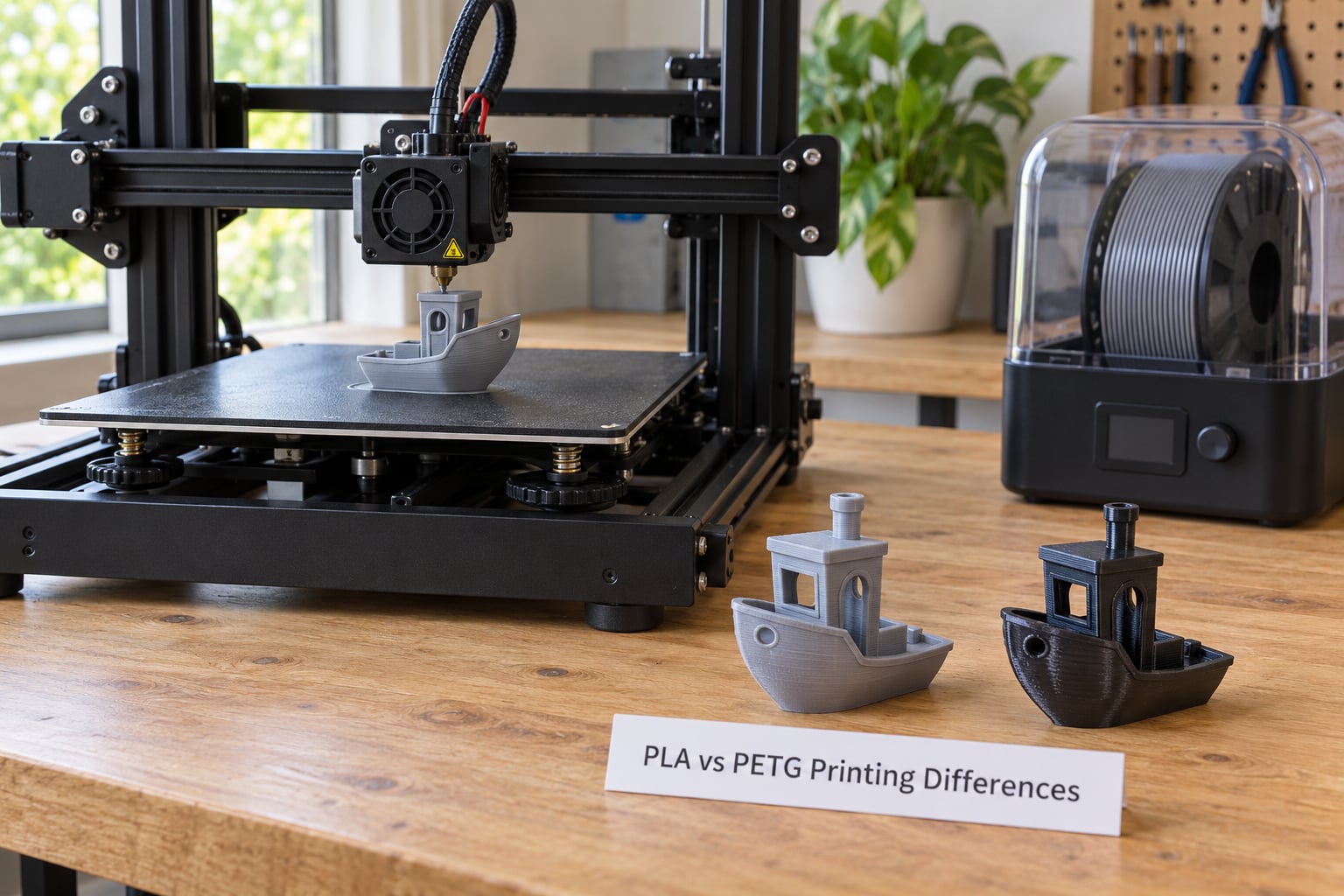
PLA and PETG feel completely different on the same printer. PLA flows at lower temperatures, cools solid almost instantly and releases from most plates without a fight. PETG needs a hotter nozzle and bed, resists rapid cooling, oozes between moves and grips build plates hard enough to pull coating with it.
PLA vs PETG Printing Differences by Setting
| Setting | PLA starting point | PETG starting point |
|---|---|---|
| Nozzle temperature | 200-215 °C | 235-250 °C |
| Heated bed temperature | 50-60 °C | 70-85 °C |
| First layer temperature | No extra heat needed | Add 5-10 °C to nozzle and bed |
| First layer speed | 20-30 mm/s | 15-25 mm/s |
| Part cooling fan | 100% from layer 2 | 30-50% for most layers, 0% on first layer |
| Maximum print speed | Up to printer capability | Typically 20-30% slower than PLA |
| Retraction distance | 0.4-0.8 mm direct drive | Often 0.3-0.6 mm, tune for stringing |
| Travel speed and acceleration | Standard | Raise to reduce stringing |
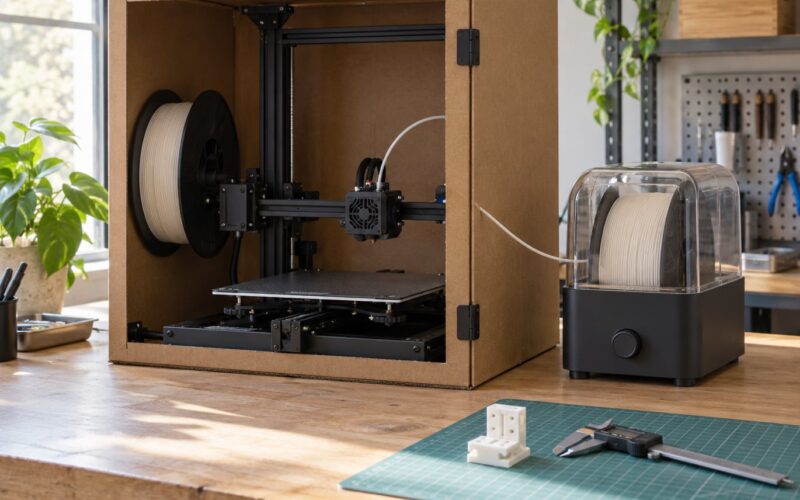
| Enclosure | Not required | Helpful for larger parts and drafty rooms |
| Drying before printing | Usually not needed | 60-70 °C for 4-6 hours recommended |
Always start from your filament supplier’s recommended temperature range. Brands tune their own blends, and a high-speed PLA or a reinforced PETG can sit well outside the generic numbers above.
Stringing is the complaint that comes up most from people switching from PLA to PETG. PETG runs at a higher temperature, so the melt in the nozzle stays fluid longer between layers and travels further during retraction and travel moves. In order of how often it works: drop the nozzle temperature a few degrees, reduce retraction distance, raise travel speed, and only then lower the volumetric flow limit.
Bed adhesion runs the opposite direction of what most people want. PETG bonds to smooth PEI and glass sheets aggressively, and a large flat base can tear the coating off the plate when it is removed. A glue stick as a release agent, a textured or powder-coated sheet, or scoring the surface with a silicone tool all work.
Cooling is the third big difference. PLA accepts 100% fan from the second layer and gets better bridges and sharper overhangs because it freezes on contact. PETG needs part cooling kept low, usually below 50%, or bridges droop and overhangs turn into blobs. Slower print speed with bridge acceleration enabled usually fixes more than any temperature change.
On moisture, PETG is hygroscopic, meaning it draws water from the air. Wet filament pops, bubbles, strings badly and prints at the wrong flow, and layer adhesion suffers first. Dry it at roughly 60-70 °C for 4 to 6 hours, let it cool sealed before opening, then keep it in a dry box with desiccant. Plain PLA is far less sensitive and rarely needs drying.
Heat, Flexibility, and Chemical Resistance
PETG handles heat better than PLA, which is the difference between a part that survives a parked car and one that deforms on a windowsill. PLA softens noticeably above roughly 50-55 °C and has a glass transition temperature around 55-60 °C. PETG sits higher, holding shape to roughly 70-75 °C with a Tg near 70-80 °C.
Flexibility follows from the same chemistry. PLA is rigid with a low elongation at break, typically 2-6%, and tends to fracture. PETG stretches further before yielding and bends rather than snapping, which is why living hinges, snap-fit joints and protective cases are usually made in PETG.
Neither material should be treated as food-safe or medical-grade by default. Layer lines harbour bacteria, additives vary by brand, and certification has to come from the supplier for a specific grade. Check the filament’s own documentation and follow local guidance for anything that touches food or skin.
Annealing offers a workaround for PLA in warm environments. Heating a finished PLA part in an oven pushes it above its glass transition so the molecules reorganise, raising heat resistance and stiffness. Xometry notes annealed PLA can exceed 80 °C, which beats standard PETG, though parts can shrink or warp during the process, so measure after treating.
Surface Finish, Precision, and Post-Processing
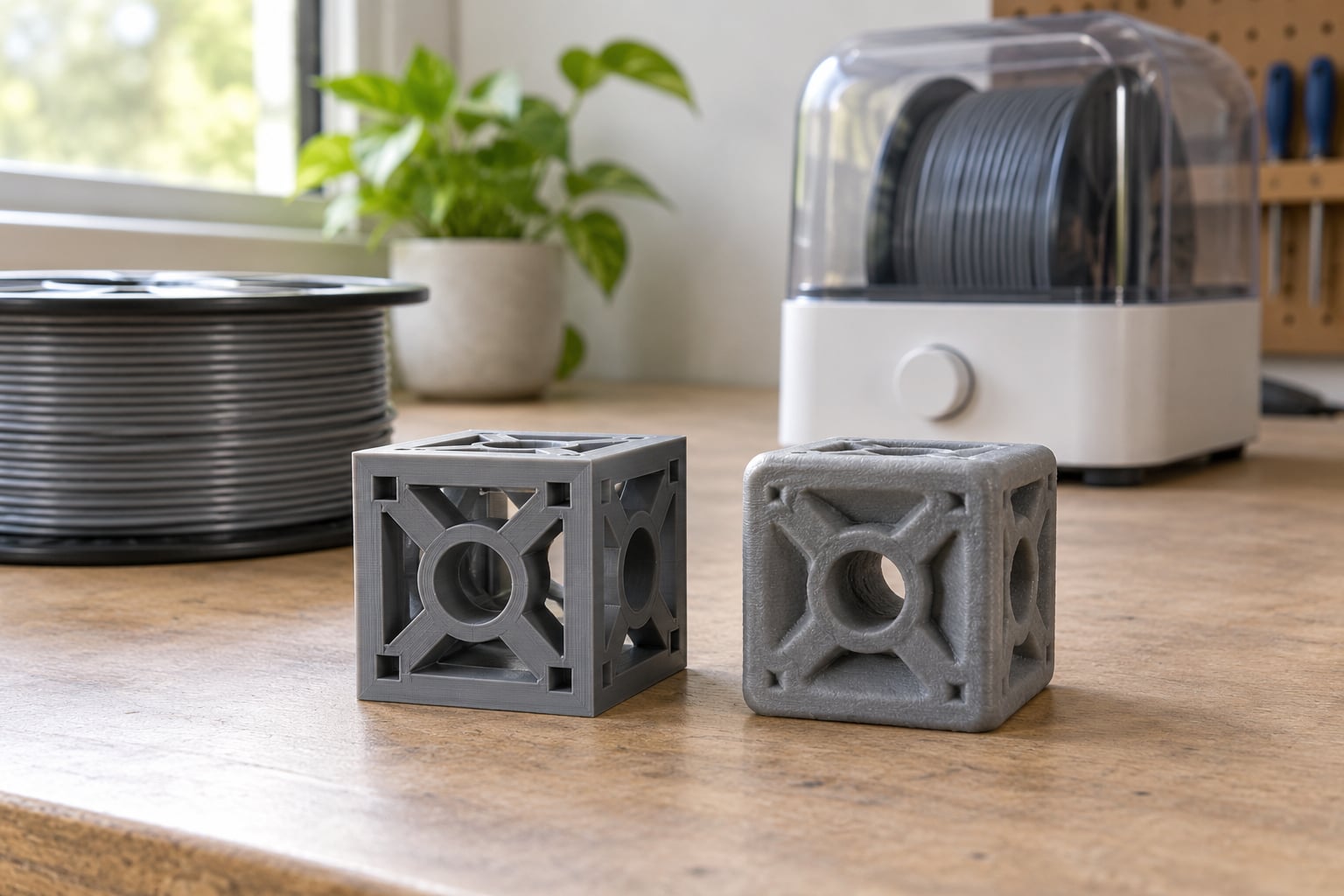
PLA finishes more cleanly. It sands, files and fills without smearing, takes paint and primer readily, and holds fine detail because it solidifies so fast that bridges and thin features stay sharp. That makes it the better choice for display models, painted props and fit checks where surface quality matters.
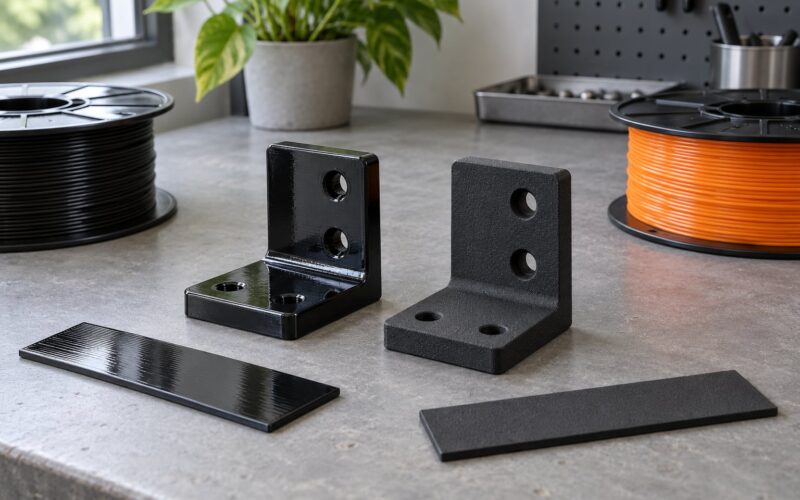
PETG has a naturally glossier finish that looks good straight off the printer, but the surface scratches easily and gums up abrasives, so sanding a PETG part wears down paper and bits quickly. Support removal also leaves visible scars, because PETG is soft enough to deform where supports touch it. Primer and paint adhere poorly compared with PLA.
Layer lines matter less than settings on both materials. A slow, well-cooled PLA print with proper first-layer pressure can look cleaner than a badly tuned PETG one at any speed. Fix the profile before blaming the filament.
Where PLA Wins
PLA wins on detail, finish and ease. Display models, figurines, vases and decorative parts come out sharp, and prototypes and dimensional checks benefit from the low warp and tight tolerances PLA delivers without much tuning.
It also wins for jigs, fixtures and toys that will be handled but not loaded. Because it prints at lower temperatures with minimal stringing and releases easily from most plates, it is the fastest material to get right, which matters most when you are iterating on a design.
Toughened and high-flow PLA variants narrow the gap. Impact-modified PLA holds up far better under load than standard PLA, and some annealed grades surpass PETG on heat resistance. If your PLA part failed because of a brittle break, a tougher grade may solve it without changing your whole workflow.
Where PETG Wins
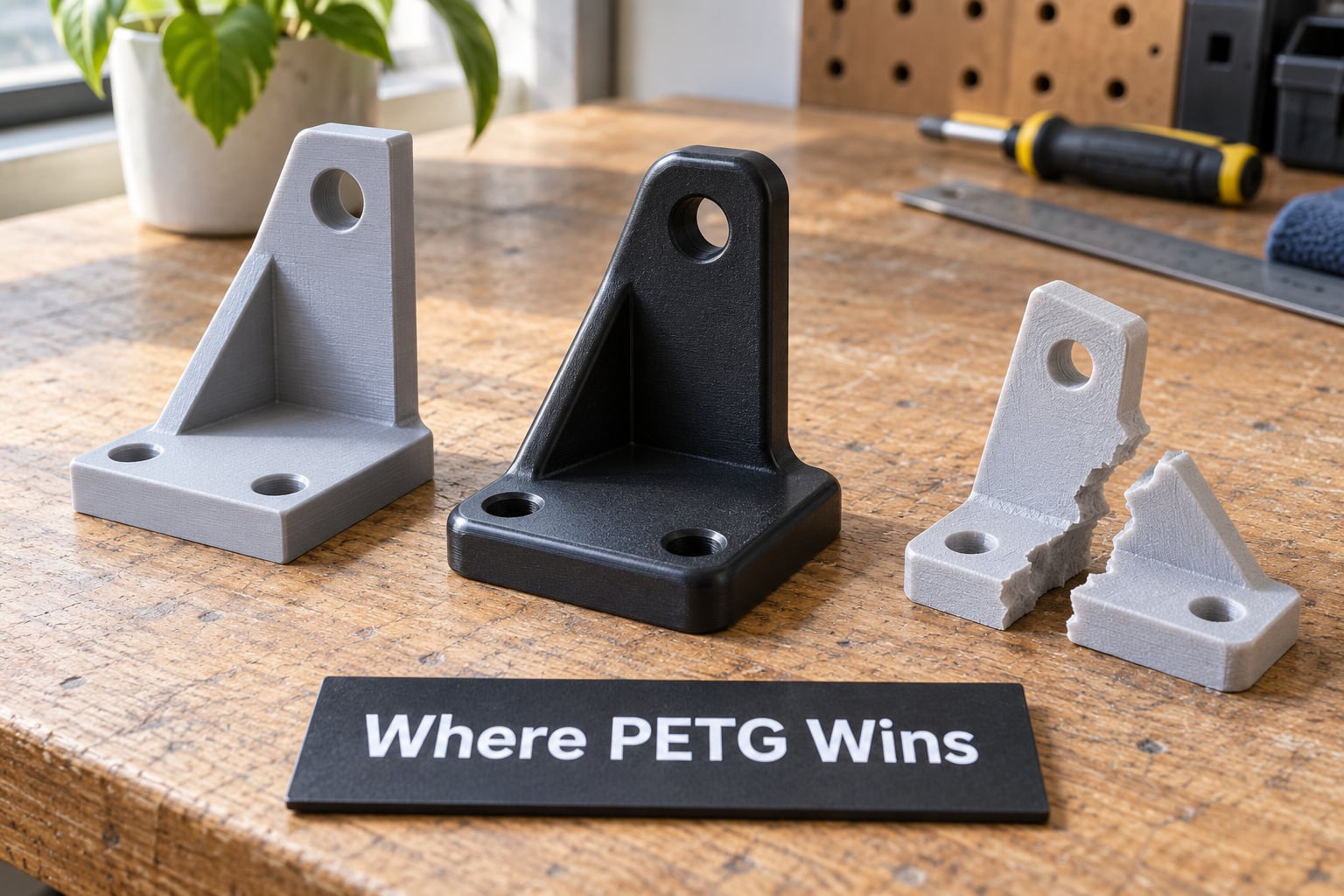
PETG wins where parts get handled, loaded, dropped or left outside. Brackets, clamps, hooks, hinges, snap-fit joints and phone cases are the classic list, because toughness and layer adhesion matter more than crisp detail for these parts.
It also wins anywhere heat or moisture shows up: car interiors, garden fixtures, workshop parts near heat, and anything that will be washed. Standard PETG also tolerates a wider range of printing conditions than high-flow PETG grades, which makes it the safer default when you cannot babysit the spool.
The practical PETG caution is speed and cooling. Printed hot and cooled aggressively it looks worse than PLA and can be weaker than expected. Printed slowly with restrained fan speed, it is the more capable material every time.
Which Should You Choose?
| If the part is… | Choose | Because |
|---|---|---|
| A display model, figurine or painted prop | PLA | Crisp detail and an easy finish |
| A dimensional check or fit prototype | PLA | Stiff, low warp, accurate |
| A jig, fixture or shop organiser | PLA | Fast to print and easy to sand |
| A hook, clamp or bracket under sustained load | PETG | Resists creep and sustained load |
| A phone case, clip or living hinge | PETG | Bends and absorbs impact |
| An outdoor or garden part | PETG | Tolerates moisture and weather better |
| Anything in a parked car or hot room | PETG | Higher heat deflection |
| A part near boiling liquid or real heat | Neither, consider PCTG or nylon | Both soften before that range |
Choose PLA when appearance, speed and low-stress use dominate. Choose PETG when the part will be handled, dropped, heated or left outside. For hybrid cases, prototype the geometry in PLA because it prints fast, then reprint the final part in PETG once the shape is right.
Two machine questions decide how well PETG will go: does your hotend reach the upper 230s, and can you control part cooling? A printer that cannot do both will produce PETG that droops and clogs, which people usually blame on the filament. Budget for a dry box or filament dryer early, because it changes PETG results more than any other accessory.
A simple checklist: if the part snaps, crack or deforms, switch to PETG. If it prints rough, stringy or detail-free, fix the profile before switching materials.
Frequently Asked Questions
Is PLA or PETG better for strong 3D printed parts?
PETG is the better choice for most strong parts because it absorbs far more impact energy, bends instead of snapping, and resists creep under sustained load. PLA has the higher tensile strength at roughly 50-70 MPa, so it wins in straight pulling loads and stiffness. Use PLA for models and prototypes, PETG for brackets, clips, hooks and anything handled, heated or left outdoors.
Does PETG bridge and print overhangs as easily as PLA?
No. PETG prints bridges and overhangs less easily than PLA because it stays molten longer, so gravity pulls sagging strands down. Print slowly, keep part cooling below 50% for most layers, enable bridge fan optimisation if your slicer has it, and lower the temperature a little if you still see droop. PLA solidifies on contact and forgives far more.
Can PETG be used outdoors or in hot environments?
PETG is the better of the two outdoors and in heat, holding shape to roughly 70-75 °C while PLA softens past 50-55 °C. For a parked car, a garden fixture or a warm room, PETG is the accepted community choice. Neither material is fully UV-stable forever, so check your supplier data and plan to reprint parts that see constant direct sun.
Do PLA and PETG need an enclosure for reliable printing?
PLA does not need an enclosure at all; it prints well in an open room. PETG benefits from one, mainly to block drafts on larger parts and to limit stringing from temperature swings. A heated build chamber is not necessary for either. If your printer has no enclosure, keeping the room still and the bed at 70-85 °C is usually enough.
Are PLA and PETG waterproof, and can either be recycled?
Both absorb small amounts of water, and neither printed part is watertight without sealing. PETG is more moisture-tolerant in service than PLA, but both can be hardened with epoxy or resin. PLA is bio-based and compostable only in industrial facilities; PETG is recyclable through specialist streams and is more widely collected in clean filament form. Check local guidance.
Conclusion
PLA is stronger when you pull on it in a straight line and better for crisp, low-stress models. PETG is stronger when a part is hit, bent, loaded or left in the heat, and it is the right default for functional parts.
Start by printing a small test coupon in whichever material the part needs, using your supplier’s recommended temperature range, and dry PETG before the first attempt. That one hour tells you more than any spec sheet.