Short answer: the PLA resin itself is a qualified food contact material, but a printed PLA cup or plate is not automatically food safe. It works for cold, dry, short-contact use with verified filament and a sealed surface, and it fails for hot liquids, dishwashers, and long-term contact. So is PLA food safe for cups and plates? Only under those conditions.
That distinction trips up most people, including a lot of experienced printers. Food safe filament and a food safe print are two different claims, and the gap between them is where the actual risk sits.
Below is the framework I use when someone asks me to look at a printed mug or a pet bowl: what the filament actually says, what the print looks like under a light, and where the part is going to be used.
Table of Contents
- 1Is PLA Food Safe for Cups and Plates?
- 2What Makes PLA Food Contact Risky?
- 3What PLA Can and Cannot Withstand
- 4Which PLA Filament Should You Use?
- 5How to check is PLA food safe for cups and plates claims
- 6How to 3D Print for Cleaner Food Contact
- 7How to Post-Process PLA Food Contact Parts
- 8How to Clean and Store PLA Cups and Plates
- 9Are Better Materials Available for Food Contact?
- 10When Should You Avoid 3D-Printed Food Contact Parts?
- 11Frequently Asked Questions
- 12Is natural PLA automatically food safe?
- 13Can PLA be used for food containers?
- 14Can PLA cups go in the dishwasher?
- 15Is PLA safe for plates with hot or oily food?
- 16What 3D printing filament is best for food contact?
- 17Conclusion
Is PLA Food Safe for Cups and Plates?
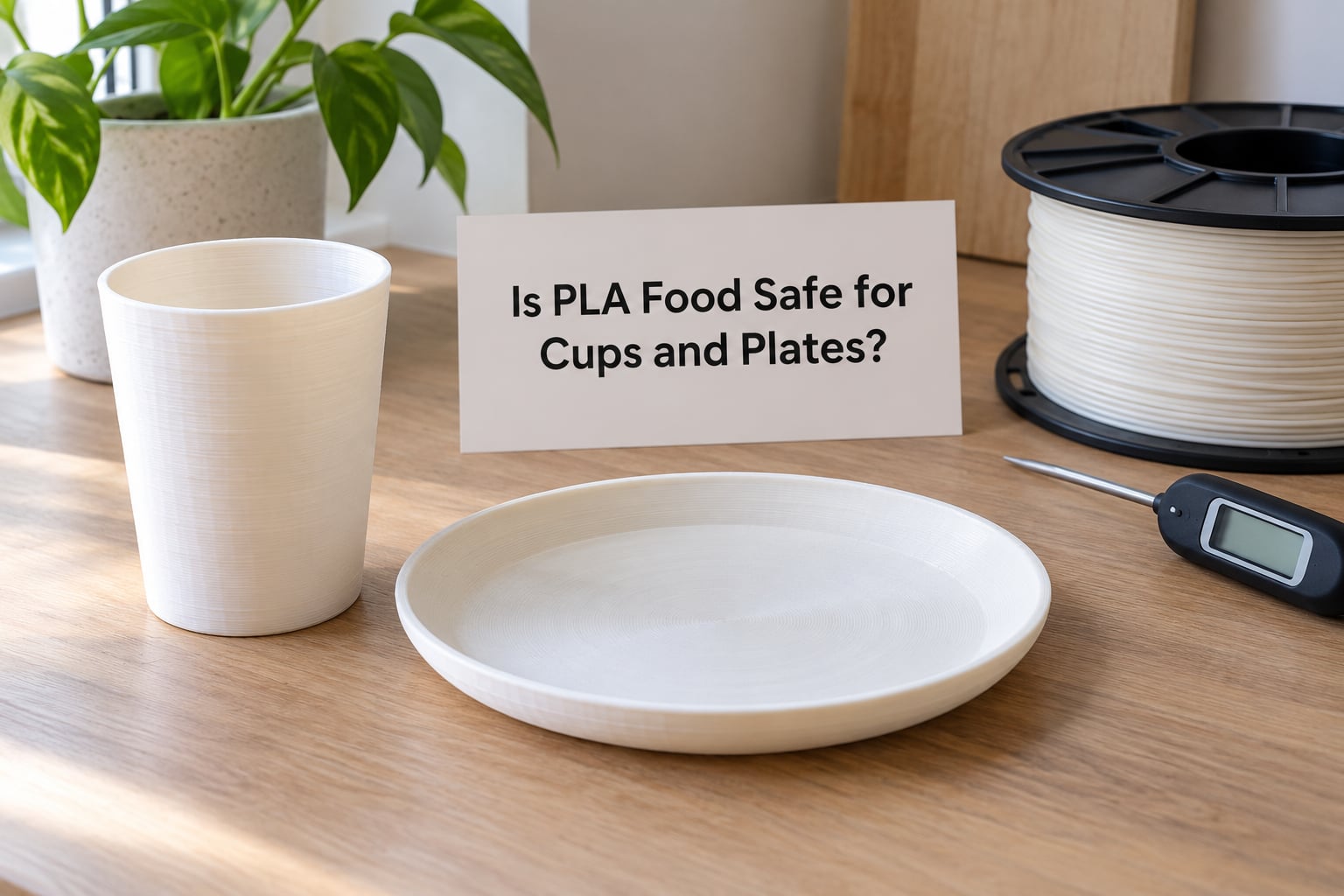
PLA can be used for some food contact prototypes when the filament is approved for that application, but an unmodified printed part should not automatically be treated as a food safe cup or plate. The complete system decides it: resin additives, printing conditions, surface finish, temperature, cleaning, and how often the part gets used.
A food contact material is a material intended to touch food or food packaging without transferring harmful amounts of substance to it. Poly(lactic acid) got its start as a compostable bioplastic made from renewable feedstock like corn starch or sugarcane, and a 1995 safety assessment found it generally recognized as safe with minimal migration of lactic acid.
Regulators in the US and EU work from lists of permitted food contact substances rather than a general approval of a whole product. That is why the polymer on your desk and the mug on your table sit in different regulatory categories.
What Makes PLA Food Contact Risky?
The resin is rarely the problem. Printing turns a qualified polymer into a shaped object with new surfaces, new voids, and new places for things to hide, and five risk families come out of that process.
- Additives, pigments, and impact modifiers. Natural unmodified PLA is one thing. PLA+ filament adds an impact modifier for toughness, and coloured filament adds dyes and pigments, and those additives may never have been evaluated for food contact at all.
- Porosity at and between layers. FDM builds an object out of bonded beads. Between them there are micro-voids and grooves that a sponge-free rinse does not reach, and biofilm settles into those crevices and stays there.
- Heat. PLA has a glass transition temperature of roughly 55 to 65 degrees Celsius depending on the formulation. Near or above that point the material softens, loses stiffness, and deforms.
- Process residues. FDM is lower emission than resin printing, but it is not zero. Emission studies have measured lactide release around 4 to 5 micrograms per minute during printing, which is why a part printed next to open food is a bad idea and why ventilation matters.
- Long-horizon migration. Time plus heat plus moisture plus fat or acid pushes more migration than a single short contact does. A part that survives a cold glass of water for an hour is not the same object after a year of daily use and washing.
The community summary of this is blunt: the small gaps, folds, and voids inherent in 3D printing are the actual risk, not the polymer. Threads on r/3Dprinting keep coming back to the fact that you cannot rinse an FDM layer gap in water hot enough to kill what lives in it, because water that hot would already distort the part.
There is a fair counterargument, raised often on the Bambu Lab forum: PLA is already used in mass consumer food packaging such as cups and cutlery, so single-use printed ware is not obviously worse. Both sides have a point, which is why the honest answer is conditional rather than a flat yes or no.
What PLA Can and Cannot Withstand
The table below is the working answer to is PLA food safe for cups and plates in most kitchens. Limits vary by manufacturer and by formulation, so treat these as the starting point and check your own filament data sheet.
| Use | Verdict | Why |
|---|---|---|
| Cold drinks, water, juice | Conditional yes | Below the glass transition temperature and short contact time; seal the surface and clean promptly |
| Hot coffee or tea | No | A 70 degree C drink pushes PLA past its glass transition range and softens the walls |
| Microwave | No | Unpredictable heating softens the part unevenly, and an unknown filament may not be rated for microwave energy |
| Dishwasher | No | Hot water plus detergent plus jet force drives layer separation and cracking over repeated cycles |
| Warm food, roughly 40 to 50 degrees C | Conditional | Works in a sealed coating, unreliable in bare printed PLA because you sit close to the softening point |
| Acidic food such as tomato or citrus | Discouraged | Acid increases migration and the surface degrades faster |
| Oily or fatty food | Discouraged | Fats act as carriers for migration and soak into rough printed surfaces |
| Dry goods, snacks, fruit bowls | Yes, usually fine | Dry and cool, low contact time, and the surface stays stable |
| Cutting boards | No | Knife scoring opens crevices, and washing does not restore them |
| Long-term daily tableware | No | Wear, wash cycles, and micro-cracking accumulate faster than a printed part can be replaced |
One myth worth killing here: a high melting point does not mean heat resistance. Nylon melts well above boiling water, yet its glass transition is around 47 degrees C, which makes it a poor choice for a hot drink vessel despite the impressive number.
Which PLA Filament Should You Use?
Start with the simplest possible rule: the least modified filament available. Unpigmented, unmodified natural PLA from a producer that publishes documentation gives you the shortest distance between the qualified resin and your print.
Watch for wording. Food contact safe, food grade, non-toxic, and certified are not interchangeable, and they are not all regulated the same way. A safety data sheet describes hazard handling for a chemical, not a finished food contact article, so reading one tells you about the raw material rather than the object.
How to check is PLA food safe for cups and plates claims
Run through this list before you print anything you intend to eat or drink from.
- Find the producer’s own food contact documentation, not just a marketplace listing. Look for a technical data sheet or a compliance page that names the regulation it is claiming.
- Check the regulatory frame. US producers reference FDA food contact rules under 21 CFR. European producers reference EU Regulation 10/2011 or an equivalent national implementation. Either is a usable reference frame; a bare logo is not.
- Ask for the third-party lab report and see whether it covers overall migration and specific migration testing rather than composition alone.
- Read the conditions of use. Temperature ceiling, contact duration, and whether the material is intended for single-use or repeated contact. A claim limited to cold, short contact still answers your question honestly.
- Confirm lot traceability so a safety complaint can be tied back to a batch.
- Read the additive list. If it is an impact-modified PLA+ variant and the producer does not address food contact, treat that as an unanswered question.
If a producer will not share any of this, you are guessing, and on a safety topic guessing is not a good trade for a nicer print.
How to 3D Print for Cleaner Food Contact
Settings cannot make an unsuitable filament suitable, but they decide how much surface your food touches. A cleaner print is a print with fewer voids, fewer cracks, and fewer places to hide.
- Clean the printer first. A cold pull or a filament change leaves crumbs on the build plate, and those crumbs end up printed into your part.
- Use a hardened or stainless steel nozzle. A brass nozzle wears and can pick up metal and lead from the plate over time, and printed abrasive filament accelerates that wear. For food contact parts, change the nozzle rather than reusing an old one.
- Run a separate print dedicated to food contact parts. A printer that regularly runs carbon fibre or glow-in-the-dark pigment is not the machine you want producing your child’s bowl.
- Lower the nozzle temperature to the low end of the recommended range and slow the print. Both reduce lactide emission during printing and slightly reduce stringing.
- Print solid walls, not sparse walls. Three to four perimeters with a modest top and bottom layer count close off the surface porosity that traps food.
- Keep the layer height moderate and make sure the part is fully solid where food will sit. A thin lattice wall next to a drink is a leak and a dirt trap.
- Dry the filament when the producer recommends it. Wet filament prints stringy, and stringing plus seams equals gaps.
- Let the part cool fully before handling. PLA stretches and deforms while hot, so peeling a cup off the plate too early bends it permanently.
Defects you can see are disqualifying. Look under decent light for visible layer separation, gaps at the rim or base, cold-pill lumps, blobs at seams, and any warp. Scratches do not heal, and a crack that reaches the inside surface is a channel straight into the wall of the part.
How to Post-Process PLA Food Contact Parts
Post-processing is what moves a PLA print from raw to plausibly food contact ready. It works in a fixed order, and skipping a step undoes the one before it.
- Outgas the finished part in a well ventilated space or a dedicated cure oven for 24 to 48 hours. This clears residual processing vapour before anything gets sealed against it.
- Sand the food contact surface wet, working through progressively finer grits, then rinse and dry fully. Wet sanding with no gaps in the process is easier to keep clean than dry sanding followed by a long clean.
- Wash with mild dish soap and cool water to remove abrasive residue from the sanding stage.
- Seal the surface. A thin food contact epoxy, such as Masterbond EP42HT-2FG, is the route experienced users describe as the point where they stop worrying. Generic hardware-store epoxy is not a food contact material.
- Cure the coating for the full time the coating manufacturer specifies. Users describe cure cycles running into days, and rushing it is how a coating ends up soft, sticky, or poorly adhered.
Be honest about what coating can and cannot do. Adhesion to PLA is a real question and some coatings sit on top rather than bonding, so a flexible or thin-walled part can craze where the coating is stiffer than the plastic underneath. A coating that is not rated for food contact does not become food safe because it is thin.
A clear coat on a good print helps. A clear coat on a contaminated or poorly printed part does nothing but seal the problem inside, and it cannot close the gap between layers that you never filled.
How to Clean and Store PLA Cups and Plates
Cleaning is where most printed food contact parts get quietly ruined. Wash soon after use with mild dish soap and cool or lukewarm water, and follow the filament or part manufacturer’s instructions where they differ from this.
Skip the dishwasher entirely, hot water, abrasive pads, and solvent cleaners. None of them help a printed surface and all of them open it up. Dry parts completely rather than stacking them damp, because PLA hydrolyses slowly in warm moisture and prolonged dampness shortens the life of a printed surface.
Replace a part when you see a crack, a deep scratch, a lifted layer, or a smell that was not there when it came off the printer. Forum users describe prints going brittle, cracking, and starting to smell after months of use, and the practical answer is to throw it away at that point rather than wash it again.
Are Better Materials Available for Food Contact?
Sometimes, and the honest comparison matters more than a single winner. No 3D printed material becomes automatically food safe just because the label says so, and every option below still needs a controlled process.
| Filament | Food contact notes | Usable temperature | Dishwasher |
|---|---|---|---|
| Natural PLA | Well documented as a food contact polymer | Glass transition roughly 55-65 degrees C | No |
| PLA+ | Impact modifier usually undocumented for food contact | Similar or slightly higher | No |
| PETG | Commonly qualified by producers for food contact | Around 70-80 degrees C before softening | Rated by some producers, verify per spool |
| Polypropylene | Stable, chemically inert, widely used for food packaging | Glass transition around 0 to 10 degrees C, melts near 160 degrees C | Often suitable, but it prints badly |
| ABS | Styrene emissions make it a poor first food contact choice | Glass transition near 105 degrees C | Not without care |
| ASA | Better UV and thermal stability than ABS, same emission concerns | Glass transition near 100 degrees C | Not without care |
| Polycarbonate | BPA-containing, requires drying, strong heat performance | Glass transition near 150 degrees C | Material tolerates it |
| Nylon | Hygroscopic, hard to print cleanly | Glass transition around 47 degrees C despite a high melt point | No |
| TPU | Flexible, tacky surface, difficult to clean | Moderate | No |
| Resin | Viable only after a full wash and UV cure cycle | Depends on the resin | Case by case |
Polypropylene is the one experienced users name most often as the genuinely microwave and dishwasher friendly choice. It is also expensive and warps badly, which is why it stays a specialist answer rather than the default.
Resin printing is the under-discussed option. A properly washed and fully UV cured part has a smooth, continuous surface with no layer lines, which removes the porosity argument that dominates the FDM debate. It is still only as safe as the resin, the wash, and the cure.
When Should You Avoid 3D-Printed Food Contact Parts?
There are situations where a printed part is simply the wrong tool, whatever the filament documentation says.
- Infants and toddlers. Anything a baby mouths or is fed from deserves a commercially certified item.
- People with chemical sensitivities or compromised immunity. If you are sensitive to additives or smells, you are a poor candidate for a filament whose additive list you have not seen.
- Hot food and hot drinks. The temperature argument does not change with better technique.
- Repeated dishwasher use. Coated or uncoated, the wash cycle is what ends the part.
- Permanent household tableware. Printed ware is a prototype material. It is not built for years of daily service the way a moulded cup is.
- Food allergies in the household. A rough, porous, difficult-to-clean surface is the wrong thing to rely on when contamination matters.
If you are printing pet bowls, the same logic applies with extra force. Pet owners raise the bacteria concern more than anyone, and a dishwasher is not a realistic part of that routine.
And if the part needs to serve paying customers, buy a certified item. A printed cup is not a certified food contact article, and that gap is a liability question as much as a safety one.
Frequently Asked Questions
Is natural PLA automatically food safe?
Natural, unpigmented PLA is the best-documented version of the resin, and its base polymer has been treated as generally recognized as safe since a 1995 assessment. That covers the raw material, not your finished cup. The filament still needs producer documentation for food contact, and the print still adds porosity, printing residues, and surface defects that the resin itself does not have.
Can PLA be used for food containers?
Yes for cold, dry, short-contact use with a verified filament and a sealed surface. A printed container holding dry snacks, fruit, or a cold drink is a reasonable use. Containers that hold hot, acidic, oily food, or that get washed repeatedly, are where printed PLA stops being sensible. Treat it as short-term ware rather than permanent storage.
Can PLA cups go in the dishwasher?
No. Dishwasher cycles combine hot water, detergent, and jet action, and printed PLA has a glass transition around 55 to 65 degrees C. Hot water alone softens the walls, and repeated cycles separate layers and open cracks that trap residue. Even a fully coated part will crack at the seams eventually. Hand wash with mild soap and cool water, and dry it fully.
Is PLA safe for plates with hot or oily food?
Warm food is tolerable only in a well-sealed part, and oily or acidic food is the harder case. Fats and acids act as carriers for migration and soak into a rough printed surface, which degrades faster than plain water does. Plates for dry or room-temperature food are fine. For anything hot, fatty, or acidic, use a commercially certified plate instead.
What 3D printing filament is best for food contact?
There is no automatic winner. Natural unmodified PLA has the clearest documentation, polypropylene is the most chemically stable and heat tolerant, and fully washed and cured resin gives the smoothest surface. Choose based on the temperature of the food, the contact time, and whether you can find real documentation for the specific spool in your hand, then print it carefully.
Conclusion
Start with the filament, not the print. Find real documentation for the spool in your hand, decide the actual use case, and if the temperature, the contact time, and the cleaning routine all fit inside what that documentation allows, print it slowly on a clean machine with solid walls.
Coat it properly if the surface is going to touch food repeatedly, cure the coating for the full time the manufacturer specifies, and hand wash it. If any part of the plan depends on hot liquid, a dishwasher, or years of daily use, buy a certified item instead of printing one.
Is PLA food safe for cups and plates? Conditionally, for cold and short use, with verified filament and a sealed surface. Anywhere past that, the honest answer is that a printed cup is a prototype, not tableware.