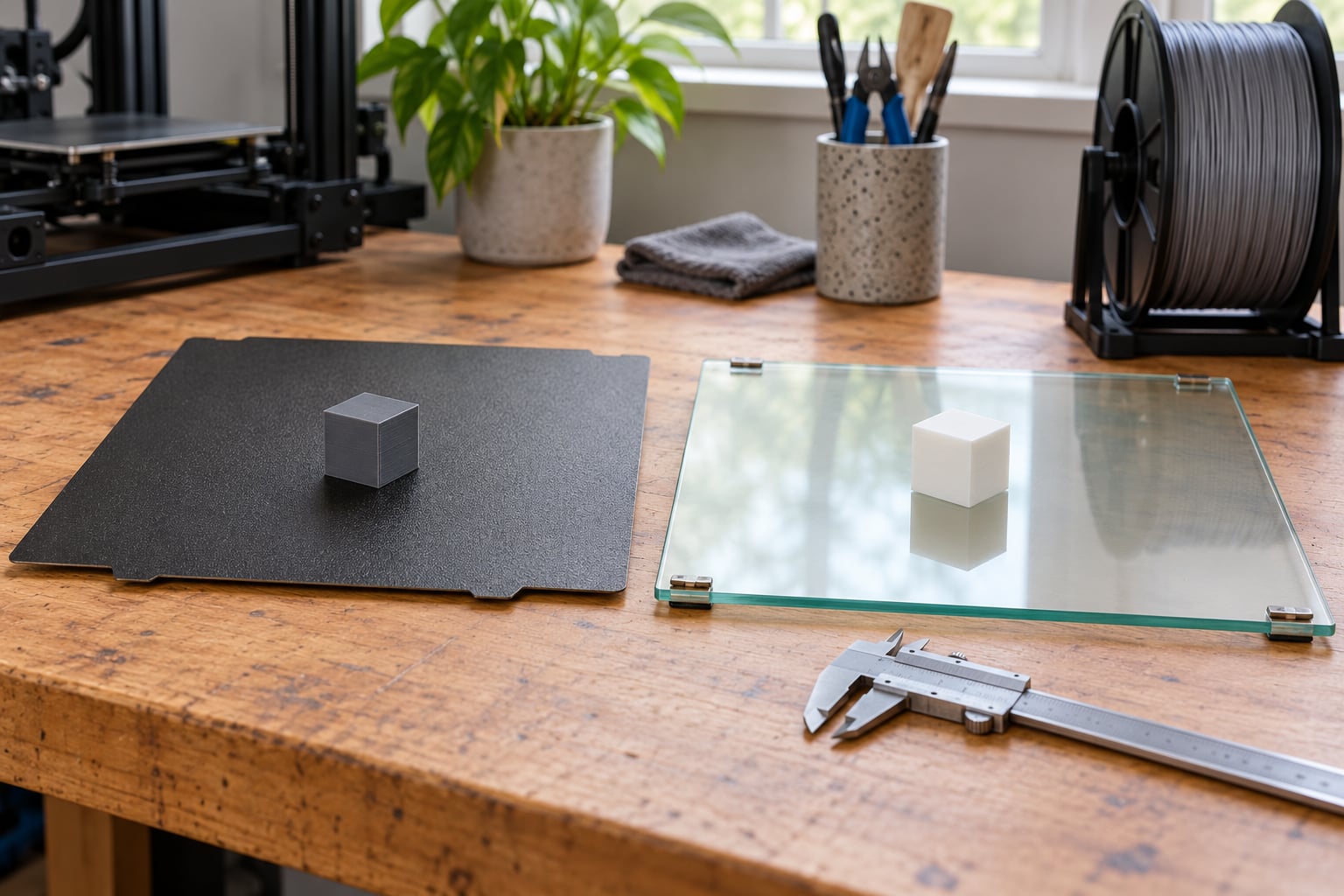
If you print mostly PLA and want parts that pop off in seconds without glue, a PEI sheet wins. If you want mirror-glossy bottom layers for cosplay armour and vase-mode pieces, and you only print now and then, a glass bed wins.
That is the short version of pei sheet vs glass bed for printing. Everything below breaks the comparison down by filament, temperature, maintenance and printer type so you can pick the surface your habits actually suit.
Neither surface is bad. Glass is flat, cheap and permanent. PEI is grippy, removable and needs an adhesive less often. The wrong pick for you shows up as failed first layers, chipped prints and a bed you keep scraping.
Table of Contents
- 1PEI Sheet vs Glass Bed for Printing at a Glance
- 2Print Adhesion and Filament Compatibility
- 3Why glue stick behaves in two opposite ways
- 4Textured and smooth surfaces grip differently
- 5PEI Sheet vs Glass Bed for Printing: Heat and Warping
- 6Surface Finish and Print Quality
- 7Durability, Maintenance, and Replacement
- 8Switching from glass to a PEI sheet
- 9Cost and Long-Term Value
- 10Which Should You Choose?
- 11Frequently Asked Questions
- 12Is PEI better than glass for FDM printing?
- 13Do I need glue for PEI or glass beds?
- 14Can a glass bed print ABS and ASA?
- 15Is textured PEI safe for high-temperature filaments?
- 16Why does my print lift from the bed?
- 17Is a smooth PEI sheet better than a textured PEI sheet?
- 18The Short Answer and What to Do First
PEI Sheet vs Glass Bed for Printing at a Glance
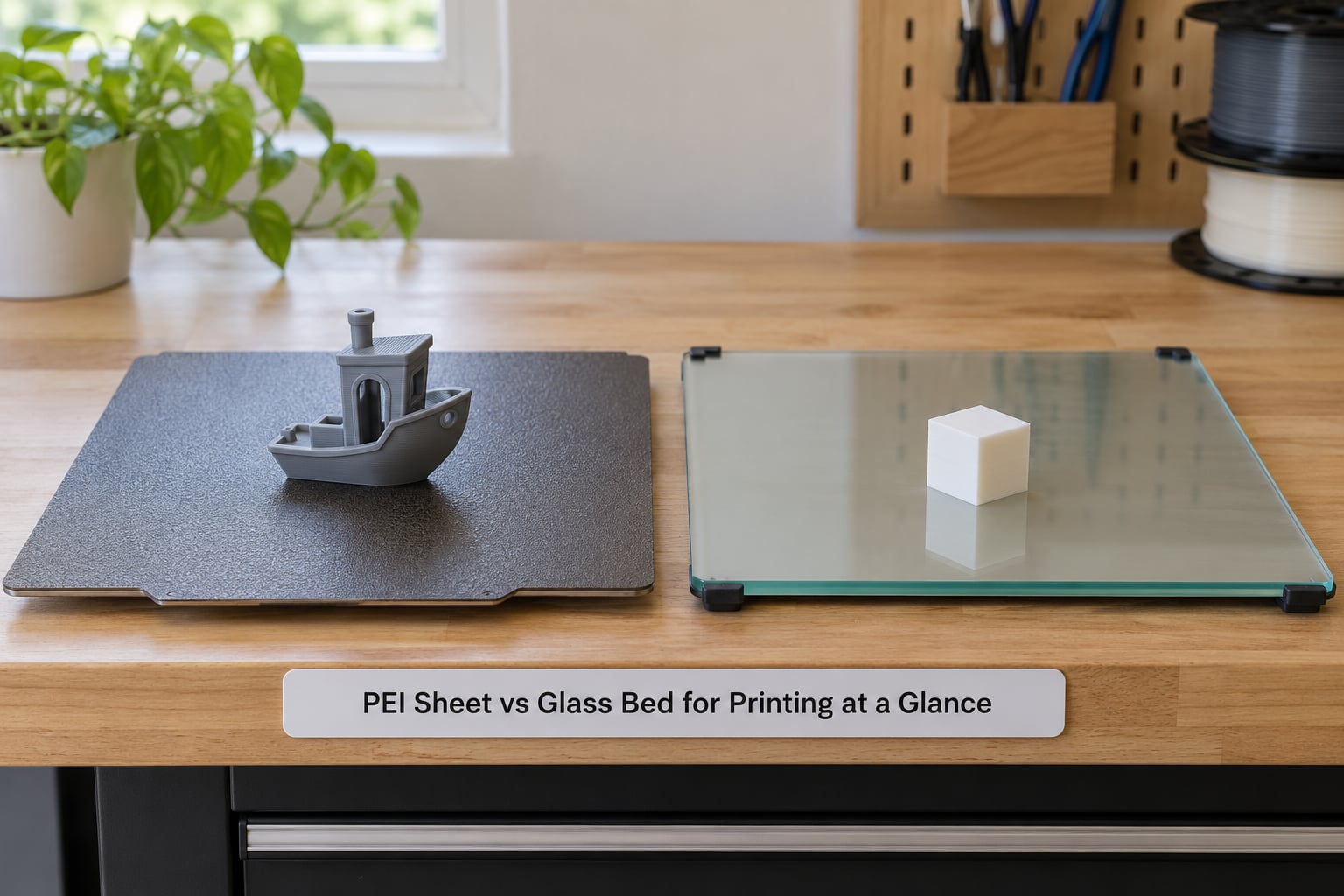
The table below covers the differences that actually change your print results. Everything else is preference.
| Criterion | PEI sheet (spring steel) | Glass bed (borosilicate or tempered) |
|---|---|---|
| Print adhesion with PLA | Excellent, no adhesive | Needs glue stick or hairspray |
| Adhesion with PETG | Strong, risks lifting the coating | Bonds chemically, can chip the glass |
| Adhesion with ABS and ASA | Strong at high bed temperatures | Weak, usually needs an adhesive slurry |
| Usable bed temperature | Runs hot without adhesive breaking down | Limited by the glue film |
| Print removal | Flex the sheet and it releases | Pry, soak or flex with risk of cracking |
| Flatness over time | Can develop a gentle bow | Stays flat for years |
| Bottom layer finish | Matte on textured, glossy on smooth | Glossy and smooth |
| Cleaning | IPA wipes, warm water for heavy grease | Same, plus easy visual inspection |
| Typical lifespan | Roughly 6 to 12 months of heavy use | Effectively unlimited |
| Best for | Multi-material and high-volume printing | Cosplay, display prints, light use |
Print Adhesion and Filament Compatibility
PEI sheet vs glass bed adhesion differs because the two surfaces do completely different jobs. PEI is a plastic that chemically bonds to hot thermoplastic while it softens. Glass is chemically inert, so it holds nothing until you give it something to hold on to.
Here is how that plays out filament by filament.
| Filament | On textured PEI | On smooth PEI | On glass |
|---|---|---|---|
| PLA | Holds well, no adhesive | Holds well, slightly easier removal | Glue stick works reliably |
| PETG | Very strong, may tear the coating | Very strong, tear risk on removal | Bonds to the glass itself |
| TPU | Good grip, watch for lifted corners | Good grip | Adhesive and patience needed |
| ABS and ASA | Best option with a hot bed | Works when the bed runs hot | Weak without an adhesive slurry |
| Nylon and composites | Strong, watch the surface wear | Strong but check for gaps | Adhesive only, abrasive wear |
Why glue stick behaves in two opposite ways
On glass, glue stick is an adhesion promoter. You apply a thin film, the bed heats, the glue softens and the part bonds to the film instead of the glass. The glue film is sacrificial, so you reapply it every few prints.
On PEI, the same glue stick acts as a release agent. PEI already grips harder than most people want, so a thin coat lets a PETG part come away cleanly instead of taking the coating with it. This inversion confuses almost everybody who moves from one surface to the other.
One r/FixMyPrint thread that comes up repeatedly frames the case for glass as maintenance and glue rather than print quality. That matches what I see: glass makes fine parts, it just asks more of you.
Textured and smooth surfaces grip differently
Texture gives mechanical keying for PLA and PETG, which is why textured PEI forgives a slightly under-heated bed. Smooth PEI relies more on thermal bonding, so it wants a hotter bed and a clean surface. Most double-sided sheets let you flip between the two per filament.
PEI Sheet vs Glass Bed for Printing: Heat and Warping
PEI tolerates higher bed temperatures than glass with adhesive. That single difference decides most ABS, ASA and nylon work.
ABS and ASA shrink as they cool, and that shrinkage pulls the corners up. A bed surface only helps warping by holding on through the whole cool-down, and glue film on glass gives out when the bed goes past about 60°C. Textured PEI keeps gripping at 90°C and beyond, which is why a TeamFDM user described textured PEI working very well for ABS “if you get it hot enough”.
Glass is a different story. Borosilicate expands slightly and so does the adhesive layer, and once the glue film slides, the whole first layer goes with it. Some users print ABS on glass using an ABS-and-acetone slurry instead, which works but is fussy and needs redoing every print.
Two practical limits to keep in mind. Warping is mostly an enclosure problem, not a bed problem, so a heated chamber or a tent does more than any surface swap. And hot filament plus a hot bed means styrene vapour from ABS and ASA, so run those in a ventilated room and never spray hairspray near a heated bed.
Surface Finish and Print Quality
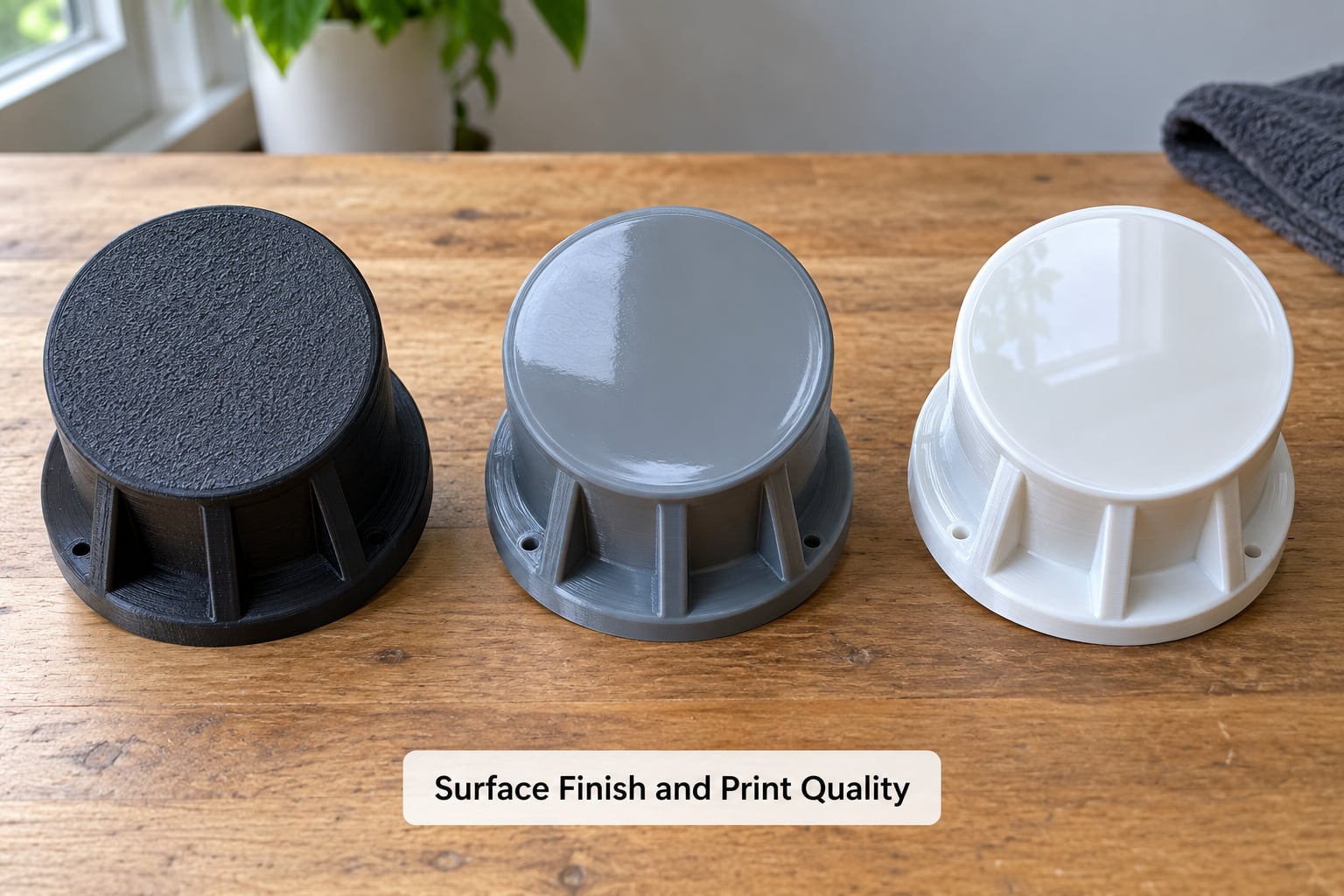
Glass gives the flattest, glossiest bottom layer of the three surfaces. That is its whole argument for anyone making cosplay armour, display pieces or anything that sits on a table and gets looked at.
Smooth PEI comes close but adds a faint plastic sheen, and textured PEI gives a matte, slightly grainy underside that hides scuffs beautifully and shows every layer line under raking light. Layer height changes that picture. At 0.2 mm and below, glass wins on flatness. At 0.28 mm with a wide layer width, the texture difference mostly disappears.
Vase mode exaggerates all of this because the outer wall is the print. If the vase is going on a shelf, glass or smooth PEI. If it is a shop item people handle, textured PEI hides fingerprints and scuffs better than either.
Detail suffers slightly on texture because the peaks and valleys change the effective first-layer contact. Files with small footprints, thin walls or a heavy first layer tend to look cleaner on glass. A brim on textured PEI solves most of it.
Durability, Maintenance, and Replacement
PEI wears out in the spot you print most. A high-volume seller on r/ender3v2 described running close to 100 hours a week and wearing through glass in the fixed spot where every product landed. On a flexible PEI sheet the same pattern eats the coating instead.
Cleaning routines are straightforward on both. Wipe PEI with isopropyl alcohol between prints, and drop to warm water and dish soap when oils build up. Do the same on glass. Neither surface likes being scraped with a metal spatula while hot, and that habit is what scratches glass and cuts textured PEI.
| Task | PEI sheet | Glass bed |
|---|---|---|
| Routine clean | IPA wipe after each print | IPA wipe after each print |
| Heavy grease | Warm water and dish soap | Warm water and dish soap |
| Most likely damage | Coating scratched by blades or nozzle crashes | Chipping from a pried print, cracks from impact |
| Warping risk | Sheet can bow over many heat cycles | Stays flat |
| Replacement | Drop-in magnetic sheet | Full plate or the whole bed assembly |
Switching from glass to a PEI sheet
Every switching question I see ends with the same answer: you re-level, because thickness changed. That part is unavoidable.
Switching from glass to a PEI sheet takes a few steps. First, remove the glass and clear any silicone bed spacers, since leftover silicone under a spring steel sheet causes a high spot at one corner. Second, fit the sheet and run a full bed mesh or four-corner level. Third, reset your Z-offset, because a spring steel plate sits differently than glass. Fourth, run a first-layer calibration in the centre and at all four corners. Fifth, print a small adhesion test square on each filament you use before you trust it with a real job.
Keeping two plates is possible, but you cannot skip step two when you swap. One user in a TeamFDM Voron thread asked the same question and the answer there was that textured PEI on the largest plates “just wasn’t doing it for me”, so they bought glass instead. On large formats, test before committing.
If you switch, you can drop a magnetic PEI sheet straight on most beds that already use a removable plate. Glass beds clipped to a fixed carriage need the hardware swapped, which is more work than the marketing suggests.
Cost and Long-Term Value
Prices move constantly, so treat these as relative tiers rather than fixed figures. Glass is generally the cheapest option, and it is often included with the printer. A basic smooth or textured PEI sheet sits above that, while magnetic spring steel plates and coated-glass options sit higher again.
Total value depends on the running costs underneath the purchase. A glass bed needs glue stick or hairspray on a regular cycle, which adds up quietly over a year of production printing. A PEI sheet needs almost nothing until the coating goes.
Then there is the replacement clock. Glass, in ordinary use, lasts indefinitely. Textured PEI is commonly quoted at roughly 6 to 12 months depending on use, and abrasive filaments shorten it further. Someone printing 100 hours a week should expect the coating to go first in the print zone and treat the sheet as a consumable.
Bed mass matters too. Glass is heavy, and on bed-slinger kinematics the extra mass shows up during rapid travel as a small loss of acceleration and deceleration. A flexible PEI sheet is light, so rapid and ramping prints feel more responsive.
Which Should You Choose?
Pick PEI if you are printing more than one material, mostly PLA with some PETG, or you change parts frequently and want them off in seconds. It is also the right call if you run ABS or ASA and want the bed adhesion to keep working at temperature.
Pick glass if you make cosplay armour, vases and display parts where the bottom layer gets seen, or if you print a few times a month and want hardware that will still be there in five years.
For a beginner, either works. Buy whichever plate your printer’s manufacturer supports natively, because Z-offset profiles and first-layer calibration come pre-tuned for it. That convenience outweighs any surface advantage.
If you print PETG regularly, keep glass or a smooth sheet as your dedicated PETG plate and a glue stick barrier on top, or you will pull the coating off with the part. The practical move most experienced users settle on is one of each plate, since they are both inexpensive compared with a failed print.
Frequently Asked Questions
Is PEI better than glass for FDM printing?
For most FDM users, yes, because PEI grips PLA, PETG and ABS without adhesive and lets you flex the part off in seconds. Glass still wins for mirror-glossy bottom layers and for anyone who prints rarely and wants hardware that lasts indefinitely. The right answer depends on your filaments and how often you print.
Do I need glue for PEI or glass beds?
You need glue or hairspray on bare glass, reapplied every few prints because the film is sacrificial. Textured PEI needs nothing for PLA and most PETG. On PEI, glue stick is sometimes used in reverse as a release agent so a strong part like PETG does not tear the coating when you pull it.
Can a glass bed print ABS and ASA?
Technically yes, practically it is hard. The glue film that holds PLA softens and lets go at the bed temperatures ABS needs, so the corners lift as the part shrinks. You can print ABS on glass with an ABS and acetone slurry, but a textured PEI sheet grips reliably at high temperatures and is far less fiddly.
Is textured PEI safe for high-temperature filaments?
Textured PEI handles the bed temperatures high-temperature filaments need, including ABS, ASA and nylon, and it keeps gripping as the bed heats. Wear a respirator when printing styrene-based materials and ventilate the room. Never use hairspray near a heated bed, since the aerosol is flammable.
Why does my print lift from the bed?
Start with surface cleanliness, since fingerprint oils create dead spots on PEI and dust defeats glue film on glass. Then check Z-offset, because too high a nozzle leaves gaps and too low scrapes. Raise bed temperature, add a brim, clean the plate with isopropyl alcohol and give the room a draft shield or an enclosure.
Is a smooth PEI sheet better than a textured PEI sheet?
Textured PEI grips better and forgives a slightly cool bed, which makes it the safer default for PLA, PETG and ABS. Smooth PEI gives a glossier bottom layer and is kinder to fine detail and small footprints. Most double-sided sheets let you flip sides per filament, so you do not have to choose for good.
The Short Answer and What to Do First
PEI sheet vs glass bed comes down to whether adhesion or finish matters more to you. Multi-material and high-volume printing is better served by a textured PEI sheet. Cosplay, vase mode and occasional parts are better served by glass.
Do this first: print a small test square on your current surface, then switch plates and print the same file again. Comparing the same file on both surfaces tells you more than any table, including the one above. Update your Z-offset and run a mesh level after every change, and you will avoid most of the disappointment this swap causes.