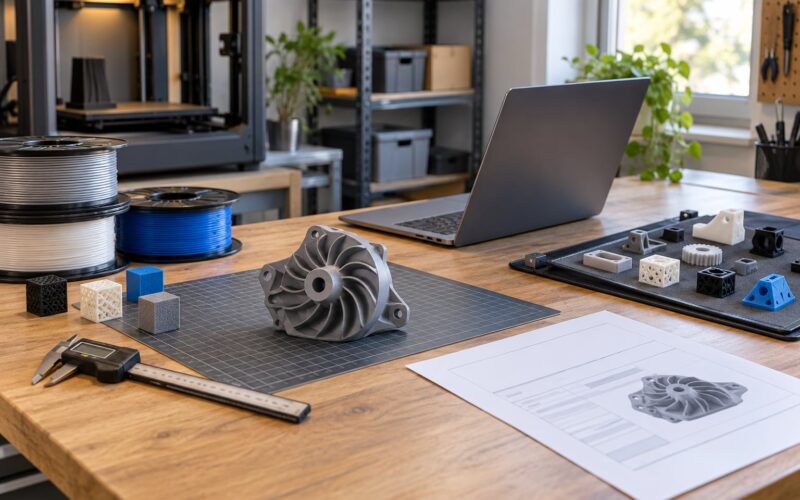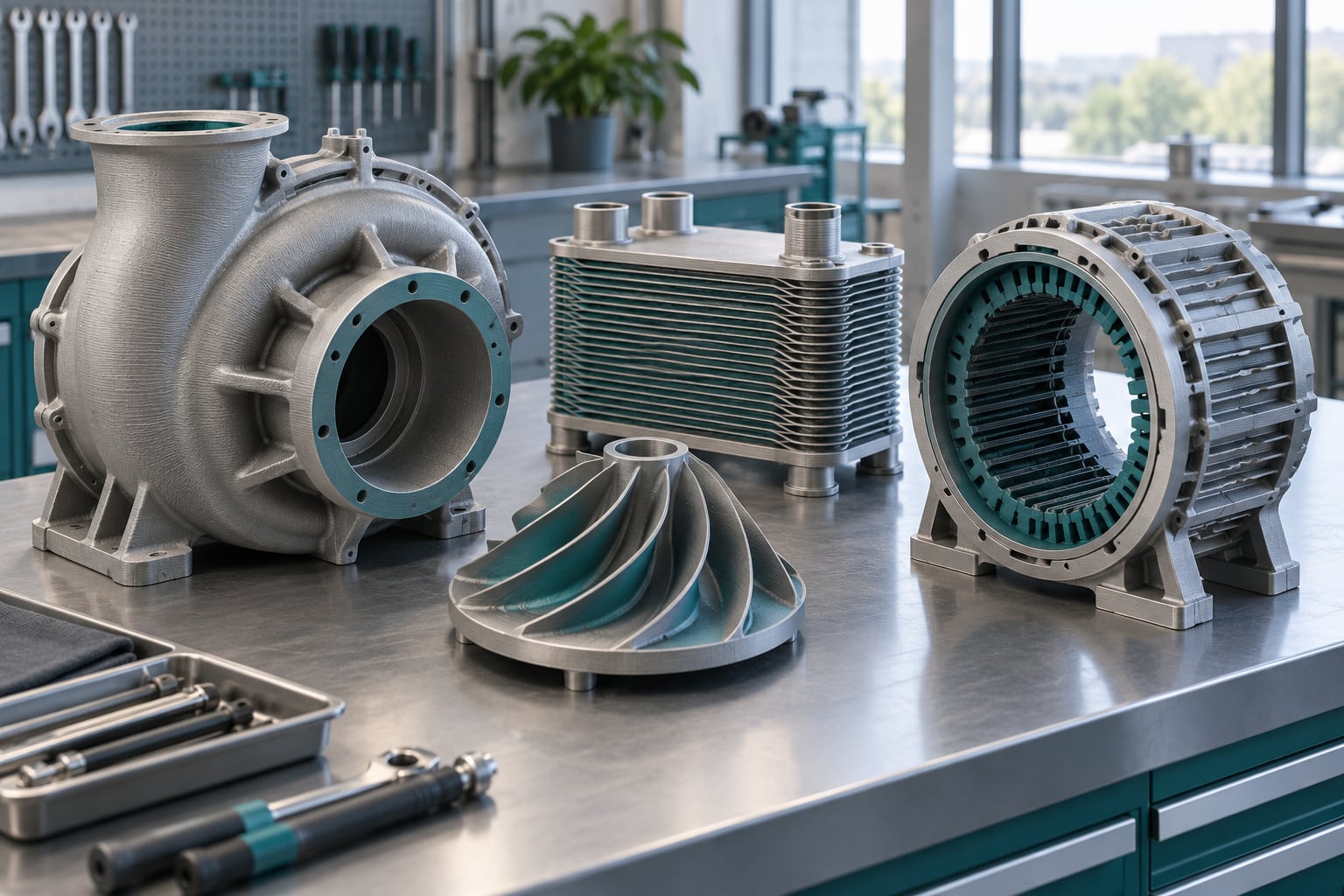
Additive manufacturing in the energy industry means using 3D printing to build energy equipment components layer by layer from metal powders, polymers or concrete. It is used for gas turbine parts, oil and gas spare parts, hydrogen electrolyzer hardware, nuclear internals, wind turbine tooling and grid equipment. Its value is not speed alone: it removes moulds, cuts part counts and lets operators print replacement parts close to the asset instead of shipping them across the world.
Adoption has been real but uneven. Metal 3D printing is now routine for prototypes and increasingly common for flight-critical turbine and downhole hardware, while certification and surface finish still block it from pressure-retaining and fatigue-critical work. The rest of this guide covers how the process works, where it earns its keep, what it costs you to adopt, and how operators are getting parts qualified.
Short version for anyone in a hurry: the strongest use cases today are complex, expensive, low-volume parts where lead time and design freedom matter more than unit cost. Casting and forging still win on high-volume, simple shapes.
Table of Contents
- 1What Is Additive Manufacturing in the Energy Industry?
- 2How Does Additive Manufacturing Work for Energy Applications?
- 3How Additive Manufacturing in the Energy Industry Is Used
- 4Where Is Additive Manufacturing Used in Energy?
- 5Which Materials and Printing Processes Suit Energy Work?
- 6What Benefits Does Additive Manufacturing Deliver?
- 7What Challenges Limit Widespread Adoption?
- 8How Can Energy Companies Implement Additive Manufacturing?
- 9Frequently Asked Questions
- 10Is additive manufacturing safe for critical energy infrastructure?
- 11Which additive manufacturing materials are used in the energy industry?
- 12Can additive manufacturing reduce the cost of energy components?
- 13Are 3D-printed parts approved for oil, gas, and power generation?
- 14Will additive manufacturing make energy production more sustainable?
- 15Conclusion
What Is Additive Manufacturing in the Energy Industry?
Additive manufacturing builds an object by adding material in successive layers from a digital 3D model. In the energy sector that means metal powders such as nickel superalloys, stainless steel and titanium are melted or bound layer by layer to make parts that then go into turbines, wells, reactors, electrolyzers and substations.
The contrast with conventional methods is simple. Casting pours metal into a mould, forging hammers a billet into shape and machining removes material from a solid block. Each needs tooling, and each constrains geometry: no undercuts, no enclosed channels, no lattice infill. Additive manufacturing has no mould, so the only real limits are the size of the build chamber and the physics of the material.
That matters in energy because the parts that drive the most downtime are often the ones conventional methods handle badly: obsolete gas turbine blades, downhole tools no one casts any more, pump impellers with curved internal passages, and subsea manifolds with dozens of connections.
Where the technology sits today spans four levels of maturity: rapid prototyping and design iteration, qualification of spare parts for existing equipment, direct production of new components, and in smaller pockets, printed subsystems such as complete heat exchangers and structural concrete.
How Does Additive Manufacturing Work for Energy Applications?
The workflow is closer to a quality assurance process than a factory shortcut. Every step has to be documented for a part that will end up inside a pressure boundary.
- Digital design. The part is modelled in CAD, often with design for additive manufacturing rules applied: overhang angles, support strategy, and deliberate consolidation of brackets and fasteners into a single item.
- Material selection and powder certification. You pick an alloy the specification already recognises, ideally one with published mechanical property data. For energy work that usually means Inconel 718, 316L stainless steel or Ti-6Al-4V.
- Build preparation. The build file is sliced into layers, supports are generated, and a parameter set is locked. Changing any of those parameters reopens the qualification argument.
- Printing. The machine deposits or fuses layer by layer under a controlled atmosphere. Powder bed fusion machines spread a thin layer of powder and melt it with a laser or electron beam; deposition machines feed wire or powder straight into a melt pool.
- Post-processing. Parts come off the machine rough, stressed and covered in powder. They go through stress relief, heat treatment, support removal and machining of sealing surfaces.
- Inspection. Density and internal soundness are checked with computed tomography, ultrasonic testing or metallography, plus mechanical coupon testing per build.
- Integration. The finished part is coated, assembled and installed, then tracked in service so failure data feeds back into the qualification file.
How Additive Manufacturing in the Energy Industry Is Used
Industry bodies classify additive manufacturing into seven main process families. Most energy work uses the first four.
- Powder bed fusion (LPBF, EBM, DMLS). A laser or electron beam selectively melts metal powder. The workhorse for turbine parts, impellers and downhole tools in Inconel 718, 316L and titanium.
- Directed energy deposition (DED). Wire or powder is fed into a melt pool from a nozzle. It handles larger parts, cladding, repair and build-to-part deposition, and is the process most cited for nuclear work.
- Wire arc additive manufacturing (WAAM). A DED variant using welding wire, with high deposition rates for near-net-shape large structures and dimensional accuracy sacrificed for speed.
- Binder jetting. Metal powder is bound with a liquid then sintered. Fast and low-distortion, common for low-volume production and lattice parts, but the sintered parts usually need machining and infiltration.
- Material extrusion (FDM). Thermoplastic filament or pellets are laid down, used for polymer tooling, ducts, insulators and composite layup patterns on turbine and blade molds.
- Polymer and composite printing. Large-format printers produce glass-fibre reinforced blade molds, radomes and fairings that would be prohibitively expensive to machine.
- Concrete and large-format additive manufacturing. Cementitious material is extruded to build wind turbine foundations, anchors and subsea structures where formwork would otherwise dominate cost and time.
Where Is Additive Manufacturing Used in Energy?

Applications in energy tend to sort by component, not by sector, because the same impeller design shows up in gas turbines, compressors and pumps. Here is where the technology has real deployments.
| Application area | What gets printed | Typical materials | Why it fits |
|---|---|---|---|
| Gas turbines | Combustor liners, nozzle guide vanes, transition pieces, impellers, casings | Inconel 718, 625, Hastelloy X | Conformal cooling channels that casting cannot form, cutting cooling air demand |
| Heat exchangers | Compact core units, tube sheets, manifolds | 316L, aluminium alloys, titanium | High surface area per kilogram; small footprint |
| Burners and fuel systems | Fuel nozzles, swirlers, premixers | Nickel superalloys | Internal mixing geometry with no machined counterparts |
| Generators and motors | Housings, stator supports, cooling jackets | 316L, 17-4PH | Consolidation of castings and brackets into one item |
| Wind turbines | Tooling, molds, nacelle covers, blade root inserts, anchors | Tool steel, composites, concrete | Cheap iteration of molds and large parts that exceed machine tool envelopes |
| Transmission equipment | Transformer bushings, switchgear enclosures, insulator cores, cooling ducts | 316L, epoxy and composite resins | Complex insulator shapes with no tooling and short runs of custom geometry |
| Oil and gas | Downhole tools, valve bodies, impellers, subsea manifolds, seals | Inconel 718, 316L, maraging steel | Obsolete spare parts reprinted on demand; wear-resistant cladding |
| Nuclear | Reactor internals, shield blocks, channel heads, repair overlays | 316L, low-alloy steels, Inconel 625 | DED builds and repairs large structures with low distortion |
| Hydrogen | Electrolyzer bipolar plates, stacks, manifolds, balance-of-plant skid parts | 316L, titanium, nickel alloys | Thin flow fields and complex stack hardware at low volume |
| Fuel cells | Bipolar plates, flow fields, cooling plates, end plates | Stainless steel, titanium, graphite composites | Fine channel patterns and fast changes to flow-field design |
Several named deployments show how far this has moved. Siemens Energy has used metal additive manufacturing in its SGT-9000 HL gas turbine class, with the printed combustion hardware tied to a record efficiency figure reported at the Keadby plant in the UK. Shell’s Amsterdam technology centre holds a best-practice qualification for its powder bed fusion facility, which practitioners on engineering forums cite as the real unlock rather than the printer itself.
Siemens Gamesa and Vestas have both publicly worked with printed tooling and blade mold components, and Orbital Composites pushed large composite additive manufacturing into wind blade work. Offshore, operators have reprinted obsolete downhole tools and subsea components on demand, and the DOE and America Makes have both funded qualification programmes intended to move printed parts out of the prototype bin and into regulated production.
Hydrogen is the quieter story. Bipolar plates and electrolyzer stack components are geometrically awkward, produced in modest volumes, and needed in many slightly different configurations per project, which is exactly where printing earns its cost back.
Which Materials and Printing Processes Suit Energy Work?
Material choice is where most energy projects are won or lost, because the alloy has to exist in the operator’s specification before the geometry becomes interesting.
Nickel superalloys. Inconel 718 and 625 dominate hot-section work, burners and well components. They keep strength at high temperature and resist oxidation and sour-service corrosion. Powder bed fusion is standard; DED handles larger parts and repair.
Stainless steels. 316L covers valves, manifolds, fuel cell hardware and general corrosion service, and has the deepest qualification data of any AM alloy. 17-4PH is common for stiff, machined-then-printed parts.
Titanium alloys. Ti-6Al-4V gives a very high strength-to-weight ratio at low density, which matters for rotating and downhole parts. It is expensive per kilogram and unforgiving of process variation, so tight monitoring pays off.
Cobalt-chromium and maraging steels. Cobalt-chromium suits high-wear downhole and valve trim. Maraging steels give near-zero distortion during post-processing, useful when dimensional accuracy comes from machining finished features.
Polymers and composites. Glass-fibre reinforced thermoplastics and printed composites handle molds, ducts, covers and radomes. Cost per part stays low and lead times are days, so the economics work even at volume.
Concrete and ceramics. Cementitious extrusion makes turbine foundations and anchors without formwork. Ceramic and functionally graded materials show promise for heat shields and insulators but remain largely research-stage.
One practical rule from practitioners: pick a material with published mechanical property data before you pick a process. Everyone has data on Inconel 718 in laser powder bed fusion. Almost nobody has it on the alloy your supplier prefers.
What Benefits Does Additive Manufacturing Deliver?
The benefits fall into three groups: what happens to the part, what happens to the schedule, and what happens to the inventory.
Geometry and performance. Conformal cooling channels follow the gas path instead of running straight through a casting, which lets a turbine run hotter with less cooling air. Lattice structures add stiffness at low weight. Integrated manifolds replace a bolted assembly of dozens of parts with one item, cutting leak points and assembly labour.
Lead time. A small impeller that takes months to source through casting can come from a machine in days. For equipment where an hour of idle time is expensive, that difference converts directly into money.
Supply chain and inventory. Printed spares replace warehouse stock with digital inventory. Operators report avoiding shipping, customs handling and long lead times on obsolete parts, and the same digital model serves several asset classes.
Here is how the three routes compare for energy components:
| Factor | Additive manufacturing | Casting | Forging |
|---|---|---|---|
| Lead time for a low-volume part | Days to weeks | Weeks to months | Weeks to months |
| Tooling cost | None | Mould required | Die required |
| Internal geometry | Any enclosed channel or lattice | Limited by cores and draft | Limited by die geometry |
| Part consolidation | High, merging brackets and passages | Moderate | Low |
| Unit cost at high volume | Higher | Lower | Lower |
| Material utilisation | High, most powder is reused | Loss to sprues and gating | Loss to flash and cropping |
| Surface finish as built | Rough, needs machining for seals | Good, requires finishing | Good |
| Certification path | New codes still maturing | Mature, decades of data | Mature |
| Best fit | Low volume, complex, obsolete spares | High volume, simple shapes | High strength, simple shapes |
Maintenance and repair. DED puts metal back exactly where it is missing. A damaged turbine casing or a worn flange gets clad and remachined instead of replaced, which shortens outages and cuts material waste.
Development speed. Engineers iterate on cooling and flow designs in days rather than waiting for a foundry. For hydrogen and fuel cell developers racing to improve stack efficiency, that iteration speed is often worth more than the part cost.
What Challenges Limit Widespread Adoption?
Nobody in the practitioner communities is arguing that 3D printing failed. What they argue is that vendors sell it as solved when the hard parts are still paperwork, inspection and surface finish.
Certification is the rate limiter. Practitioners report that material and machine qualification takes far longer than printing the part. Approval by one regulator rarely transfers to another, and each class of equipment wants its own qualification file.
Surface finish. As-built roughness makes printed parts unacceptable for sealing surfaces without machining, which eats into the time and cost advantage. Engineers on machining forums are blunt about this: you still pay for the finish.
Anisotropy and repeatability. Layer-by-layer build creates directional properties, and small changes in parameters or powder lot shift results. Every build needs mechanical coupons and monitoring to confirm it met the same properties as the last one.
Build volume and geometry. Not everything fits in a chamber. Very large parts need deposition or large-format processes, and overhangs in certain directions still force support structures that add post-processing.
Inspection. Internal porosity and lack of fusion are hard to guarantee without specialised non-destructive testing, and that gap creates liability questions that insurers and regulators ask about early.
Cost structure. Metal powder is expensive and partly single-use, machines are capital-heavy, and post-processing plus inspection can exceed the printing cost. For small operators, a service bureau is usually the sensible first step rather than buying hardware.
Cultural resistance. Energy operators describe a race to be second: they adopt a process once a peer has proven it. Drilling technology is roughly a century old and institutionally conservative, and AM tooling is new, so skills are mismatched.
Data and intellectual property. Service bureaus are cautious about who owns and can reverse engineer the design files for critical components, and operator teams frequently find out late how much of the process their own engineers do not understand.
The sustainability argument cuts both ways. Fewer parts and less shipping sound green, but metal powder bed fusion draws real power per kilogram. Practitioners on the forums ask for life cycle assessment figures that vendor marketing conveniently leaves out, including the unused powder stream.
How Can Energy Companies Implement Additive Manufacturing?

A staged path avoids the usual mistake, which is buying a machine before knowing which parts you want to print with it.
- Pick two or three candidate parts. Choose components that are low volume, geometrically complex, expensive to store, and whose failure would be operationally costly. Obsolete spares and small impellers are ideal first targets.
- Run the total cost comparison honestly. Compare against casting and machining including post-processing, inspection, coating and logistics, not just the machine time.
- Decide machine versus service bureau. Machines make sense at steady volume with in-house engineering depth. A qualified bureau makes sense for everything below that, and often for testing the business case first.
- Qualify the supplier before the part. Ask for machine and process qualification records, material certificates with mechanical property data, and NDE capability. Any provider that cannot supply these cannot support a pressure application.
- Work through the standards. Map your part to the relevant codes, including ASTM and ISO standards for additive manufacturing materials and methods, ASME for pressure equipment, API for oil and gas, and class society rules such as DNV or ABS for marine and subsea work.
- Test the qualification ladder. Build from material specification to machine qualification, then process qualification, then the specific part, then operator approval. Each rung needs its own evidence.
- Run a pilot and measure. Pick two or three real maintenance events, track downtime, lead time and failure-free service hours, and compare against the conventional part.
- Train the organisation. Engineers, inspectors and maintenance staff all need time. The commonest failure mode is a print that arrives with no inspection plan and no budget to qualify it.
- Scale only what measured well. Once pilot parts have run a full duty cycle without surprises, widen the part list and consider onsite printing at remote or offshore assets.
One caution on timing. Contracts in this sector are short and payback windows are tight when energy prices swing, so a business case that depends on five-year savings rarely survives a capital committee. Start with parts where the saving shows up in the first operating cycle.
Frequently Asked Questions
Is additive manufacturing safe for critical energy infrastructure?
It can be, when the part is produced under a formal qualification file and inspected to the same standard as any other critical component. Practitioners note that material and machine qualification takes far longer than printing the part, and approval by one regulator rarely transfers to another. Most operators treat printed parts as proven hardware only after mechanical coupons, non-destructive testing and service history support it.
Which additive manufacturing materials are used in the energy industry?
Nickel superalloys such as Inconel 718 and 625 dominate hot-section and well components. 316L stainless steel covers valves, manifolds and fuel cell hardware, Ti-6Al-4v serves lightweight and rotating parts, and 17-4PH is common where machining follows printing. Polymers, glass-fibre composites and concrete are used for tooling, ducts, blade molds and turbine foundations.
Can additive manufacturing reduce the cost of energy components?
Yes for low-volume, complex parts where tooling, inventory and lead time dominate the cost, and less so for high-volume simple shapes where casting or forging is cheaper per part. Compare totals including post-processing, inspection, coating and logistics, not just machine time. Many operators find the clearest savings on obsolete spares reprinted on demand rather than stored or shipped.
Are 3D-printed parts approved for oil, gas, and power generation?
Approval is real but uneven. Codes from ASTM, ISO, API and ASME, plus class society rules from DNV and ABS, increasingly cover additive manufacturing, and some operators hold approved process specifications for specific parts. A practical rule from practitioners: qualification is transferable across parts only rarely, so expect each new component family to need its own evidence and its own approval cycle.
Will additive manufacturing make energy production more sustainable?
It can, but not automatically. Fewer parts, lighter components and shorter supply chains cut material and transport, while repair instead of replacement extends component life. Against that, metal powder bed fusion draws real power per kilogram and produces an unused powder stream. Engineers on practitioner forums keep asking for life cycle assessment figures rather than marketing claims, and the honest answer depends on the specific part.
Conclusion
Additive manufacturing in the energy industry already earns its place in gas turbine hardware, downhole and subsea spares, nuclear repair, wind tooling, hydrogen stacks and grid components. What it still cannot do is skip qualification, inspection or machining, and any plan that assumes otherwise will stall in the approval meeting.
If you are deciding where to start, take one low-volume, geometrically awkward, obsolete part that matters to downtime. Get it printed through a qualified supplier, put it in service, and measure the lead time and service hours against the conventional part. That single measurement will tell you more than any market forecast.