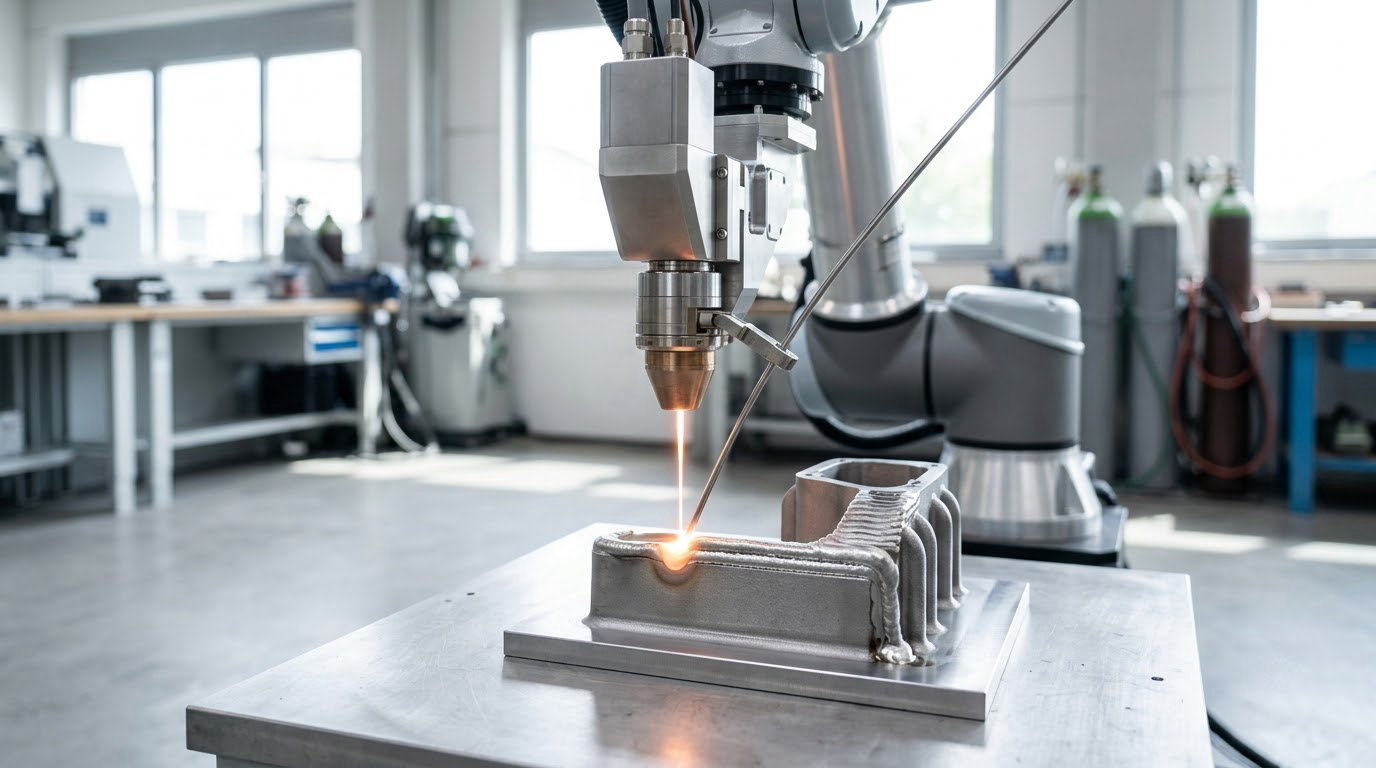
Directed energy deposition (DED) is a group of metal 3D printing processes in which a laser, electron beam or plasma arc melts metal powder or wire as it is fed, building a solid part one layer at a time directly onto a workpiece. Here is directed energy deposition explained from the melt pool outward: how it works, which metals it handles, where it beats powder bed fusion, and where it still needs a machinist.
DED is the oldest of the fusion-based additive processes. It is also the fastest, because it puts metal down only where you want it instead of spreading powder across a whole tray.
Table of Contents
- 1What Is Directed Energy Deposition?
- 2How Does Directed Energy Deposition Work?
- 3Directed energy deposition explained step by step
- 4What Materials Can Directed Energy Deposition Use?
- 5What Are the Main Advantages of DED?
- 6What Are the Limitations of Directed Energy Deposition?
- 7How Does DED Compare With Other Additive Manufacturing Methods?
- 8Where Is Directed Energy Deposition Used?
- 9How Do You Choose the Right DED Process?
- 10Frequently Asked Questions
- 11Is directed energy deposition the same as 3D printing?
- 12What metals can be used with directed energy deposition?
- 13How accurate is directed energy deposition compared with other 3D printing methods?
- 14Can directed energy deposition make large parts?
- 15Do DED parts need machining or other post-processing?
- 16Is directed energy deposition suitable for multimaterial parts?
- 17Conclusion
What Is Directed Energy Deposition?
The ISO/ASTM 52900 standard defines DED as an additive manufacturing process in which focused thermal energy is used to fuse materials by melting them as they are being deposited. No powder bed, no recoater, no support scaffold. The feedstock travels through the nozzle and lands in the melt pool right where the beam is pointing.
That single sentence is the whole difference from the processes people confuse it with. In powder bed fusion, a laser or electron beam melts a selected slice of a powder bed that covers the whole part. In DED, the material travels with the tool.
Under ISO/ASTM 52900, additive manufacturing splits into seven categories: binder jetting, directed energy deposition, material extrusion, material jetting, powder bed fusion, sheet lamination, and vat photopolymerization. DED is the one that behaves most like a welding process with a robot attached, which is why it borrows so much from that world.
How Does Directed Energy Deposition Work?
Every DED machine has three core pieces: an energy source, a feedstock delivery system, and a motion system. Everything else is a variation on those three.
The energy source is usually a ytterbium-doped fiber laser, and commercial machines run from a couple hundred watts up to multi-kilowatt systems around 10 kW. Older systems used CO2 or Nd:YAG lasers; fiber lasers won because they are compact, efficient and reliable in an industrial shop. Electron beam systems, sold under names like EBAM, run at much higher voltages and need a vacuum chamber. Plasma arc systems use a welding torch and run in open air.
Feedstock delivery comes in two flavors. Powder systems blow powder through a coaxial nozzle into the melt pool using argon as a carrier gas. Wire systems push a continuous metal wire into the same pool, usually with the arc itself doing the melting.
The motion system is where the size advantage lives. A deposition head rides on a 4- or 5-axis table, a 6-axis robot arm, or a large gantry. Because the head can tilt, it can follow a CAD trajectory from any angle and build overhangs that a fixed-bed machine could not manage without supports.
Shielding matters. Titanium, aluminum and nickel alloys oxidize fast at melt-pool temperatures, so DED uses either a hermetically sealed chamber backfilled with argon or a coaxial gas jet that blankets the melt pool in inert gas as it travels.
Directed energy deposition explained step by step
Here is the sequence from an empty table to a finished part.
- Prepare the substrate. The base plate is cleaned, degreased and often preheated. Preheating cuts the temperature gradient between the deposit and the parent metal, which is where most distortion problems start.
- Focus the energy. The laser spot size sets the resolution. A 500 W system produces a spot around 0.5 to 1 mm; a 2.5 kW system pushes 1.5 to 3 mm. Bigger spot, faster build, rougher detail.
- Feed the material. Powder or wire enters the melt pool through the nozzle. Not all of it lands in the pool: powder capture rate in the field runs from 70 to 80 percent at best down to 20 to 30 percent when the nozzle geometry and gas flow are wrong.
- Deposit and repeat. The head sweeps the path, the metal solidifies almost immediately behind the beam, and the tool indexes up for the next layer. Layer thickness in DED typically runs 30 to 90 µm, several times thicker than a powder bed layer.
- Inspect and finish. Parts come off the machine rough. Dimensional inspection, heat treatment, stress relief and machining finish the job.
The build-time difference is dramatic. A Ti-6Al-4V nozzle that takes roughly 20 minutes to deposit took about four hours in a powder bed system, because every layer in that machine also needed a recoating cycle. At 9 seconds per recoat across 1,500 layers, you lose over three and a half hours to powder handling alone.
What Materials Can Directed Energy Deposition Use?
Anything that can be melted and welded. DED shares its alloy palette with welding and casting, not with powder bed, which is one reason aerospace approves it so readily.
Titanium alloys such as Ti-6Al-4V, nickel superalloys like Inconel, cobalt alloys, stainless steels, aluminum alloys, tool and die steels, tungsten and copper all run in production DED systems. Certified powders and wires exist for each of them.
The feedstock choice changes the economics more than the alloy choice does.
Powder DED gives finer feature detail and smoother surfaces, handles complex alloys and multi-material blends, but costs more per kilogram and needs controlled storage. Some shops run a dedicated powder room because fine powder behaves like a dust hazard. Wire DED is dirt cheap by the kilo, has a much higher deposition rate, and the wire is a mess-free rod that sits on a shelf. The tradeoff is a rougher bead and less freedom in blending alloys on the fly.
Multiple powder feeders are where DED gets genuinely interesting. Running two or three hoppers at once lets you grade the composition layer by layer, producing functionally graded alloys with a hard surface over a tough core.
What Are the Main Advantages of DED?
The headline advantage is deposition rate. DED adds material at tens of grams per minute, orders of magnitude above powder bed fusion, because there is no bed to reset between layers.
From there the rest follows. Build volume is effectively unlimited because the tool is the limit, not a chamber: parts spanning five meters have been produced, and structural members for buildings have been printed the same way. Material waste is minimal since you only deposit where the part is. And because the system is mobile, repair happens where the broken part already sits.
Three more advantages show up in real shops. Feature addition on existing castings and forgings is fast: deposit a boss, a pad or a mounting lug onto a part you already have. In situ machining on hybrid machines lets the tool switch from depositing to cutting between passes, so each layer gets flattened before the next one lands. And multimaterial builds let you put a wear-resistant alloy on a shaft journal without changing machines.
None of this makes DED the right answer everywhere. It is the right answer when the part is big, the material is expensive, the geometry is machinable, and volume matters.
What Are the Limitations of Directed Energy Deposition?
Surface finish is the honest weak point. Deposited metal comes out at roughly Ra 100 µm, which in shop language is about a sand-cast surface. That is fine if you are machining 2 mm off it later. It is not fine if the part is finished as-deposited on a sealing face.
Dimensional accuracy follows from that finish. DED holds roughly a millimeter, sometimes better with tight parameter control, where powder bed fusion holds fractions of a millimeter. You cannot swap a DED part into a powder bed tolerance stack without finishing work.
Geometry has limits too. Overhangs past about 45 degrees need supports or a multi-axis strategy. Thin features below the layer height simply do not print. Sharp internal corners and deep narrow cavities that a cutting tool can reach are all reasons a DED part gets machined back toward net shape.
Thermal history is the other big constraint. Large deposits cool unevenly and carry residual stress. That means stress relief or a solution treatment before machining, sometimes an interpass check during the build, and attention to distortion on thin-wall sections.
Finally, the shop requirements. You need inert gas supply, fume extraction, powder handling controls, laser safety interlocks and operators who understand melt-pool metallurgy. Most shops that adopt DED add a CNC mill next to it in the same cell, because the two finish each other’s work.
How Does DED Compare With Other Additive Manufacturing Methods?
DED sits opposite powder bed fusion on almost every axis. The table below puts the main alternatives side by side.
| Process | Typical materials | Max part size | Speed | Surface finish | Typical uses |
|---|---|---|---|---|---|
| Directed energy deposition | Most weldable metals, polymers with arc systems | Meters, limited only by the motion system | Tens of grams per minute | Rough, Ra around 100 µm | Repair, cladding, large structures, forging features |
| Powder bed fusion (SLM, EBM, DMLS) | Titanium, nickel, steel, aluminum, ceramics | Typically a few hundred mm | Grams per hour | Fine, machined surfaces optional | Complex geometries, surgical implants, fuel nozzles, aerospace brackets |
| Binder jetting | Metal and sand cast materials | Moderate | Fast, then sintered | Grainy, needs sintering and infiltration | Patterns, low-volume casting, prototype tooling |
| Material extrusion | Polymers, composite filaments, some metals | Large, machine-limited | Slow for structural parts | Visible layer lines | Jigs, fixtures, large polymer panels, composite tooling |
| Conventional machining | Any machinable alloy | Limited by the machine | Fast on simple geometry | Tight tolerance as standard | Anything needing precision features or finished surfaces |
Powder bed fusion wins on resolution and finish, and it is the process that made metal 3D printing famous. Its liabilities are build time, machine cost per part, and a chamber that caps your part size. DED wins on size, speed and material efficiency, and pays for that with finish and tolerance.
Welding is the more honest comparison. Structurally, a DED bead is a weld bead. What DED adds is a robot following a CAD path, a melt pool you can control programmatically, and the ability to change alloys mid-build. If your job is a straightforward repair weld, a welder is often the right tool.
Where Is Directed Energy Deposition Used?
Aerospace is where DED became an industry standard. Turbine blade repair is the textbook case: a damaged blade is stripped, the tip is rebuilt by depositing alloy powder over the damaged region, the surface is machined back to profile, and the whole job finishes in tens of minutes using tens of grams of material, at a small fraction of the cost of a new blade.
The same logic applies to other high-value parts. Engine nacelle components, structural frames, satellite brackets and military airframe parts all get repaired rather than replaced when the economics favor it. Feature addition covers the rest: adding a pad, rib or mounting flange onto an existing forging so the casting supplier does not need a new tool.
Tooling shops use DED constantly. A damaged injection mold cavity or a worn die gets clad and remachined instead of scrapped, and because the deposit only covers the damaged zone, a small amount of expensive tool steel does the job.
Energy and heavy industry follow the same pattern. Petrochemical valves and pump housings get corrosion-resistant cladding laid over carbon steel. Nuclear component work uses DED for qualified repair programs where replacement means a shutdown. Marine and offshore parts use it to restore corroded sections in place. In construction equipment, bucket teeth, cutting edges and hardfacing layers are common DED work.
Automotive and motorsport use it for prototypes and low-volume parts, where tooling costs for a one-off would dominate the part price.
How Do You Choose the Right DED Process?
Start with the part, not the machine. Before you compare systems, write down four things.
Material. Match the alloy to a feedstock you can buy in wire or powder form. If no certified feedstock exists, the process is not available to you, regardless of machine capability.
Geometry. Ask how much material has to come off afterward. Heavy stock on machined faces is fine for DED. Thin-wall cosmetic parts are not.
Finish and tolerance. If any functional surface needs to be sealed, bearing-mounted or held to tight tolerance, budget for machining after deposition. That is normal, not a failure.
Quantity. A one-off justifies a manual setup and heavy post-processing. A run of hundreds justifies nesting paths, automated powder handling and in situ machining.
Then pick the variant. Laser DED gives the best combination of detail and rate for aerospace and tooling work. Electron beam DED needs a vacuum chamber and suits very reactive alloys at high deposition rates. Plasma arc and wire arc additive manufacturing run at high amperage with no optics, and are the sensible choice for large structural steel.
Choose powder when the alloy is exotic, the features are small or you need graded materials. Choose wire when the material is cheap, the geometry is chunky and volume is high.
If you are a small shop without a laser, a service bureau is the realistic route. Send the model, get a quote, ask what post-machining allowance they build in. The recurring community question about whether DED works outside a factory has a practical answer: the machine rarely leaves the factory, but the parts can.
Frequently Asked Questions
Is directed energy deposition the same as 3D printing?
Yes, DED is metal 3D printing, but it works differently from the desktop machines people picture. A robot arm moves a laser, electron beam or plasma arc head along a path from a CAD model, while powder or wire is fed into the melt pool and solidifies layer by layer. Nothing is scraped across a powder bed, which is what lets DED build parts measured in meters rather than centimeters.
What metals can be used with directed energy deposition?
Anything that can be welded and machined: titanium alloys such as Ti-6Al-4V, nickel superalloys like Inconel, stainless steels, aluminum alloys, cobalt alloys, tool steels, tungsten and copper. Powder DED suits fine features and exotic alloys, while wire DED favors high deposition rates and cheaper material. Certified powders and wires exist for the common aerospace and industrial grades.
How accurate is directed energy deposition compared with other 3D printing methods?
Less accurate. DED typically holds around a millimeter, with a deposited surface roughness near Ra 100 µm, because the melt pool is far larger than a powder bed layer and the finished bead follows the toolpath rather than a pixel grid. Powder bed fusion holds fractions of a millimeter. For functional surfaces, DED parts are machined after deposition to bring them into tolerance.
Can directed energy deposition make large parts?
Yes. That is its defining strength. Part size is limited by the motion system rather than a chamber, so gantry systems and long robot-arm cells build components several meters long. Structural steel members and large frames are routine at that scale, where powder bed fusion would be physically unable to fit the part and would take far longer per kilogram anyway.
Do DED parts need machining or other post-processing?
Nearly always, unless the part is a repair deposit or clad surface that will be finished in service. Expect stress relief or heat treatment to deal with residual stress from the thermal cycle, then CNC machining of functional faces and holes. Many shops run hybrid machines that alternate deposition and milling so each layer is flattened before the next one is laid down.
Is directed energy deposition suitable for multimaterial parts?
It is one of the main reasons to choose DED. Most powder DED systems carry two or three feeders, so the head can switch or blend alloys between layers. That enables functionally graded structures such as a hard alloy surface graded into a tough core, or a corrosion-resistant clad layer over carbon steel. Wire systems can change wire but have less freedom for continuous blending.
Conclusion
Start with four questions, not a machine: what material, what geometry, what finish, and how many. Directed energy deposition explained simply is a high-output, low-precision metal 3D printing process that wins on large parts, repair and material cost, and needs machining afterward to hit tight tolerances. Answer those four first, and the right system, feedstock and service bureau follow on their own.
Last updated: 2026