Careers in 3D printing design and engineering are the jobs that sit around additive manufacturing: designing parts that can actually be printed, running and programming the machines, keeping quality on spec, and applying printed components to real products. Almost nobody advertises these roles under the phrase “3D printing” — recruiters search the formal term, additive manufacturing, and the job titles split into a design cluster and a manufacturing cluster. Below are ten of them, with what the work involves, who it suits and how people actually get in.
One thing worth saying up front: this field is hiring, but it is not frictionless. The most common complaint from people trying to break in is that entry-level postings still ask for years of experience on industrial printers. That catch-22 is real, and the last section of this guide is about how to get around it.
Table of Contents
- 1Careers in 3D Printing Design and Engineering at a Glance
- 21. Additive Manufacturing Design Engineer
- 3How This Role Fits Careers in 3D Printing Design and Engineering
- 42. CAD Designer for Additive Manufacturing
- 53. Product Development Engineer
- 64. Additive Manufacturing Engineer
- 75. Applications Engineer
- 86. Materials Engineer
- 97. Additive Manufacturing Process Engineer
- 108. Quality and Testing Engineer
- 119. Technical Support Engineer
- 1210. Additive Manufacturing Research Engineer
- 13How to Choose the Right Path and Get Started
- 14Frequently Asked Questions
- 15Do I need an engineering degree for a career in 3D printing?
- 16Which software should I learn for additive manufacturing design and engineering?
- 17Can a maker or 3D printing hobbyist become an engineer?
- 18What is the best entry-level 3D printing job for someone with no experience?
- 19How do I build a portfolio when I have no professional additive manufacturing work?
- 20Conclusion: Make a Test Print Your First Step
Careers in 3D Printing Design and Engineering at a Glance
If you want the short version, the ten roles below fall into three groups. Design-side roles turn requirements into printable geometry. Process-side roles make the machine produce the same result every time. Commercial and support roles sit between the two and the customer. The table maps each role to its main responsibility, the skills that get you hired, the usual entry route and where the work happens.
| Role | Main responsibility | Key skills | Typical entry route | Where you work |
|---|---|---|---|---|
| 1. Additive Manufacturing Design Engineer | Turns product requirements into manufacturable printed geometry | CAD, DfAM, topology optimisation, FEA, material selection | Mechanical or manufacturing engineering degree plus AM coursework | Aerospace, automotive, medical device OEM |
| 2. CAD Designer for Additive Manufacturing | Produces accurate models, assemblies and print-ready documentation | Parametric CAD, assemblies, GD&T, tolerance stack-ups, support thinking | Drafting certificate, associate degree, or self-taught with a strong portfolio | Engineering services, small AM firms, contract rooms |
| 3. Product Development Engineer | Runs rapid prototype cycles to prove out geometry and fit | CAD, design for manufacturing, ergonomics, test planning | Product or mechanical engineering degree, co-op placement | Consumer products, footwear, industrial equipment |
| 4. Additive Manufacturing Engineer | Owns the bridge between design, process, material and scale-up | Wide process range, testing, DFM, production planning | Engineering degree plus a couple of years in any manufacturing role | AM service bureaus, production AM cells |
| 5. Applications Engineer | Turns customer problems into printable designs and process picks | Customer-facing communication, printability rules, CAD, testing | Technical support, engineering or field service background | Printer manufacturers, material suppliers |
| 6. Materials Engineer | Tests and qualifies polymers, metals, ceramics and composites | Characterisation, mechanical testing, process-parameter relationship | Materials, chemical or biomedical engineering with a masters | Universities, national labs, material suppliers |
| 7. Additive Manufacturing Process Engineer | Develops and holds the process window and the build recipe | Parameter tuning, build preparation, quality data, root-cause analysis | Process engineering, technician route with a certification | Production AM factories, aerospace plants |
| 8. Quality and Testing Engineer | Inspects parts, interprets defects and sets tolerances | Dimensional inspection, NDT, statistics, drawing interpretation | Quality, metrology or manufacturing engineering background | Regulated production, medical and defence supply chains |
| 9. Technical Support Engineer | Solves file, slicer, machine and material problems for users | Slicing software, printer setup, materials, clear written communication | Entry-level, often the easiest first AM job to land | Remote or inside printer and material companies |
| 10. Additive Manufacturing Research Engineer | Works on new materials, processes, simulation and advanced applications | Research methods, modelling, publishing, interdisciplinary teamwork | Graduate degree, postdoc, or research assistant post | Universities, research institutes, advanced R&D groups |
1. Additive Manufacturing Design Engineer
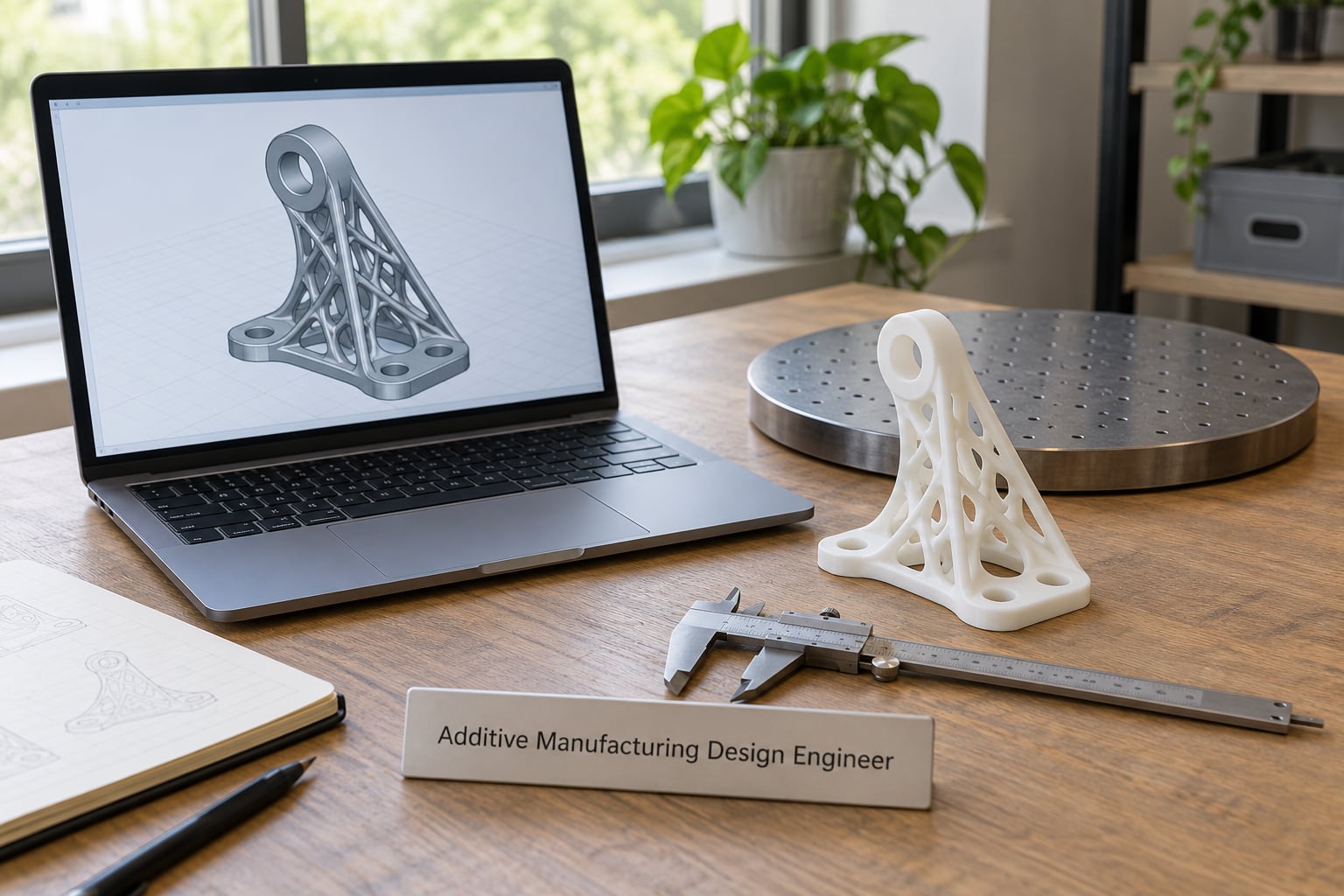
This is the role most people picture when they imagine a career in 3D printing: you take a set of product requirements and produce a part that prints correctly the first time, holds up in service, and can be made again next year. The hard part is not the CAD. It is knowing which design choices are cheap in a printer and expensive in a machined part, then trading one against the other deliberately.
The core toolkit runs from solid and surface CAD through design for additive manufacturing, usually shortened to DfAM, to finite element analysis and topology optimisation. Topology optimisation in particular reshapes how you approach a part: you define a load case and a volume constraint, the solver proposes the material placement, and you clean up a result that no human would sketch. Material selection is the other half, because a geometry that works in a glass-filled nylon will print differently in an unfilled polymer or a metal alloy.
A concrete example: a mounting bracket on a machine guard has to carry a static load and survive a handling knock. In conventional design you would machine it from aluminium plate and accept the weight. For FDM, the engineer remodels it as a ribbed, curved section with material placed only where the load path needs it, checks it in FEA against the same load case, prints a test coupon to confirm the layer direction carries the stress, and only then releases it for production. That sequence — geometry, analysis, printed proof — is the job.
How This Role Fits Careers in 3D Printing Design and Engineering
This role sits at the junction that makes additive manufacturing different from traditional manufacturing: the person drawing the part is also the person who has to answer for how it gets built. That means a design engineer here talks to the process engineer about layer height and orientation, to the quality engineer about what tolerance is achievable, and to the customer about cost per part, not just part price.
Getting in usually means a mechanical, manufacturing or similar engineering degree with real analysis coursework, plus proof you understand printing behaviour rather than just modelling. A co-op placement, a graduate scheme, or an internal transfer from a traditional design team are the common doors. Several people in AM communities describe being told by an internship supervisor that design-for-AM and FEA are exactly where the field is thin on experience — which is a hint about where the value sits.
2. CAD Designer for Additive Manufacturing
A CAD designer for additive manufacturing makes accurate, unambiguous models that a machine, a technician or a supplier can act on without guessing. The work looks like drafting from the outside, but the decisions are different, and that is the whole distinction.
Conventional CAD drafting assumes a subtractive process where material is removed from a solid block. Additive work has other constraints to design around: support structures that must reach certain surfaces, build orientation that determines which faces are rough, and anisotropy that makes strength depend on layer direction. A designer who ignores those will hand the printer a part that prints, then warps, then fails inspection.
You also deal with assemblies rather than single parts. A duct assembly might have a dozen components, snap fits, seals and mounting points, each needing orientation planning and a support strategy, plus a tolerance stack-up that accounts for both the printed part and the mating hardware. Documentation matters as much as the geometry: build orientation, support notes, material, orientation of any cosmetic face, and any post-processing steps all belong in the drawing package so the same part can be produced months later by someone else.
Example: preparing a cooling duct assembly for a machine builder. Each segment gets oriented so the round sections print without supports and the flanges print flat to keep them dimensionally true, the snap-fit tolerances are relaxed to suit layer height, and the assembly file carries orientation and support instructions per body. This is the most common entry point in the field for people without an engineering degree, and it rewards precision more than creativity.
3. Product Development Engineer
A product development engineer uses additive manufacturing to answer product questions fast — does this shape feel right in the hand, does this fit, does this perform — before anyone commits to tooling. In a traditional product cycle, each of those questions can cost months and a mould; printed prototypes turn them into a week.
The skill set is CAD plus design-for-manufacturing thinking plus a tolerance for iteration. Product developers tend to be strong at shape and ergonomics and weaker at production detail, and additive manufacturing is unusually forgiving of that split because a printed part that fails a fit test costs almost nothing. The workflow usually starts as a rough concept model, becomes a dimensional prototype for fit and grip, then a functional prototype in a production-intent material with printed fasteners, and finally a test article that goes into a rig or onto a user.
Example: a handheld device. The team prints a stack of grip studies at different radii and textures, cuts them up, and hands them to users. The winning profile goes forward, an internal rib layout lands, the wall thickness is set to resist flex during a drop test, and the design team hands a verified geometry to manufacturing instead of a rendering. The job is well suited to people who like the messy middle of development rather than the finished detail of production.
4. Additive Manufacturing Engineer
An additive manufacturing engineer is the broad-hands role that connects design, printing process, materials, testing and production. Where the design engineer owns the geometry, this engineer owns whether that geometry can be made repeatably, at a rate, at a cost that works.
It is the role with the most variety day to day. You might spend a morning deciding whether a part should be FDM or SLS, the next on a fixture for first-article inspection, and the afternoon writing a build plate layout so the nesting works. The judgement calls are comparative: FDM gives you cheap, large parts with anisotropic behaviour and visible layer lines; SLS gives you consistent, support-free geometry at a higher per-kilogram cost, with more thermal history on the powder. For a functional enclosure with snap fits and threads, SLS often wins on dimension; for a large low-load jig, FDM usually wins on everything else.
People move into this role from process engineering, manufacturing engineering or technician work, and it is a good landing spot if you can talk both to the CAD side and to the shop floor. Bureau and contract work tends to mean variety across industries, while in-house production means depth on one process and one product family.
5. Applications Engineer
An applications engineer translates a customer’s problem into a design that prints and a process that suits it. You are the person who looks at a proposed part and says, this as drawn will not work, and here is what will — usually with a printed proof to prove it.
That makes the job unusually concrete. A customer sends a housing with three deep overhangs, a thin unsupported roof and a snap-fit that will be stressed along the layer line. The applications engineer models the housing so the roof is at a 45-degree draft, adds a printed-in hinge boss instead of the snap feature, reorients the part flat, prints it, hands it back with the reasoning written down. The customer gets a part that works; the supplier gets a design it can quote against.
The skills are printability knowledge, CAD, test printing and the ability to explain a decision to someone who did not study engineering. Many people arrive from technical support or field service. It suits people who enjoy the moment a customer realises their idea is not impossible, just designed differently.
6. Materials Engineer
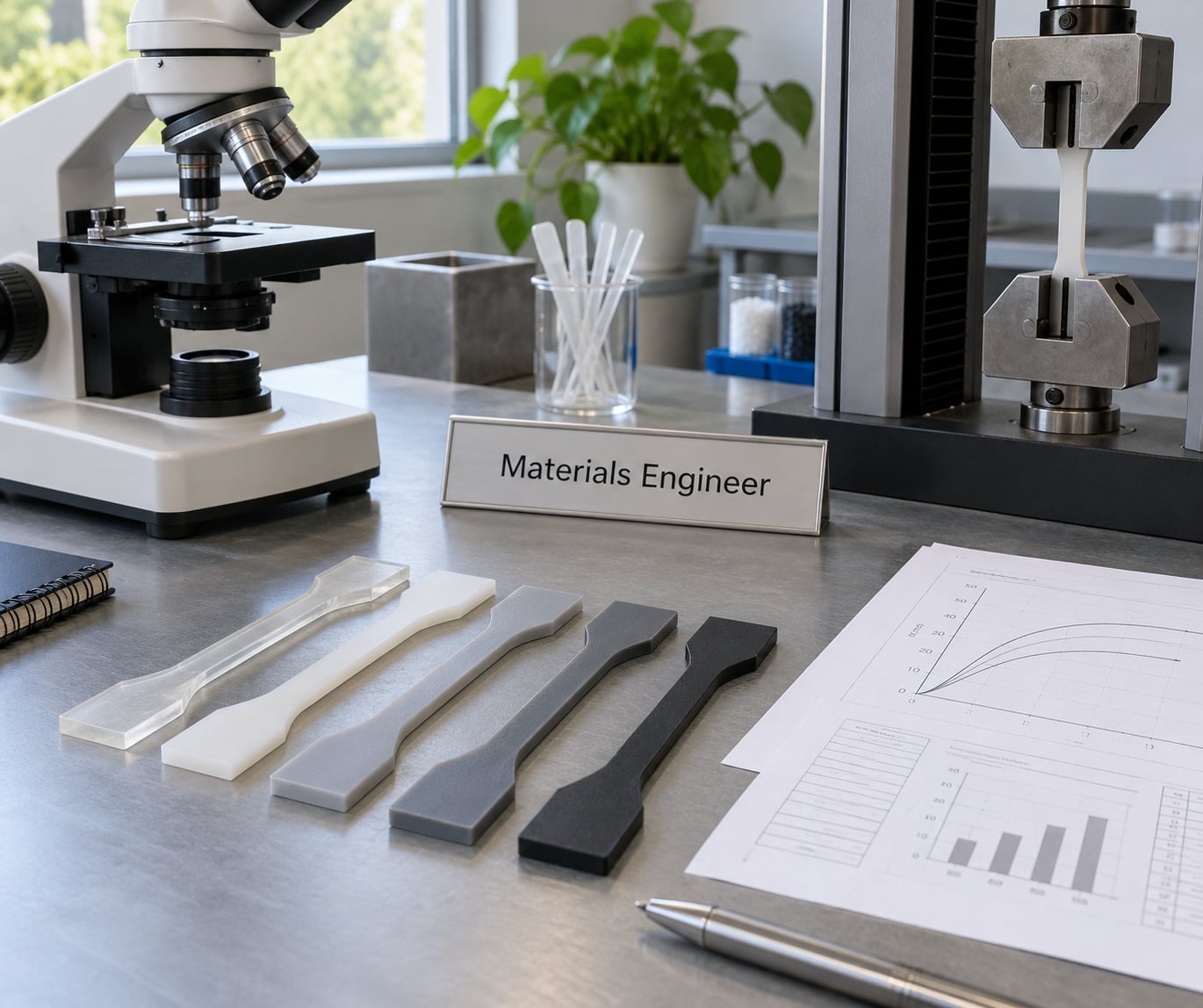
Materials engineers in additive manufacturing study how a material behaves while it is being built, layer by layer, rather than after it is finished. Printed parts are not homogeneous billets. Their strength depends on layer bonding, thermal history, orientation, porosity and the chemistry of the feedstock, and that makes the material-performance relationship unusually interesting to study.
The work covers polymers, metals, ceramics and composites, and it is more experimental than most people expect. You run tensile coupons, examine fracture surfaces, test across orientations and process settings, and then connect the numbers to a print profile so the production team can hold performance instead of chasing it. Questions that occupy a lot of this role: how much does interlayer adhesion fall at higher speeds, what does long-term thermal exposure do to a recycled feedstock, which powder reuse cycle keeps properties stable, and how much anisotropy is acceptable for a given load direction.
Example: evaluating layer bonding in a polymer coupon. The engineer prints a single coupon matrix at different layer heights and temperatures, pulls them in tension, compares strength in the print direction against strength across it, and produces a recommended parameter window that the process engineer adopts as a standard. The role usually needs a materials, chemical, mechanical or biomedical degree, and a masters degree is common in research-heavy groups.
7. Additive Manufacturing Process Engineer
A process engineer owns the window between the machine’s nominal settings and a part that meets spec every time. In a production cell, this person writes the recipe, prepares the build, monitors the run, and investigates whatever goes wrong on the fourth part.
Day to day that means parameter tuning, build-plate layout and orientation strategy, powder or filament handling, machine qualification, and control plans that describe how each parameter was set and why. When a part warps, curls at the corners, or shows porosity that shows up in inspection, the process engineer runs it down: which plate temperature, which layer height, which cooling, which orientation, and is the failure in the design or in the recipe. Fixing a warp can mean reorienting the part, adding a brim, slowing the outer wall, or reducing the overall footprint. Picking the smallest effective change is the skill.
This is one of the more accessible routes in. A technician with a few years on machines and a formal certification can step into process work, and the path runs upward toward process engineering manager and then production leadership. It suits people who are methodical, curious about machines, and comfortable holding a number rather than a drawing.
8. Quality and Testing Engineer
Quality and testing engineers decide whether a printed part is acceptable, and they do it with evidence rather than reassurance. That means dimensional inspection against the drawing, mechanical and coupon testing, interpretation of internal defects, and the statistical work that turns individual measurements into a process signal.
Additive manufacturing complicates this because tolerances and surface finish behave differently from machined parts. Layer height sets a floor on achievable detail, orientation puts rough faces where they can be accepted and sharp ones where they cannot, and porosity can sit inside a part where nobody sees it. The quality engineer defines what is measurable, specifies how it is measured, and sets the inspection frequency that catches drift before it becomes scrap.
Example: a coupon-testing and inspection routine. Rather than measuring every part, the engineer runs a first-article coupon set with dimensional and tensile checks, uses the results to set a sampling plan for production, and feeds the correlation back to the process engineer as a control-plan limit. This role is unusually valuable in regulated industries — medical devices, aerospace under AS9100, defence work with export controls — because documentation discipline is as important as measurement skill.
9. Technical Support Engineer
Technical support is the friendliest door into the industry, and often the fastest one. You handle the questions that arrive from users: the model will not slice, the surface is rough on one face, the part keeps delaminating, the dimension drifts between builds, the material is behaving differently from the datasheet.
The work is diagnosis. A file that slices into nothing is usually a non-manifold or zero-thickness feature; a part that keeps lifting off the plate is usually plate temperature and separation; inconsistent strength in one direction is usually layer bonding rather than material. To be useful you need real hands-on time with the machines, because support advice and temperature advice are worthless if you have never watched a part fail.
A typical day: a user sends a failed part and a screenshot. You ask for the orientation and the profile, notice the unsupported overhang, check the nozzle height, and send back a reoriented model with a support note and a revised temperature. Repeat, roughly fifty times a day, across time zones. It suits patient, clear communicators, and it builds the process knowledge that applications and process roles eventually need.
10. Additive Manufacturing Research Engineer
Research engineers work on the parts of additive manufacturing that are not solved yet: new feedstocks, new processes, better simulation of the thermal and mechanical history, and applications where the current limits are still the binding constraint.
Typical projects include modelling the mechanical behaviour of lattice structures, characterising recycled feedstock so its properties can be predicted rather than measured part by part, developing process monitoring from in-build sensor data, or exploring hybrid routes that combine deposition with machining. Results usually surface as conference papers, journal articles or patents, so writing is part of the job rather than an afterthought.
Entry runs through a graduate degree, a postdoc, or a research assistant position inside a university or institute. Industrial research groups at printer and material companies hire people with the same profile. If your interest is the underlying science rather than a production job, this is the honest route — and it is longer than the other nine, with fewer openings and a stronger maths and materials background expected up front.
How to Choose the Right Path and Get Started
Choose by the kind of problem you like, not the title. If you enjoy geometry and load paths, go design. If you enjoy machines and repeatable outcomes, go process. If you enjoy experiments and open questions, go materials or research. If you enjoy explaining things to people who are stuck, go applications or support. Most people are happy for years in the role that matches their instinct, and miserable in the one that does not.
Then take these steps in order. Pick one printing process and get close to it — FDM, SLA, SLS or metal powder bed is enough, and depth on one machine teaches more than shallow exposure to five.
Learn the core software for that side of the work. Solid modelling first, since it is the shared language; then FEA if design is your target, slicer and build-preparation tools if process is, and inspection and statistics if quality is. Self-taught CAD is a real qualification, but it has to be professional-grade: a materials engineer with years of hands-on FDM and SLA work described his CAD as solid but probably not at the level he would call professional, which is exactly the gap a portfolio can close.
Build a focused portfolio of two or three projects, not ten. One design-for-AM redesign with a printed before-and-after and an FEA comparison. One parameter study with measured data. One support-free redesign explained in writing. For each, state the process, material, layer height, orientation and what you would change next. That single write-up is what separates you from an applicant with a desktop printer and no idea what he built.
Look for the first door that does not demand industrial experience — technician, support, contract CAD or a co-op. The catch-22 is real: people applying to entry-level AM roles report that employers consistently want extensive industrial-printer experience. Internal transfer from a machining, drafting or quality role inside a company that owns printers is the most underused route, and freelance contract CAD work is the fastest way to turn portfolio pieces into evidence that someone will pay for.
Add a certification where employers ask for it. The SME Certified Additive Manufacturing Technician and Fundamental credentials show a verified baseline, and they are cheap compared with a year of tuition. Do not treat any certificate as a substitute for hands-on machine time. Join the communities where the real problems get discussed, ask technical questions in public, and go to an additive manufacturing event once a year to meet the people who hire.
Frequently Asked Questions
Do I need an engineering degree for a career in 3D printing?
Not for most roles, but it changes which ones open to you. Design, process, materials and research positions usually want a mechanical, manufacturing, materials or biomedical engineering degree because they involve analysis and specification. Technician, technical support and many CAD designer roles are open to associate degrees, drafting certificates, or a strong self-taught portfolio. A degree also matters in regulated sectors like medical devices and aerospace, where documentation and standards training are part of the role.
Which software should I learn for additive manufacturing design and engineering?
Start with parametric CAD, because it is the shared language across every role: solid and surface modelling, assemblies, and drawing packages. Add finite element analysis next if design or process is your target. For process work, learn build preparation and slicing tools, machine monitoring, and basic statistics for reading quality data. Quality roles need inspection and metrology software. Keep one browser-based or open tool alongside a commercial package so you can open whatever a client sends.
Can a maker or 3D printing hobbyist become an engineer?
Yes, but the hobby part is the easy half. Printing at home teaches you machine behaviour, materials and failure modes, and that is genuinely useful. What it does not teach you is tolerance stack-ups, analysis, material characterisation, documentation or the regulatory side of production work, which is where engineering roles are judged. Close the gap with formal coursework or a certification, and with portfolio projects that show measurement and reasoning, not just finished prints.
What is the best entry-level 3D printing job for someone with no experience?
Additive manufacturing technician and technical support roles are the most realistic first jobs, because they are designed to train rather than to assume prior industrial experience. Contract CAD work for print-capable parts is the other good door, and it lets you build references quickly. Two things help more than most applicants expect: an SME certification, which gives a hiring manager a verified baseline, and a portfolio with two or three projects documented properly.
How do I build a portfolio when I have no professional additive manufacturing work?
Build two or three documented projects instead of a gallery of prints. For each one, record the process and material, the layer height and orientation, the problem you were solving, the measurements you took and what you would change next. A design-for-AM redesign with a printed comparison and an FEA check is the strongest example. A parameter study with measured data comes second. Photograph the parts, include the slicer settings, and keep the write-up short and factual.
Conclusion: Make a Test Print Your First Step
Careers in 3D printing design and engineering now split cleanly into ten distinct paths, from design engineering and CAD work through process, quality, materials, applications, support and research, and the honest difference between them is the kind of thinking each one demands. None of them is reachable by waiting for a posting that asks for less experience than you have. Match your instinct to the role, choose one process, and print something this week with the orientation, the material and the settings written down beside it. That single project, done properly and explained clearly, is the first rung.