Short answer: most US print shops, libraries and makerspaces charge roughly $0.10 to $0.20 per gram of FDM plastic, usually with a minimum order of $1.50 to $5. That figure covers the material and the machine, but not really your part. The raw filament itself costs about $0.02 to $0.06 per gram, so the gap between the two numbers is labour, wear and overhead.
If you just want to budget for a custom part, use the shop rate and the minimum. If you are pricing prints yourself, you need the full breakdown, because per-gram pricing on its own is where most sellers lose money.
Every figure below is a typical US range as of 2026, not a fixed standard. Materials move, electricity rates vary by state, and two shops in the same zip code can quote double.
Table of Contents
- 13D Printing Cost per Gram: Typical US Ranges
- 2How Much Does 3D Printing Cost per Gram by Material?
- 3What Affects the Price
- 4Ways to Save
- 5Frequently Asked Questions
- 6How do I calculate the cost of a 3D print?
- 7Is 3D printing cheaper than buying a manufactured part?
- 8How much does 1 kg of PLA or PETG cost in the US?
- 9Why does the cost per gram differ between a home printer and a service?
- 10Are resin and filament more expensive to print with?
- 11What is the cheapest 3D printing material for prototypes?
- 12Conclusion
3D Printing Cost per Gram: Typical US Ranges
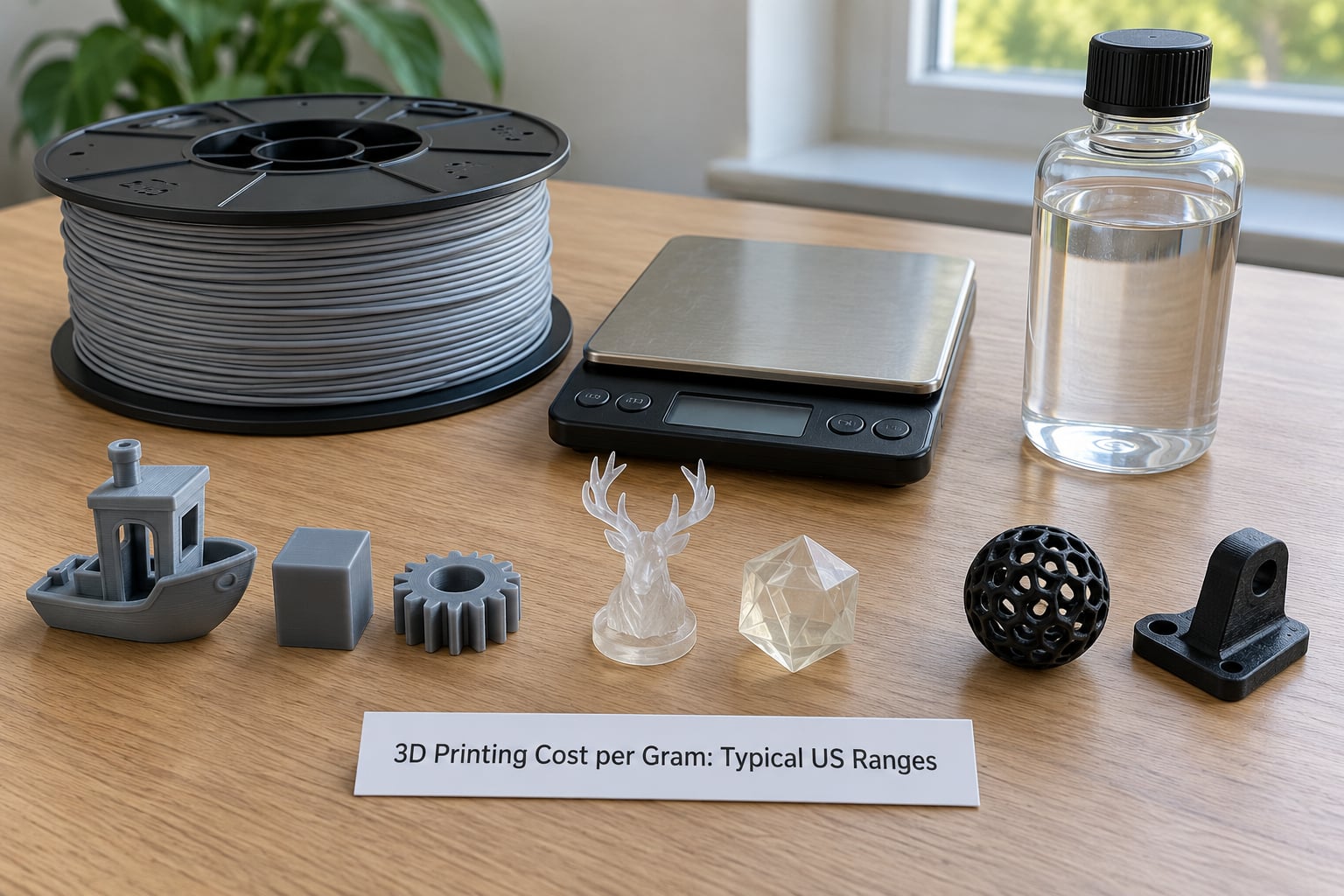
There are two different numbers people mean when they ask how much does 3D printing cost per gram, and mixing them up is the single most common source of confusion. The first is what a service charges you. The second is what the material costs the person doing the printing. They are not close.
Published institutional rate cards are the most reliable reference points, because a library or city service has to publish the figure and stand behind it.
| Provider type | Published rate | Notes |
|---|---|---|
| Public library 3D printing programme | $0.10 per gram | Support material included in the rate |
| City makerspace | $0.15 per gram of plastic | $1.50 minimum per order |
| Public library, larger prints | $0.15 per gram | Higher tier for smaller parts |
| Public library, small prints | $1 minimum, then $0.10 per gram | Rate applies above 10 g |
| Large-format print shop | $0.10 per gram | Quoted separately for small parts |
| Independent seller, hourly | About $35 per hour | Billed in 15-minute increments, one hour minimum |
| Independent seller, per gram | About 0.10 EUR per gram | Filament used, quoted by sellers on r/3Dprinting |
| Size-band pricing | $3 small, $5-7 medium, $10+ large | Band model rather than per gram, used in maker Facebook groups |
Read that table as a convention with a range, not a fixed rate. Institutional providers cluster tightly between ten and fifteen cents because their material cost is low and they are not trying to turn a printer into a business. Independent sellers have to recover their own time, so they drift to hourly rates or much higher per-gram figures.
If a quote lands far above $0.20 per gram for ordinary plastic, it is usually not greed. Small parts get a minimum charge because the handling takes longer than the print.
How Much Does 3D Printing Cost per Gram by Material?
Material price is the easiest number to check because filament is sold by the kilogram and the arithmetic is trivial. Divide the spool price by the spool weight, then multiply by the grams your slicer estimates.
A 1 kg PLA spool in the US typically runs $19.99 to $24.99, so one gram of PLA costs about two to three cents. One gram is a rounding error. One hundred grams is $2.00 to $2.50 of material, which is still less than many people expect.
| Material | Typical US material cost per gram | Context |
|---|---|---|
| PLA | $0.02 – $0.03 | $20 – $25 per 1 kg spool; the default prototype material |
| PETG | $0.03 – $0.04 | $25 – $32 per 1 kg; tougher and heat-resistant |
| ABS | $0.03 – $0.04 | $25 – $30 per 1 kg; needs an enclosure, warps otherwise |
| ASA | $0.04 – $0.06 | $35 – $45 per 1 kg; UV-stable outdoor parts |
| TPU | $0.04 – $0.07 | $35 – $50 per 1 kg; flexible, prints slowly |
| Nylon | $0.08 – $0.15 | $70 – $140 per 1 kg; absorbs moisture, needs drying |
| Standard photopolymer resin | About $0.06 | Quoted by sellers for finished resin prints; plus waste, wash and cure time |
| Engineering polymers (PEEK, PEI) | $1.50 and up | Specialist machines and high-temperature chambers required |
| Metal powder (SLS / SLM) | Several dollars per gram | Material, support structure and HIP processing all land in the quote |
Two details matter here that the table cannot show. First, density: ABS is about 1.04 g per cubic centimetre while PETG sits near 1.27, so a part of identical volume consumes meaningfully less ABS material. Second, waste. Slicers estimate grams for the solid model, and you will use more than that in practice from purge blocks, supports, brim, raft and failed attempts. Five to ten percent is a fair buffer, and support structures on an overhang-heavy part can push it higher.
There is also a difference between price per gram and price per cubic centimetre. Some European services quote per cubic centimetre because volume reads more naturally on a CAD model. Same underlying math, just a different unit, and it catches people out when comparing a quote to a spool price.
What Affects the Price
Material is only one of five cost lines, and on small parts it is rarely the biggest one. Here is the formula most people in the community converge on:
Price = (material + energy + wear + labour) ÷ (1 − failure rate) × (1 + markup)
Each line is simple on its own. Material is grams × cost per gram. Energy is watts ÷ 1000 × print hours × your kWh rate. Wear is your printer’s price divided by its expected print hours, multiplied by the same hours. Labour is the minutes you spend slicing, cleaning the plate, removing supports, packing and answering messages.
Electricity is the line everyone overestimates. A 120 W printer running at a $0.16 per kWh rate uses about two cents of electricity per hour. Even a six-hour print costs well under a quarter to run. One published proportion analysis puts electricity at roughly 1.4 percent of a print attempt’s cost, with labour around 61 percent and filament around 29 percent.
One trap worth naming: the wattage on the spec sheet is the power supply maximum, not what your printer draws. Measured with a plug-in meter, a machine rated at 350 W often pulls a fraction of that. Take the reading rather than the datasheet.
Failure rate divides, it does not add. If one print in ten fails, you divide by 0.90, which multiplies your cost by about 1.11. At a 30 percent failure rate the multiplier is 1.43, not 1.30. On a small part with thin margins that difference is real money, and it is why logging failures beats guessing them.
This is why the community shortcut of charging three times your filament cost fails. Take a 120 g bracket using $0.03 per gram PLA. Material is $3.60, so triple it and you charge $10.80. Now price it properly: $3.60 material, about $0.12 energy over six hours, roughly $1.20 of wear on a printer amortised over its print hours, and around three dollars of handling and post-processing. That is about $9.15 before a single failure or markup. The 3x rule happens to land close here by luck, but on a 20 g clip the same rule underprices the work by roughly eight times, because the labour barely changes when the part gets smaller.
| Cost line | 120 g bracket, PLA | How it was calculated |
|---|---|---|
| Material | $3.60 | 120 g at $0.03 per gram |
| Energy | About $0.12 | 105 W measured, 6 hours, $0.18 per kWh |
| Machine wear | About $1.20 | Printer price ÷ 2,500 expected print hours × 6 hours |
| Labour and handling | About $3.00 | Six hours print, 20 minutes of hands-on time |
| Subtotal per attempt | About $7.92 | Sum of the four lines |
| Failure buffer at 10 percent | About $8.80 | Subtotal ÷ 0.90 |
| With 40 percent markup | About $12.32 | Failure-adjusted cost × 1.40 |
Assumptions are labelled so you can swap them. Your electricity rate, your machine hours and your hourly value are the three inputs most worth changing.
Weight and speed interact in a way that flatters per-gram pricing. Bigger parts amortise setup over more grams, so the effective rate per gram falls as weight climbs. Fast, high-layer-height prints consume more grams per hour but spread machine time over them, and the direction you end up in depends on which effect dominates.
| Part weight | Material only | Typical true cost per part | Handling share |
|---|---|---|---|
| 10 g clip | $0.30 | $4 – $6 | Dominant |
| 20 g clip | $0.60 | $5 – $7 | Dominant |
| 50 g figurine | $1.50 | $7 – $10 | Large |
| 120 g bracket | $3.60 | $10 – $13 | Material-heavy |
| 350 g enclosure | $10.50 | $20 – $28 | Small |
| 1 kg+ part | $30.00 | $45 – $65 | Marginal |
Batching is where the money actually is. Ten of those clips plated together share one warm-up, one plate clean and one packing job, and published worked examples land around $1.73 per clip batched against roughly $5 each printed individually. That gap is larger than any material saving you will find.
Regional spread is wide and mostly unexplained by anything you control. US institutional rates sit at ten to fifteen cents per gram, European community quotes land around 0.10 EUR, and sellers on IndiaMart list from roughly Rs 7 to Rs 50 per gram for the same PLA and PETG. Labour rates, power prices and machine ownership costs sit underneath all three. If you are comparing quotes across borders, you are comparing economies, not printers.
Marketplace fees belong in the model too. One seller working a full landed-cost example landed around $11 to $15 in parts, $4 to $6 in postage, roughly $7 in Etsy fees, and $25 to $30 all in, then concluded that a 30 to 50 percent markup on top of cost was needed just to break even. Build that layer in from the start rather than discovering it later.
Ways to Save
Cut handling before you cut material. Printing four copies on one plate does more for your per-part cost than switching to a cheaper filament ever will.
Pick the least demanding material that still does the job. PLA costs less to print than ABS because it needs no enclosure, warps less and often prints faster. Only move up when temperature, impact or UV exposure actually forces it.
Reduce infill without weakening the part. Infill between 10 and 20 percent handles most functional geometry, and adding perimeters buys strength far more cheaply than adding density. Check your design rules first, since some parts genuinely need solid shells.
Thin your walls where the design allows. Every layer height increase and every removed perimeter cuts both grams and hours, which is the only saving that hits two cost lines at once.
Reuse supports and slice closely. Every support you generate is material you pay for twice, once as filament and once as the time to remove it afterwards.
Maintain the machine. A clear nozzle, a clean extruder and a first-layer that passes first time cut your failure rate, and the failure rate multiplies everything else in the formula.
Buy filament in larger quantities. Spools get cheaper per kilo in bulk, and a dry box pays for itself if you have ever had a spool absorb enough moisture to pop and string.
Quote small jobs hourly instead of per gram. A flat per-gram rate quietly underpays you on anything under about 50 g because the labour does not scale down with the part.
Skip the shortcuts that cost you quality. Under-driving infill to save grams, skipping a brim on a large flat part, or ignoring an enclosure for ABS will fail more than it saves, and a failed print costs material and hours at once.
Frequently Asked Questions
How do I calculate the cost of a 3D print?
Take the slicer’s gram estimate and multiply by your material cost per gram. Add electricity using watts divided by 1000, multiplied by print hours and your kWh rate. Add wear by dividing your printer price by expected print hours and multiplying by the same hours. Add your hands-on time. Divide the total by 1 minus your failure rate, then apply your markup.
Is 3D printing cheaper than buying a manufactured part?
For one-off parts, prototypes, replacement components and custom-fit items, usually yes, because there are no tooling or setup costs. For a hundred identical injection-moulded brackets, no. Printing is slow and labour-heavy per unit. The crossover usually sits in the low tens of parts, depending entirely on how long each print takes.
How much does 1 kg of PLA or PETG cost in the US?
A 1 kg spool of PLA typically runs $19.99 to $24.99 in the US, which works out to two to three cents per gram. PETG usually sits slightly higher at $25 to $32 per kilo. Bulk purchases of multi-kilo packs and manufacturer-direct orders shave the per-kilo figure further.
Why does the cost per gram differ between a home printer and a service?
A home print costs you filament, a little electricity and some wear. A service adds labour, support removal, post-processing, packaging, a failure buffer and a markup. That overhead is why shops cluster around $0.10 to $0.20 per gram while raw filament is closer to two to six cents.
Are resin and filament more expensive to print with?
Per gram, resin sits around six cents before waste, which is close to PETG. In practice resin prints cost more because of supports, washing, curing and removal, all of which are hands-on time. Fine detail is the real reason to accept that overhead, not the material price.
What is the cheapest 3D printing material for prototypes?
PLA is the cheapest practical option. It needs no enclosure, warps less than ABS and prints faster, and at two to three cents per gram there is no meaningful cheaper alternative at home. Buy in larger quantities if the material line is what is holding you back.
Conclusion
Start with the slicer’s gram estimate and multiply it by your material price per gram. That number is your material line, and on a small part it will be the smallest of the five. From there, add electricity from measured watts and print hours, add wear amortised over your machine’s expected hours, add your actual hands-on time, divide by one minus your failure rate, then apply a markup that covers platform fees and postage.
If you are buying rather than selling, use the shop rates as your budget: roughly $0.10 to $0.20 per gram with a $1.50 to $5 minimum. All of the figures here are typical US ranges as of 2026, they shift with material costs, power tariffs and local labour, so recheck the two or three numbers you actually care about before you commit to a quote.