You can sell a 3D print only when the rights in the file behind it allow it. Copyright in 3D printing attaches to the digital design, not to the plastic object, so buying an STL file, printing it, and listing the result for sale are three separate permissions. Own your own design, buy a model with explicit commercial terms, or work from something in the public domain, and you are fine. Everything else needs permission in writing first.
That is the short answer. The details matter more in 3D printing than in most hobbies, because the thing you buy and the thing you sell are rarely the same thing. You buy a file, you make a physical object, and the license you accepted was written about the file. Almost nobody gets 3D printing copyright and licensing explained correctly the first time, and the bill for guessing arrives as a removed listing rather than a useful argument.
So here are the three lawful selling categories, before anything else:
- You designed it. Your own original model is yours to print, sell and license as prints.
- The model carries explicit commercial permission. The listing or file says commercial use is allowed, and you follow the stated limits.
- The model is in the public domain. It is offered under CC0 or an equivalent dedication, so almost no restrictions apply.
Everything below unpacks why those three categories hold up, who owns a model in the first place, how to read a license without guessing, and what to do when a claim shows up in your inbox. This is general information for US readers, not legal advice, and contract terms and case law change over time.
Table of Contents
- 1What Copyright Protects in 3D Printing
- 2Who Owns a 3D Printable Design?
- 3Can You Download, Modify and Sell Someone Else’s Model?
- 43D Printing Copyright and Licensing: Common License Types
- 5How to Read a 3D Printing License Without Guesswork
- 6What Rights Do Buyers Receive?
- 7How to License a Model for Commercial 3D Printing
- 8How to Document Permissions and Avoid Disputes
- 9What If a 3D Model Is Infringing or Restricted?
- 10Frequently Asked Questions
- 11Does buying a 3D model give me the right to sell the source file?
- 12Is a 3D-printed object itself protected by copyright?
- 13Can I change a licensed 3D model and sell the modified version?
- 14Does selling a physical 3D print infringe the model creator’s copyright?
- 15How can a small business prove permission to use customer-supplied 3D files?
- 16Conclusion
What Copyright Protects in 3D Printing
Copyright protects the original expression fixed in a file you made, not the idea behind it. In 3D printing that means your CAD or parametric source file is protected the moment you save it, with no registration and no notice required.
What that protection covers depends on the file type. Original geometry you drew, sculpted or modeled yourself qualifies. A parametric feature tree in a CAD program carries protection in its structure and expression. Rendered product photographs you shot qualify, as do the written assembly instructions you wrote. Generator code that produces a finished model is a literary work.
What copyright does not cover is just as important for a maker. The idea of a wall-mounted headphone holder is not protected. Neither is the printing process, the slicer settings, or the functional shape of the part. Those belong to patents, which is a different system with different requirements. A clean, detailed mesh that reproduces every original curve offers a stronger position than a crude blockout.
Two distinctions trip up almost every beginner. First, a physical print does not carry its own copyright; buying the object buys nothing at all in terms of file rights. Second, printing a digital design is not a transformative use, because the medium changed from screen to plastic but the expressive content stayed identical.
| Usually protected | Usually not protected by copyright |
|---|---|
| Original CAD or parametric source file | The concept or idea behind the part |
| Original mesh geometry and surface detail | The functional shape of the printed object |
| Technical drawings and dimensioned plans | Slicer profiles and printing settings |
| Product photographs you took yourself | Photographs of other people’s products |
| Written instructions and documentation | Facts about dimensions and materials |
| Generator script that builds a model | Scan-derived meshes of functional articles |
One more piece of law sits alongside copyright. A patent can cover a genuinely novel functional invention, and a trademark can protect a name or logo that identifies a brand. Copyright will not stop anyone from printing a functional replacement part, and it will not stop anyone from printing your logo. Those are separate problems with separate tools.
Who Owns a 3D Printable Design?
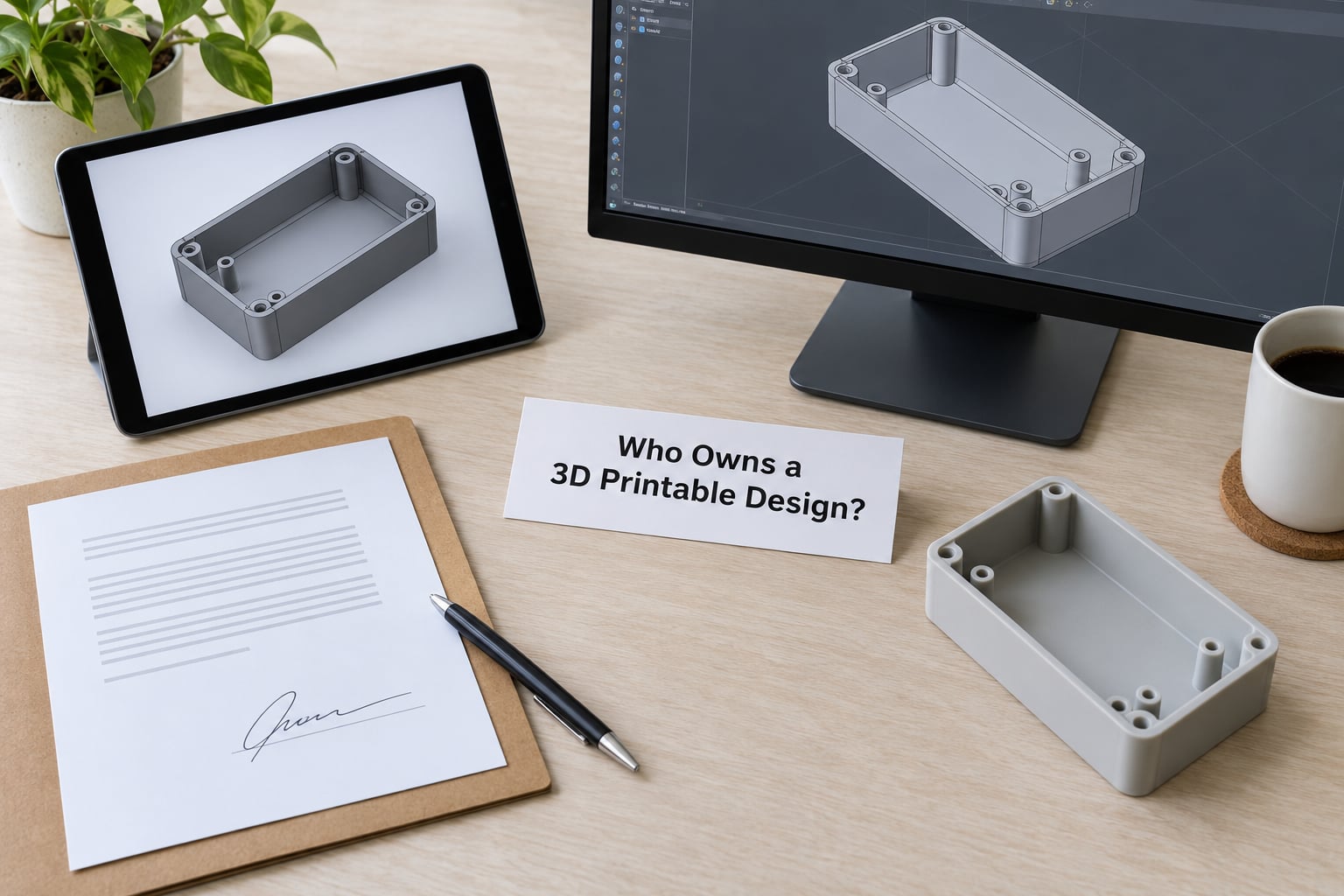
The creator owns the model by default. Ownership shifts only when an agreement, an employment relationship or a written assignment says so, which is why the answer changes so much depending on who paid and who was on the clock.
Work made by an employee for the employer as part of the job belongs to the employer under default US rules. An independent maker who models at home owns what they make, and a written license decides how much of that ownership leaves the studio. Contract work is the messy middle, because a commissioned piece is usually not a work for hire unless both the commissioning party and the creator agree in a signed writing before the work starts.
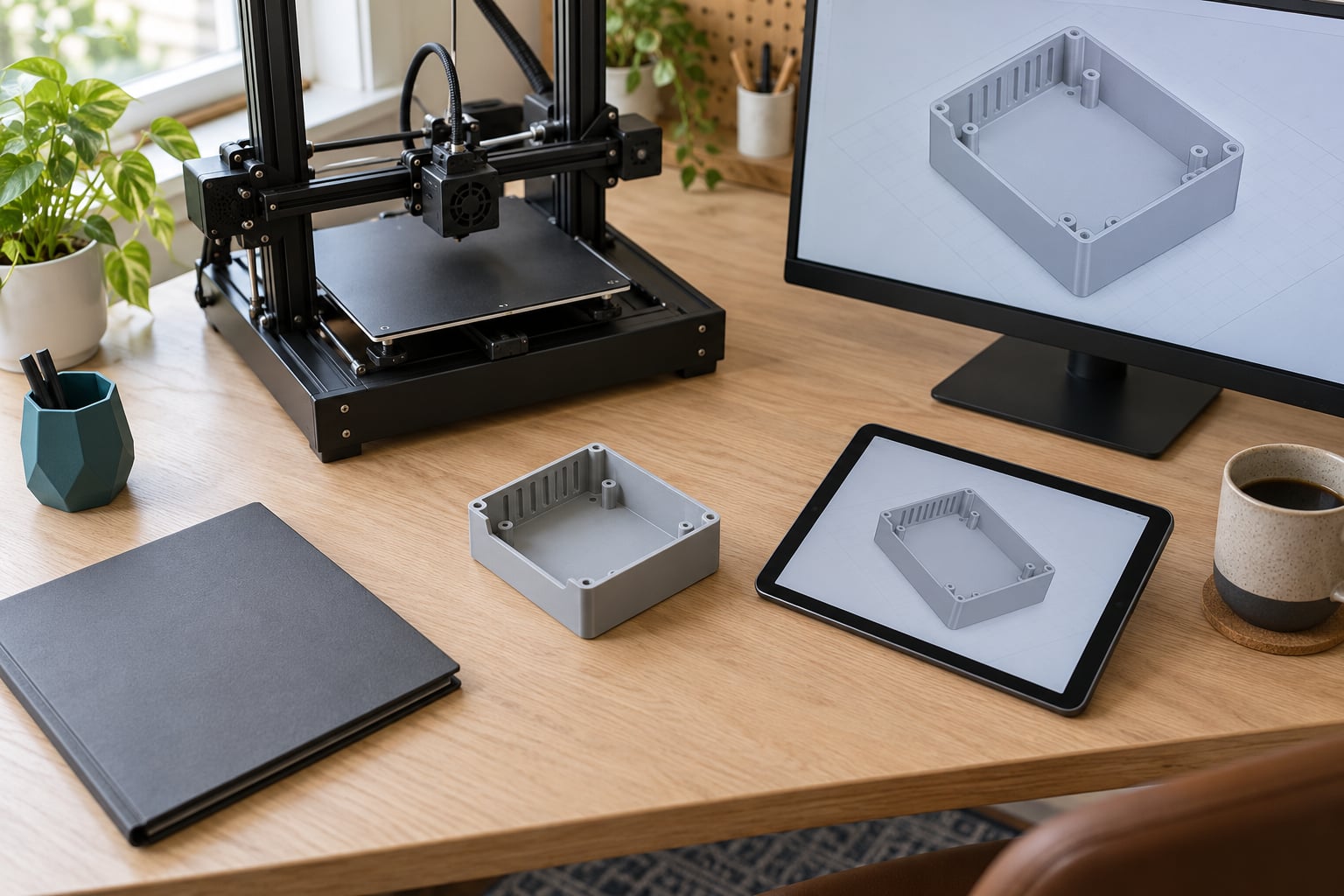
Take a small hardware company that pays a freelancer to design a custom electronics enclosure. The default outcome is that the freelancer owns the copyright and grants the company a license, often broad and sometimes perpetual. If the company needed to stop the freelancer from reselling that enclosure to anyone else, that requires language saying so. Retrofitting it later is far harder than writing it into the first contract.
| Situation | Who owns the copyright by default | What changes it |
|---|---|---|
| Staff designer paid by a manufacturer | The employer | Contract terms can carve out personal works |
| Independent maker, no contract | The maker | Any license they sign later |
| Freelancer hired for one project | The freelancer | Signed work-for-hire or written assignment |
| Student project | The student, subject to school terms | Course agreements often grant the school a license |
| Model generated from a written prompt | Unsettled and fact-specific | Human authorship, disclosed records, counsel |
That last row is worth pausing on. Models produced with generative AI tools sit in genuinely unsettled territory, and courts have focused on how much human authorship is present. If a designer directed the geometry, corrected errors and revised the result, the human contribution is stronger evidence. If a prompt produced the file untouched, the position is weaker. Documenting your process helps either way.
Scan-derived meshes fall into a similar gray area. Scanning a useful article produces a file with little independent creative expression, which leaves thin protection. Scanning an ornamental object and refining it by hand is a different case. Reviewers in the maker communities are blunt about this: a scan of a branded product carries the trademark problem regardless of who made the mesh.
Can You Download, Modify and Sell Someone Else’s Model?
Each activity needs its own permission. Downloading, printing, modifying, selling the object and distributing the file are separate rights, and a license that covers one rarely covers the rest.
| What you want to do | Permission typically required |
|---|---|
| Print for personal use | Usually covered by a free download |
| Print as a gift or for a friend | Usually fine; check for any gift restrictions |
| Modify geometry and print for yourself | Derivative rights in the license |
| Sell physical prints | Explicit commercial rights or your own design |
| Run a print farm or service bureau on it | Extended or enterprise commercial terms |
| Publish your modified file | Share-alike or redistribution rights |
| Upload the original file to another platform | Redistribution rights, rarely granted |
Selling the printed object while withholding the source file sits in a legally unsettled zone that many courts have not squarely resolved. That is why experienced sellers keep the sales physical, keep the file private, and never list a purchasable download of somebody else’s geometry.
Now the myth that circulates most often in hobby forums: if I change 20% of a model, it is mine. There is no percentage in copyright law. Substantial similarity is judged by whether protectable expression was copied, and a small edit to a distinctive shape leaves most of that expression intact. Sellers who report successful marketplace listings built on modified free models are describing a business that ends the day one claim succeeds.
Membership downloads deserve their own warning. A Patreon drop or a paid members-only library carries no automatic commercial license. Paying a subscription gets you access to a file. It does not, by itself, grant the right to sell what you make from it, unless the creator says so in writing.
For print shops and service bureaus, the working arrangement is that the shop runs the machine while the customer who supplied the file carries the copyright responsibility. That is why good shops ask for a signed statement that the customer holds the rights and that the file does not infringe. A shop that prints a customer’s file on request is generally far less exposed than a shop that advertises and sells infringing designs itself.
3D Printing Copyright and Licensing: Common License Types
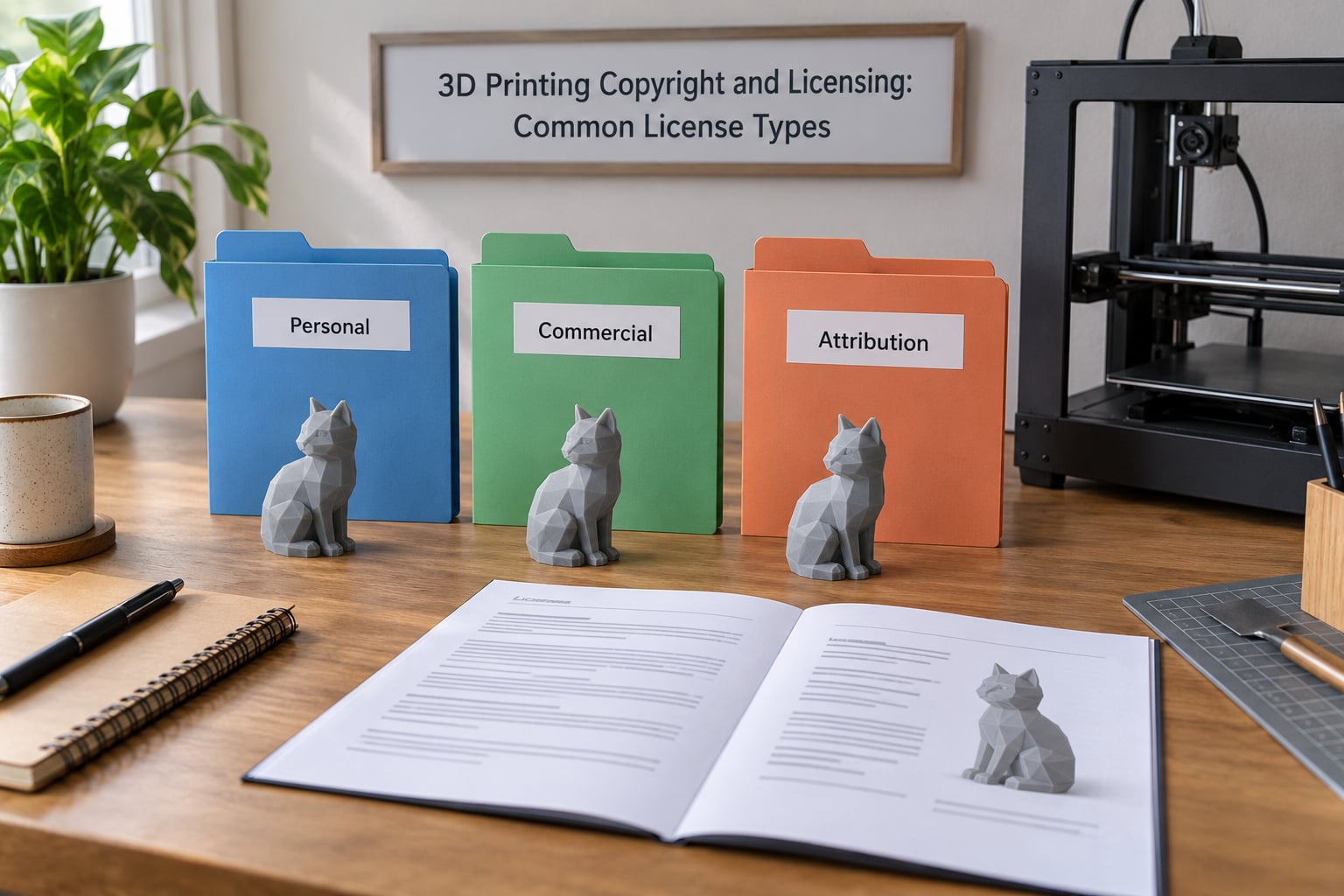
License types fall into a handful of recognizable families, and each one answers the same question differently: what am I allowed to do with the file, and what do I have to give back? Naming the exact license matters more than makers expect, because the labels carry specific legal meaning.
| License type | Commercial use | Attribution | Derivatives | Typical fit |
|---|---|---|---|---|
| Personal use only | No | Sometimes | Unclear, often no | Default on many free model pages |
| CC BY 4.0 | Yes | Required | Yes | Community sharing with credit |
| CC BY-SA 4.0 | Yes | Required | Yes, share alike | Open ecosystems and open hardware |
| CC BY-NC 4.0 | No | Required | Yes, noncommercial only | Free hobby sharing |
| CC BY-NC-SA 4.0 | No | Required | Yes, share alike | Free hobby sharing with remix rights |
| CC0 or public domain | Yes | No | Yes | Maximum downstream freedom |
| Commercial license, royalty-free | Yes | Per terms | Per terms | Sell prints without royalties |
| Exclusive license | Yes | Per terms | Usually limited | One buyer, no competing sellers |
CC BY-NC is the one that catches people. It allows free use, free sharing and free modification, but only for noncommercial purposes, and the license spells out that noncommercial use is not limited to personal or hobby projects. The noncommercial line runs through your entire business, not just your hobby budget.
CC0 is the mirror image. It is a dedication rather than a license, which means the maker gives up claims to the fullest extent legally possible. Nobody can reliably stop you from printing it, selling it, or modifying it, though trademarks and patents can still apply to a particular file.
How to Read a 3D Printing License Without Guesswork
Read for eight things, in this order: the permitted uses, the prohibited uses, attribution requirements, whether derivatives are allowed, quantity or territory limits, duration, support terms and liability limits. If a listing is silent on one of those, treat it as unresolved rather than permitted.
Look for the actual sentence that grants permission, not the marketing label. A badge reading commercial use can still hide a print quantity cap of fifty units, a requirement to link back, or a clause banning use in products aimed at children. Sellers on maker platforms report that hidden limits inside the fine print cause most of their problems.
If no license appears at all, ask the creator in writing before you print for sale. Forum folklore treats a missing license as ambiguous, and it is ambiguous: silence is not permission, but a short written answer from the creator usually settles the question in one message.
What Rights Do Buyers Receive?
Buyers get very different things depending on what they actually bought, and the word ownership does real damage in marketplace conversations because it rarely means the same thing to a buyer and a seller.
Owning a digital file means holding a copy of it. Unless the license says otherwise, that copy is for the permissions the license grants, and it is not an asset you can resell. Receiving a physical print means you own an object, which carries no rights in the underlying design at all. Buying a finished product is the same category with different packaging.
Buying the intellectual property is a different transaction entirely. That is an assignment or an exclusive license, and it is normally handled through a written agreement rather than a marketplace checkout. Some creators do sell that outright; most do not.
A receipt for a commercial license should identify the licensed asset, the permitted uses, any quantity or term limit, attribution requirements, what support is included, and an explicit statement on redistribution. Sellers who write those terms into the listing description report far fewer problems than those who rely on a checkout page and hope.
How to License a Model for Commercial 3D Printing
Licensing your own model is straightforward once you separate four decisions: what asset you are licensing, what the buyer may do, how long the grant lasts, and what happens if you want to stop. Most disputes come from leaving one of those unstated.
A workable process looks like this. Define the asset precisely by naming the file formats and version. Choose the rights tier you are offering. Write the terms in plain language and attach them to the download, not just to a page. Record the grant with a dated record showing what was bought and when. Keep proof of every transaction, because enforcement without records is guesswork.
For a creator selling files, four tiers cover almost everything. Personal is free, print for yourself, no selling. Commercial permits selling finished prints, usually with a quantity cap. Extended allows unlimited production plus modification, often for product lines and client work. Exclusive removes the model from sale entirely for a period, usually with a buyout fee and a resale restriction on the buyer.
| Tier | What the buyer gets | What the buyer cannot do |
|---|---|---|
| Personal | File access, personal prints | Sell prints or share the file |
| Commercial | Right to sell prints, capped quantity | Redistribute the file, exceed the cap |
| Extended | Unlimited prints, modification, client work | Publish the source file as their own |
| Exclusive | Sole commercial use in a field or region | Resell the license to a third party |
Service businesses handle a narrower problem. They rarely license files for redistribution, so the grant covers printing the customer’s geometry and delivering finished parts. The terms should state who warrants the design, who indemnifies the other, and that the shop does not host or distribute the file.
Companies commissioning designs have the opposite job. The goal is a work-for-hire clause or a broad assignment, plus a definition of what happens to the design if the designer leaves, gets an outside client, or wants to reuse it in a catalog. Buyers who skip that step often find they hold a license with a narrow scope and no exclusivity.
How to Document Permissions and Avoid Disputes
Permission you cannot prove is permission you do not have. A record trail costs almost nothing and settles most arguments before they start, particularly when a marketplace asks you to justify a listing after a complaint.
Keep the source files and version history for your own designs, including dated exports. Keep every invoice, signed agreement and written license grant you have received or given. Save receipts showing what you purchased, when, and which version. Record attribution details exactly as the license requires, including the URL and license version.
For commissioned work, keep the project brief alongside the signed agreement so the intended use matches what the document actually permits. When a license grants rights for a specific project or industry, a brief that shows the intended market is useful evidence later.
Ask for clarification in writing before you publish or list for sale. A short exchange asking whether the creator permits commercial prints, saved as an email, is stronger than any assumption. Sellers who contact the original designer first report that the answer is often a modest fee, a credit link, or a subscription tier, and the relationship keeps paying off.
Forum experience also favors proactive licensing over reactive takedowns. Creators who publish clear commercial terms and a contact route spend far less time fighting than creators who discover copies months later, and buyers who quote the license in their listing move much faster through a dispute.
What If a 3D Model Is Infringing or Restricted?
If a claim arrives, the first move is procedural: pause distribution of the disputed item without deleting your records. You will need the evidence later, and deleting a listing, a message thread or a file can look worse than the original problem.
Then read the claim itself. Marketplace takedowns are usually procedural, a platform or a rights holder reporting that a file infringes, and the platform may remove content before anyone evaluates the merits. A DMCA notice is a legal document with specific statutory elements, and a defective one can be challenged, though responding carries its own risks and is best handled with counsel.
Identify who actually holds the rights. Plenty of disputed models trace back to a creator who had no claim to the underlying design at all, which is why checking the claimed owner’s own license history sometimes ends a dispute quietly.
If the claim involves significant money, a design you depend on, or your own original work being sold by someone else, talk to a US intellectual property attorney before you respond in writing. A careless reply can waive rights, and a settlement offer can be read as an admission. Keep your tone factual, keep it brief, and keep your records.
Separately, product safety sits outside copyright but affects service bureaus and anyone selling functional prints. A part that fails in a customer’s equipment can create liability that no license resolves, so document material and safety limits with the customer.
Frequently Asked Questions
Does buying a 3D model give me the right to sell the source file?
Almost never. Buying a file grants you whatever permissions its license lists, and redistribution of the source file is one of the most commonly withheld rights. Personal use, commercial print sales and file resale are three different permissions. Selling the source, uploading it to another platform, or including it in a bundle requires redistribution rights stated in writing. If the listing is silent, ask the creator before you list anything, and keep that answer.
Is a 3D-printed object itself protected by copyright?
The finished print does not carry its own copyright. Copyright attaches to the original expressive work, such as a CAD or mesh file, a drawing, a photograph or written instructions. A physical copy has no independent rights, which is why purchasing a printed object transfers nothing about file permissions. Someone who bought a print can absolutely copy that object, and that copying is not infringement. Other rights, including patents and trademarks, can still apply.
Can I change a licensed 3D model and sell the modified version?
Only if the license allows derivatives and allows commercial use. CC BY 4.0 and CC BY-SA 4.0 permit modification, while CC BY-NC variants allow modification but keep it noncommercial. There is no percentage threshold in copyright law that makes a model yours, so changing 20% of a shape generally leaves most protectable expression intact. Share-alike terms may also require your modified file to carry the same license if you distribute it.
Does selling a physical 3D print infringe the model creator’s copyright?
It can, and it is the most commonly enforced mistake in the hobby. Personal use and noncommercial licenses cover printing for yourself, not listing prints for sale on a marketplace. Sellers of physical prints generally need explicit commercial rights, their own original design, or a file released under CC0. Keeping the source file private and selling only the physical object reduces risk, though courts have not uniformly settled that question. Get the permission in writing first.
How can a small business prove permission to use customer-supplied 3D files?
Require a short signed statement at the time of the order. It should identify the customer as the file owner or licensee, confirm the license permits commercial printing, name the license and its version, and describe the intended use and end product. Keep the statement with the job record and a copy of the file as received. Service bureaus that document this up front report far fewer disputes than those that rely on verbal assurances.
Conclusion
Name the exact asset you are dealing with, in the exact format and version. Document who created or commissioned it and under what agreement. Read the license sentence that grants permission, not the badge above it. Match your intended use to explicit permission, and when it is missing, ask in writing and save the reply. Then keep the whole chain: source files, invoices, receipts, agreements and attribution details.
That sequence takes an afternoon and prevents nearly every dispute in this space. Copyright law and contract terms vary by jurisdiction and shift over time, so check current guidance and get qualified US counsel when real money or material rights are on the line. This article is general information, not legal advice.