To get a job in additive manufacturing, pick one role, learn the software and processes that role actually uses, then prove you can run a part from design file to finished, measured part. Nine people out of ten who struggle with this search have a resume full of software names and no shipped parts behind them.
The field is unusually open to people coming from odd angles. Machinists, tool and die makers, dental lab techs, welders, CAD designers, materials science students and mid-career mechanical engineers all land in additive manufacturing roles, because the industry is still short on people who have actually run a machine and can explain a failed build.
This guide is written for 2026 job seekers: students finishing a program, career changers, and people already in manufacturing who want the next step to be additive rather than a lateral move. It is a roadmap, not motivational filler. Every step below has an action, a reason it works, and a way to tell whether it worked.
Table of Contents
- 1What You Need
- 2Step-by-Step: How to Get a Job in Additive Manufacturing
- 31. Choose the Career Path That Gets You Hired in Additive Manufacturing
- 42. Build the Skills Employers Request
- 53. Get Hands-On With the Technology
- 64. Create a Portfolio That Demonstrates Results
- 75. Write a Resume and LinkedIn Profile for AM Roles
- 86. Find Jobs Through Multiple Channels
- 97. Network With People in the Industry
- 108. Prepare for Technical and Behavioral Interviews
- 119. Apply Consistently and Improve Your Odds
- 12Common Mistakes
- 13Frequently Asked Questions
- 14Do I need a degree to get a job in additive manufacturing?
- 15How much do additive manufacturing technicians make?
- 16Are 3D printing jobs in demand?
- 17What software should I learn first for a 3D printing job?
- 18How do I build an additive manufacturing portfolio with no job experience?
- 19Conclusion
What You Need
Before you send a single application, five things need to be in place. Most candidates prepare two of them and wonder why the callbacks never come.
A direction. Additive manufacturing is not one job. It splits roughly into machine-side work, design-side work, quality and qualification work, and commercial or application work. Decide which family you are aiming at first, because the tools, the vocabulary and the hiring manager all change with it.
Baseline qualifications. Technician and operator roles usually ask for a high school diploma, an associate degree, or a couple of years of shop experience. Engineer roles ask for a bachelor’s in mechanical, aerospace, manufacturing, materials or industrial engineering, and many accept a master’s for research-heavy positions. A degree gets your resume read; it does not close the interview on its own.
Tools you can reach. At minimum that means a parametric CAD seat, a slicer, access to any printer you do not own, a set of digital calipers, and a phone camera for build photos. Most candidates can get all of it through a university lab, a public library makerspace, or a colleague’s machine for the price of filament.
Documents. A one-page resume, a LinkedIn profile, a short project write-up per build, and two references who will actually pick up the phone. Employers in regulated industries often ask for a training record, so keep certificates and course dates in one folder you can export as a PDF.
Connections. Three conversations with people already working in additive manufacturing will do more for your search than a month of applications. Members of r/AdditiveManufacturing and r/MechanicalEngineering regularly answer questions from people early in a career change, and most of those answers are more honest than any job ad.
Step-by-Step: How to Get a Job in Additive Manufacturing
1. Choose the Career Path That Gets You Hired in Additive Manufacturing
Job ads in this industry borrow titles from conventional manufacturing, so the same word can mean very different work. Read the responsibilities, not the title, when you compare postings.
| Role | What the work actually is | Typical entry requirements | Core software |
|---|---|---|---|
| Print technician / machine operator | Loads builds, monitors parameters, handles powder or resin, performs first-article checks and post-processing | High school diploma or associate degree, shop experience, safety training | Slicer, machine control software, MES or ERP basics |
| Additive manufacturing technician (setup and finishing) | Build orientation, support strategy, support removal, heat treatment, surface finishing, dimensional inspection | Associate degree or apprenticeship, caliper and gauge use, documentation habits | Slicer, CAD viewer, metrology software |
| CAD / DfAM designer | Designs parts for additive constraints, applies lattice and topology optimization, works with the print team on orientation and supports | Bachelor’s or associate degree in engineering or design, portfolio of designed parts | SolidWorks, Fusion 360, nTopology, Siemens NX |
| Process engineer | Owns parameters, build orientation, distortion control, powder reuse strategy, and cost per part | Bachelor’s in mechanical, manufacturing or materials engineering, 1 to 3 years in AM | Parametric CAD, slicing and simulation tools, statistics for DOE |
| Quality engineer | Inspection plans, CT and coordinate metrology, qualification and certification testing, nonconformance root-cause work | Bachelor’s in quality, mechanical or manufacturing engineering, quality systems background | GD&T, Minitab, inspection software, PLM |
| Application engineer | Finds the right process and material for a customer’s problem, runs feasibility prints, supports sales and customer trials | Bachelor’s in engineering, strong communication, travel tolerance | CAD, slicing, material databases |
| AM operations manager | Scheduling, machine utilization, shift coverage, first article and cost delivery across a cell of printers | 5 to 10 years in manufacturing with supervision experience | MES or ERP, scheduling, basic cost modeling |
| Materials specialist / R and D engineer | Characterizes powders and resins, runs mechanical testing, develops new parameter sets and material data | Bachelor’s or master’s in materials, chemistry or mechanical engineering | Minitab, material testing software, characterization tools |
Match the table to what you are already good at. If you enjoy getting parts off a machine and fixing them, start on the technician side. If you like geometry and constraints, design is the shorter path. If you are the person who asks why a part warped, process and quality work pay more and moves faster.
If you are moving from an adjacent field, the translation is usually shorter than you think. From machining and tooling, you already know tolerances, workholding and how a part distorts, so you are a credible technician or DfAM candidate today. From welding and fabrication, you bring hot-process control and safety discipline that metal AM shops value highly. From dental or medical lab work, you bring biocompatible material handling and a customer-facing mindset that transfers to patient-specific parts. From pure CAD design, you have the geometry skills but need to prove you understand orientation and supports. From software, you will be hired for simulation, generative design and machine monitoring work, not for machines.
You will know this step worked when you can name three companies and point to the specific role in each one you would apply to tomorrow. If you cannot, keep narrowing until you can.
It also helps to picture a normal week. The technician at a metal shop spends most of it on builds, powder handling, first article dimensional checks and a queue of support removal and finishing. The DfAM designer lives in CAD and review meetings, and measures success by how few supports a part needs and whether the design can be built in one orientation. The process engineer looks at failed builds, cost per part and machine utilization. Knowing which of those three days you are signing up for prevents the most common first-year regret, which is landing a job that does not match the work you pictured.
2. Build the Skills Employers Request
Job descriptions for additive manufacturing repeat the same list. Learn enough of each item that you could be asked about it in an interview without bluffing.
Design software. SolidWorks and Fusion 360 cover most entry-level postings in North America, with Siemens NX and Creo in larger aerospace and automotive shops. Autodesk Inventor shows up in smaller job shops. Learn one of them deeply and mention the others by name on your resume.
Design for additive manufacturing. This is the differentiator. Know why you cannot put a sharp internal corner in a powder bed part, how overhang angles differ between laser powder bed fusion and fused deposition modeling, when a lattice beats a solid, and how build orientation drives both strength and cost.
Slicing and build preparation. Layer height, wall thickness, infill, supports, raft, adhesion, scan strategy, hatch spacing, and the slicer tradeoffs behind them. Cura and PrusaSlicer are free and teach the concepts; PrusaSlicer, OrcaSlicer and commercial slicers such as nTopology or Materialise Magics all map to the same ideas.
The technologies themselves. Be able to explain in one sentence each what laser powder bed fusion, stereolithography, selective laser sintering, fused deposition modeling, binder jetting, material extrusion and directed energy deposition do well and where each one fails. Interviewers ask this constantly and most candidates blank.
Materials and post-processing. Aluminum, titanium, Inconel, maraging steel, stainless, PA12, TPU, photopolymer resins. Pair each with its post-processing route: support removal, stress relief, heat treatment, hot isostatic pressing, bead blasting, machining of critical features, surface finishing.
Inspection and quality. Calipers and micrometers as a baseline, then coordinate metrology, CT scanning, and tensile coupons. Know what a qualification test is and which quality systems show up in postings, most often AS9100 in aerospace and ISO 9001 elsewhere.
Safety and handling. Metal powder handling, ventilation, respirator protocol, resin disposal, and electrical and hot-end guarding. This is unglamorous and it comes up in interviews more than you would expect.
Documentation and communication. Build travelers, parameter sheets, deviation notes, and the ability to write a root-cause paragraph that a manager can act on. Additive manufacturing runs on records.
Training and certificate programs mostly add a line to a resume rather than a skill. Treat them as signals, not substitutes.
| Route | Time commitment | Cost band | Who it helps most |
|---|---|---|---|
| University certificate or track | Several months, often part-time alongside work | Low hundreds to low thousands | Career changers who need a credential signal alongside a portfolio |
| Master’s degree in additive manufacturing or manufacturing engineering | One to two years full time | Ten thousands | People targeting R and D, process ownership or regulated-industry roles |
| Apprenticeship through a regional manufacturing workforce program | Several years, paid | No tuition, paid during training | Technician and operator candidates who want income while they train |
| Vendor training on a specific platform | One to three days | Under a thousand | Anyone interviewing at a shop that already owns that machine |
| Self-study plus lab access | Ongoing | Filament and lab time only | Career changers with a degree who need proof, not another certificate |
Money ranges in this table are typical US bands and vary by region and by school. Ask any program for the current figure in writing before you commit.
This step is done when you can fill in the table above from memory, and when a stranger could look at your project list and see which of those skills each project proves.
3. Get Hands-On With the Technology
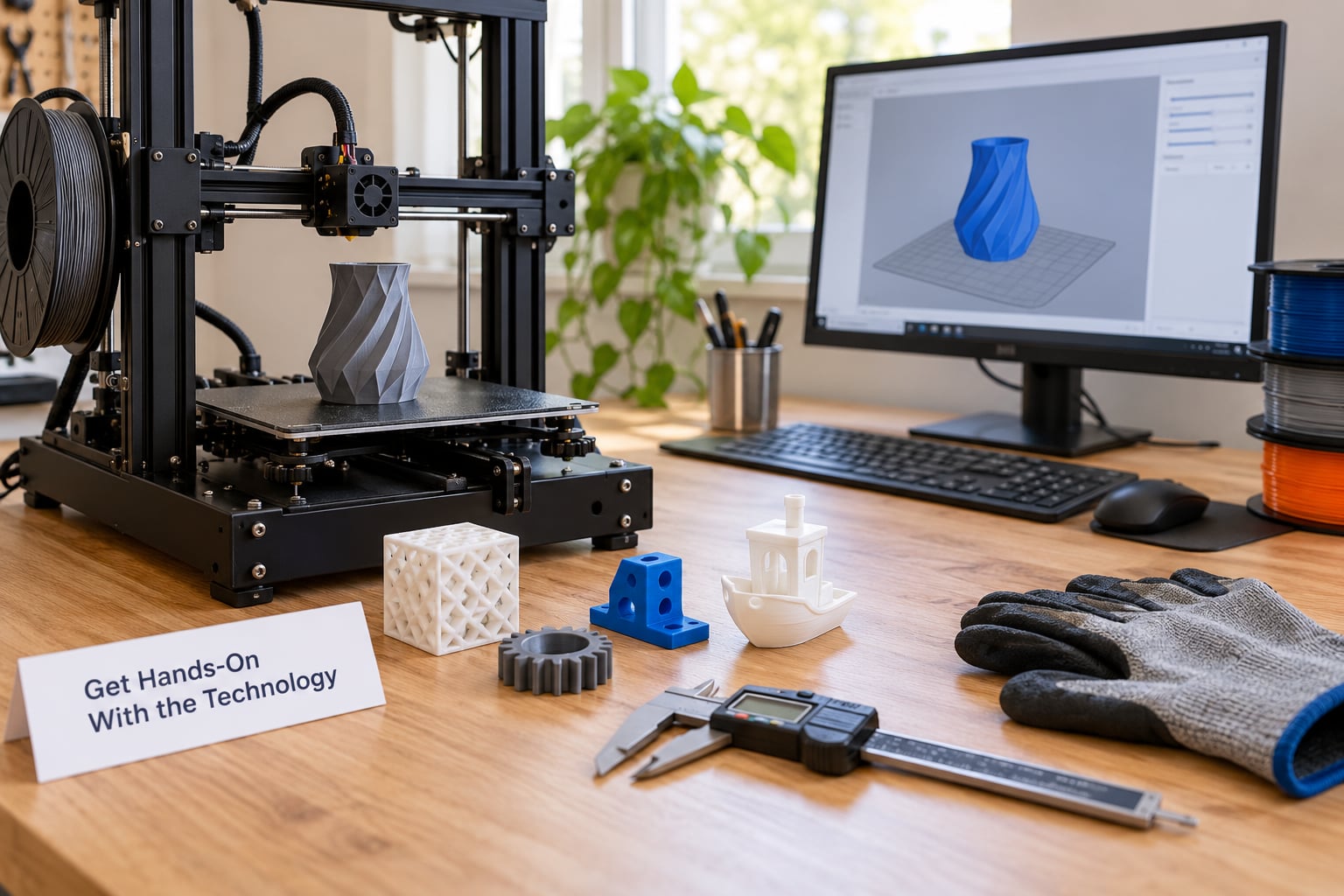
Nobody hires for a certificate alone. The single most common reason additive manufacturing resumes get filtered out is the absence of evidence that the candidate has ever watched a part fail and fixed it.
There are five routes to that evidence, roughly in order of how fast they work.
University or community lab access. Most universities with an engineering program run a makerspace with an FDM printer, a resin machine, or both, and staff will supervise a new user for a few hours. Libraries and public makerspaces do the same thing, sometimes on a membership basis.
Internships and co-ops. Aerospace primes, medical device makers and service bureaus recruit interns year round. Apply early, because AM internships close in the fall for the following summer. If you get one, ask for a project you can document rather than a filing job.
Internal transfer. The most reliable route in. Someone working in the machine shop or the quality lab inside a company that already owns printers can be moved onto an AM cell with one internal application. A machinist with tooling experience and no 3D printing background is a realistic hire for an entry AM technician role today.
Freelance and service bureau work. Small bureaus and independent shops hire part-time help for build prep, support removal and finishing. The hours are rough and turnover can be high, so treat it as a way to accumulate hours, not a destination. Veterans in r/AdditiveManufacturing consistently flag high-turnover employers as the first thing to check when weighing a job offer.
Personal projects with a real brief. A printed part that solves an actual problem beats ten calibration cubes. Jigs and fixtures for your own shop, brackets for a motorcycle, a mold insert, a replacement knob for a broken appliance.
You will know this step worked when you can name a part, describe the parameters you used, and say what you would change. Aim for ten documented builds before you start applying in earnest.
4. Create a Portfolio That Demonstrates Results
A portfolio is not a gallery of prints. It is evidence that you can take a requirement to a finished, measured part. Two or three projects written up properly will do more than twenty photos.
Each project needs six things: the problem and who needed it, the design decisions and why you made them, the material and print parameters, what went wrong, the result measured with real numbers, and what you changed as a result.
Numbers are what separate AM portfolios from 3D printing hobby pages. State your material, layer height, print time, achieved tolerance, part mass, and the failure mode you chased down. A write-up that says a part warped at the base, that you reoriented it 35 degrees, added a raft, dropped the chamber temperature, and the distortion went away is worth more than a page of renders.
Include a failure. Employers read them as troubleshooting ability, and the ability to run a root-cause analysis is the thing they are quietly screening for. Someone who has never had a bad build has not run a real machine.
Where to host it: a single well-structured PDF works, or a simple personal site with one page per project. Keep photographs consistent in lighting and angle, and label every image with the material and parameters used. Hiring managers scan these on a phone, so make the first image do the work.
You will know this step worked when someone who has never met you can read one page and describe your process accurately.
5. Write a Resume and LinkedIn Profile for AM Roles
The most common resume mistake in this field is volume. Candidates list every process and every software package they have ever opened, and the document reads like a vendor brochure. Reviewers on r/EngineeringResumes give the same advice to AM applicants: cut it down, and let a short skills section do the listing.
Write bullets around outcomes, not tools. Instead of “responsible for operating 3D printers,” write “ran 40-plus FDM and resin builds to schedule, logging layer height, cure time and dimensional results for each.” Instead of “familiar with design for additive manufacturing,” name the part and the decision: “reoriented 12 aluminum brackets to a 30-degree build angle, eliminating support removal on the critical face.”
Your skills section should name software and technologies precisely, because that is what recruiters filter on. SolidWorks, Fusion 360, nTopology, PrusaSlicer, DfAM, laser powder bed fusion, stereolithography, selective laser sintering, binder jetting, directed energy deposition, GD and T, AS9100, FDM, post-processing, metrology. Keep it to a list; do not write a paragraph per item.
For LinkedIn, put the role you want in the headline rather than a vague label. Something like “Additive Manufacturing Technician, LPBF and SLS, seeking production role” tells a recruiter exactly what to file you under. Add your three strongest projects with images, list the processes you have run, and post occasionally about something you built or fixed.
You will know this step worked when a recruiter who never speaks to you files your application under the right title, because the words on the page told them what you do.
6. Find Jobs Through Multiple Channels
One job board is a strategy with a low ceiling. Run six channels at once instead, because additive manufacturing hiring is fragmented across employers, bureaus, universities and recruiters.
Company career pages first. The aerospace and medical device companies with real AM programs post their AM roles directly and rarely list them on aggregators. Build a target list of thirty employers in the industries you want, and check their career pages weekly.
Specialist boards and general boards. Use the large general boards for volume, but also search the additive-specific and manufacturing-specific boards, and filter by the process terms rather than the job title, since titles vary so much.
Service bureaus and machine vendors. Service bureaus hire operators and application engineers constantly, and machine vendors hire field applications engineers who travel to customer sites. Both routes give you process exposure quickly.
America Makes AMJobs. The free career discovery tool from America Makes maps AM occupations to real tasks and links to training and job pathways. It is the least used resource on this list and one of the most useful for figuring out which role actually matches your strengths.
Universities, consultancies and associations. University AM centers post graduate assistant and internship roles, independent engineering consultancies hire junior engineers, and groups such as SME and America Makes run local chapters where job postings circulate.
Recruiters who specialize. A handful of agencies place AM engineers and technicians specifically. Tell them which process you want to work in, because a general recruiter will read your resume as a machinist’s.
Then track it. A spreadsheet with company, role, link, date applied, follow-up date, and response gets you more interviews than any resume rewrite, because the follow-up is what most people skip.
7. Network With People in the Industry
Community consensus among people who have hired in this field is that networking is probably the most important factor in landing a design or process role. It is not a soft extra. It is how the referral channel works, and referrals move faster than applications.
Build a repeatable weekly habit instead of occasional conference panic. One hour a week: read two technical threads and answer one question well, comment on something you built, send two short outreach messages, and follow up on anything from three weeks ago.
Where the conversations happen: r/AdditiveManufacturing and r/MechanicalEngineering for practical advice, r/EngineeringResumes for document feedback, r/findapath for career-change questions, local SME chapters for in-person introductions, and additive manufacturing trade shows for face-to-face time. Conference exhibitor booths are unusually approachable; engineers staffing a booth will talk about their process for twenty minutes if you ask a real question.
Outreach works when it is specific and short. Something like: “I am a mechanical designer with three years in tool and die, learning DfAM and building a portfolio of printed brackets. What does your team see in candidates coming from that background, and what would you want to see on a resume? Happy to send the portfolio.” That gets replies because it is about them, specific, and easy to answer in two lines.
Informational interviews are the most efficient use of this time. Ask about what a hard week looks like, what the team argues about, and what they wish they had hired differently. Those answers are also the best interview preparation you will get, because you will be talking to the same people about the same topics.
You will know this step worked when two or three people have told you what they are hiring for, and one has offered to look at your portfolio.
8. Prepare for Technical and Behavioral Interviews
Most additive manufacturing interviews are part technical, part conversation about how you work. Prepare both halves, because the same companies ask both in the same hour.
Technical questions cluster around a few predictable areas: given this STL and this material, what orientation would you choose and why. What causes warping in an aluminum LPBF part, and what would you change first. How would you decide between FDM, SLA and SLS for a functional prototype. What support strategy suits this geometry. How do you handle powder reuse, including blend ratios and sieve limits. What tolerance can you hold on each process, and how would you verify it. Which inspection method would you choose for a thin-walled internal channel, and why not the other options.
Prepare real stories for the behavioral half. Have one on a print that failed and what the root cause turned out to be, one on a time you had to deliver under a tight schedule, one on a disagreement with a designer or a customer about tolerances or orientation, and one on documentation you wrote that prevented a repeat problem. Rehearse them out loud, because the AM story about a failed build is the one interviewers remember.
Ask good questions back. What does a successful first six months look like in this role. Which process is growing here and which is at capacity. How do builds get qualified, and who signs off on a new material. How do you learn.
You will know this step worked when you can answer any question about your portfolio in ninety seconds without checking your notes.
9. Apply Consistently and Improve Your Odds
Consistency beats intensity. Ten tailored applications a week for eight weeks will outperform fifty generic ones, and most people stop at three.
Tailor the top third of the resume to each posting. Mirror the process names the employer uses, because that is literally what the applicant tracking system matches. For a role that says laser powder bed fusion and DfAM, do not lead with stereolithography.
Follow up once, ten days after applying, with something short that adds information rather than asking for a status. Mention a relevant project, a certification you just finished, or a question about their process. Two sentences is plenty.
Treat rejection as data. If you never get interviews, the problem is almost always the top of the resume or the missing evidence of hands-on work, not your degree. If you get interviews and no offers, the problem is usually your answers or your lack of process vocabulary. Track which of the two is happening and fix that one thing.
While you wait, keep building. Every documented print, every answer you write on a forum, every certificate finished is another line for the resume. A job search that produces artifacts is never wasted time.
A ninety-day plan makes the whole thing manageable. In the first month, settle the role, learn the CAD and slicing basics, and get a foot on a machine for the first time. In the second, build two finished projects and write them up while the details are fresh, and start a second project that will fail so you have something to troubleshoot. In the third, publish the portfolio, rewrite the resume around outcomes, and begin applying ten tailored postings a week while you keep the outreach habit going.
Common Mistakes
Most filtered-out candidates make one of these seven errors. Each has a simple fix.
Listing every process and every software package you have ever opened. It reads as padding and it buries the two things you should highlight. Fix: a short, precise skills list, and bullets that describe outcomes instead of duties.
No evidence of hands-on printing. This is the number one reason a perfectly good engineering resume gets passed over. Fix: ten documented builds with parameters and results, even if they are personal projects, and put them where the hiring manager sees them in the first ten seconds.
Ignoring materials and safety. Candidates focus on design and machines and can barely discuss powder handling or resin disposal. In regulated shops that is disqualifying. Fix: know the material families, their hazards, and the handling rules that apply to each.
Skipping documentation. Additive manufacturing is a documented process. If your work has no parameter records or build notes, it looks unrepeatable. Fix: keep a build log for everything you make, and bring it to the interview.
Learning only the software and never the process. You can be fluent in a CAD package and still not know why a part distorts. Fix: learn the process behind the geometry, one technology at a time, deeply, rather than five shallowly.
Treating networking as optional. The people hiring in this field are reachable and mostly friendly. Fix: the one-hour-a-week habit, and a short specific message that asks about their team.
Applying without tailoring. A generic resume that mentions resin in a laser powder bed fusion posting signals that you did not read the listing. Fix: spend fifteen minutes per application adjusting the top third.
Two extra tips worth having. Watch employer turnover before you accept, because a shop that churns technicians will churn you too, and veterans in r/AdditiveManufacturing call this out as the first thing to check. And do not let the fear of missing out push you into a bad first role; the same anxiety shows up in r/MechanicalEngineering threads, and the people who ended up happy took one deliberate step at a time rather than jumping.
One more thing about the field itself. An AM background is narrower than people fear. Process engineers move into quality, quality engineers move into manufacturing engineering, and DfAM designers move into product development everywhere. Learning the process well enough to explain it is what makes the background portable.
Frequently Asked Questions
Do I need a degree to get a job in additive manufacturing?
It depends on the role. Print technician and machine operator postings usually accept a high school diploma, an associate degree, or equivalent shop experience, and apprenticeships are a common route. Designer, process, quality and application engineer roles almost always ask for a bachelor’s in mechanical, aerospace, manufacturing, materials or industrial engineering. Where a degree is required, what gets you hired is the portfolio and the hands-on record that comes with it, not the paper itself.
How much do additive manufacturing technicians make?
Technician and operator pay varies more by state and shift pattern than by process. In the United States, entry-level additive manufacturing technicians commonly fall somewhere in the mid-40,000s to the mid-60,000s a year, and experienced technicians or those working night shifts on production cells sit higher. Engineers sit in a different band again, often reaching the low six figures. Treat all of these as rough ranges that change with the region and the economy, and check current postings in your own city.
Are 3D printing jobs in demand?
Demand is real but narrower than the headlines suggest. The strongest hiring sits with companies that have already bought machines and need people to run them, especially in aerospace, medical devices, tooling and energy. Entry-level operator roles are competitive because they are accessible, while process, quality and DfAM roles are harder to fill and pay better. Regional workforce programs and the America Makes AMJobs tool are useful for seeing which roles are open in your area right now.
What software should I learn first for a 3D printing job?
Start with one parametric CAD package, either SolidWorks or Fusion 360, because nearly every posting names one of them. Add a free slicer such as PrusaSlicer or Cura to learn layer height, walls, supports and orientation. Learn design for additive manufacturing alongside both, not afterward. Only then add simulation and generative tools such as nTopology, which matter for process and DfAM roles rather than entry technician work.
How do I build an additive manufacturing portfolio with no job experience?
Pick two or three real problems and solve them end to end. Document the brief, your design decisions, the material and print parameters you chose, what failed, and the measured result with numbers such as tolerance achieved, part mass and build time. Include one failure and the fix. Personal projects, lab access, course projects and freelance prints all count, and this write-up is usually what gets you the first interview.
Conclusion
How to get a job in additive manufacturing comes down to proof that you can run a part from design file to finished, measured piece, and the field is more open to career changers than most people realize. The path is the same for everyone: pick one role, learn its tools and processes, produce documented builds, and let people in the industry know you exist.
Three things to do this week. Choose the role from the table above and write down the three companies that hire it. Pick one project you actually need solved and book time on a printer to build it. Then start a build log and a one-page project write-up, because that log becomes your resume in six weeks.
2026 is a good year to start, since the field is still short on people who can run a machine and explain the result.