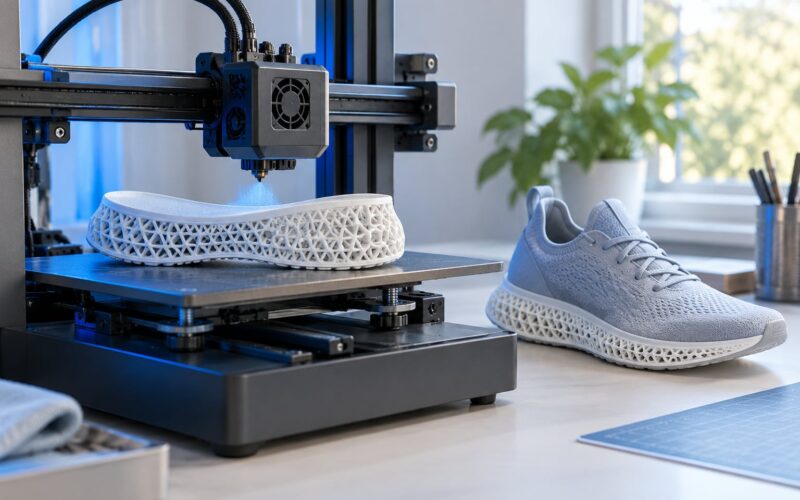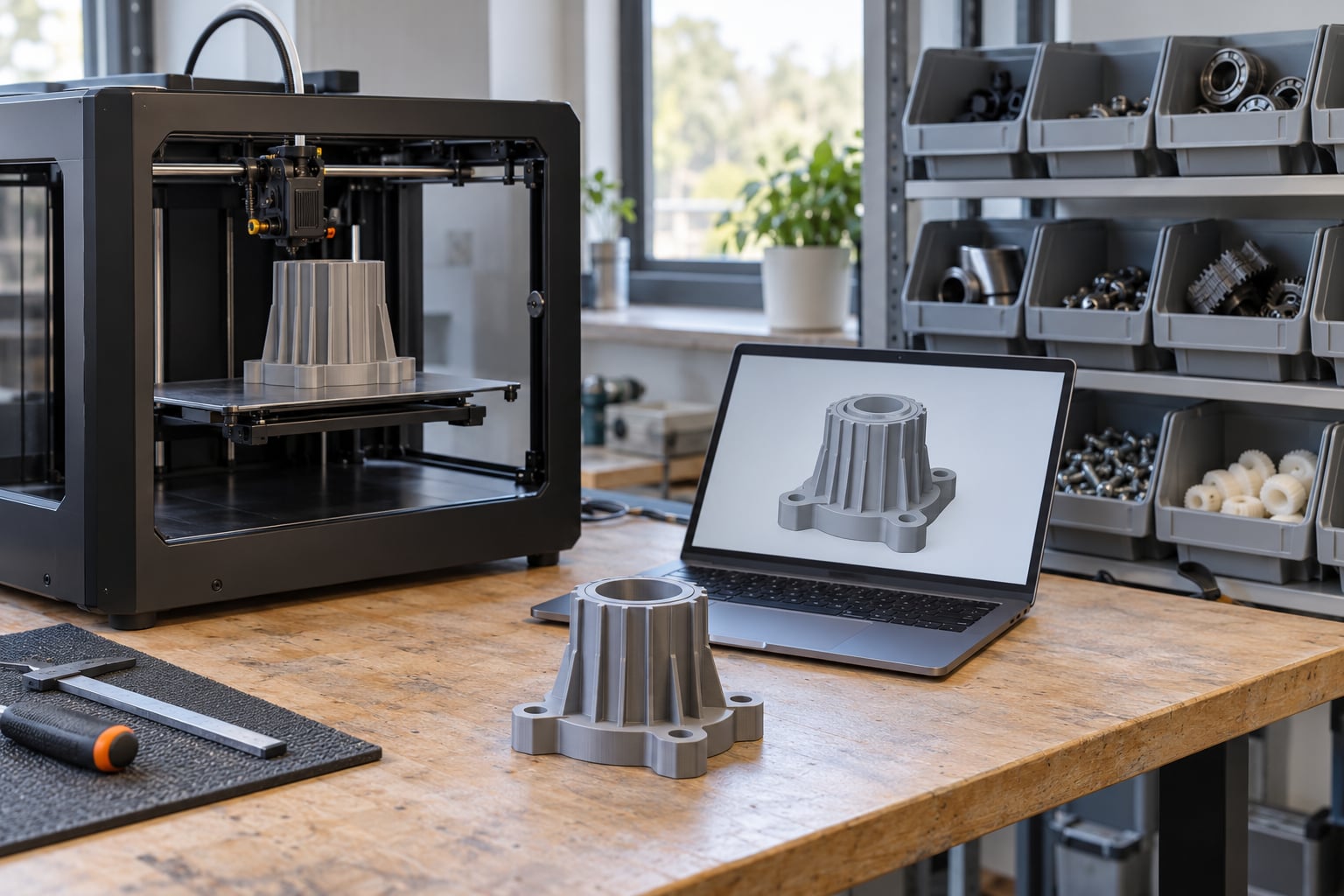
3D printed spare parts are replacement components produced additively from a digital CAD file at the moment they are needed, instead of being manufactured in batches, stored in a warehouse, and shipped when a machine breaks. For supply chain teams, that shift turns a physical inventory of parts into a file repository, cutting replenishment lead times from weeks to days and removing most of the carrying cost of holding slow-moving spares for legacy equipment.
I work with manufacturing and MRO teams who come at this from two directions. Some have a shelf full of obsolete parts they can no longer reorder; others have a maintenance technician standing next to a stopped line waiting on a courier. Additive manufacturing gives both groups a third option, but only for certain parts and only with the right controls around qualification and documentation.
Table of Contents
- 1What Are 3D Printed Spare Parts?
- 2Printed on demand versus manufactured in bulk
- 3Digital inventory and the digital thread
- 4Why Use 3D Printed Spare Parts in the Supply Chain?
- 5Which Parts Are Best Suited to 3D Printing?
- 6Strong candidates
- 7Poor candidates
- 8How to Choose the Right 3D Printing Process
- 9How to Qualify 3D Printed Spare Parts for Production
- 10The workflow
- 11How Do 3D Printed Spare Parts Affect Inventory and Lead Times?
- 12When a printed part replaces physical stock
- 13The five components of the true cost
- 14What Are the Main Risks and Limitations?
- 15How Can Companies Build a Reliable 3D Printing Supply Chain?
- 16A five-step roadmap
- 17Protecting the file
- 18Metrics worth tracking
- 19Frequently Asked Questions
- 20Is 3D printing useful for making spare parts?
- 21How do you get a spare part 3D printed?
- 22What are the benefits of 3D printing for supply chain management?
- 23Can 3D printed parts replace machined parts?
- 24What materials are used for 3D printed spare parts?
- 25What are the main challenges of 3D printed spare parts?
- 26Conclusion
What Are 3D Printed Spare Parts?
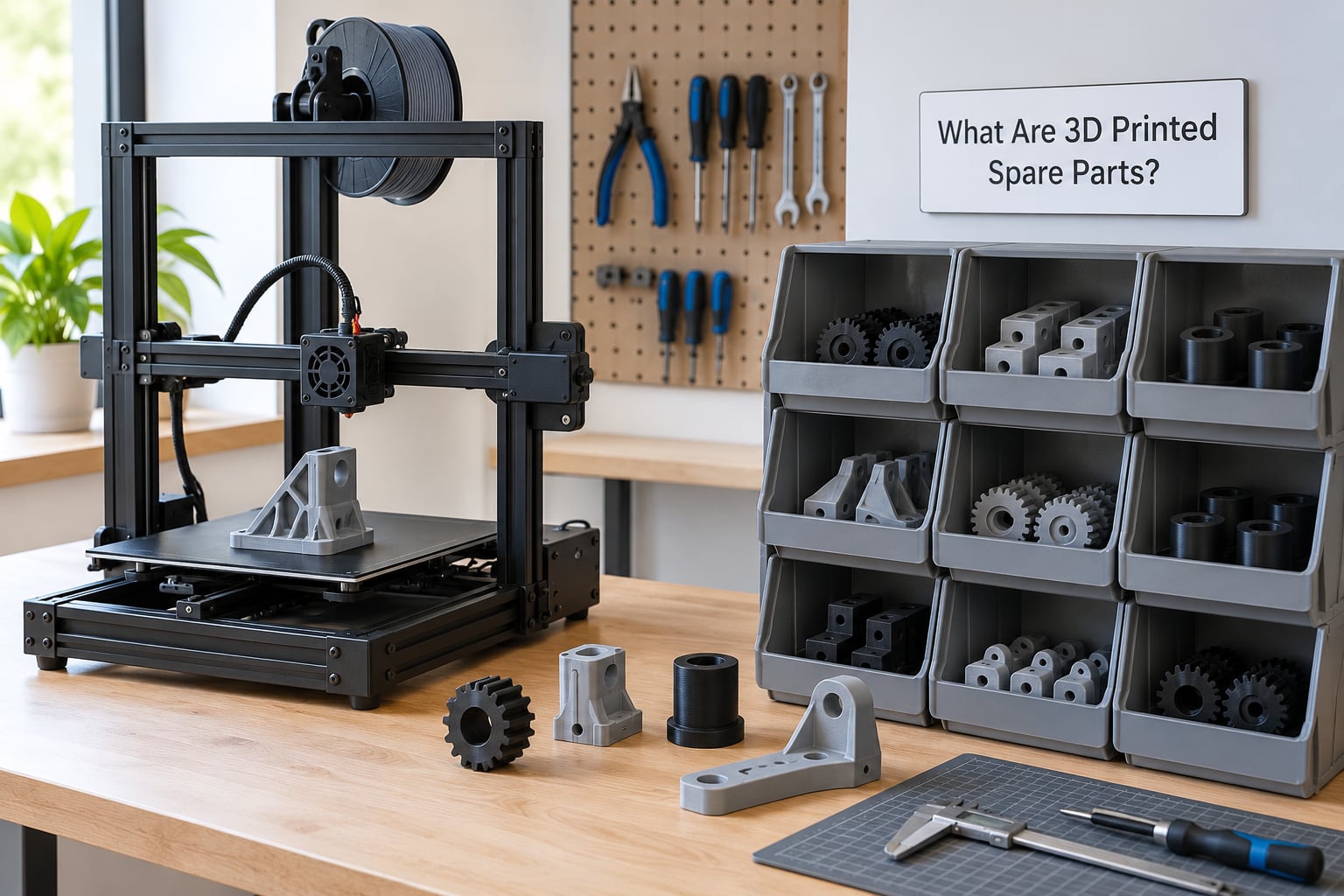
3D printed spare parts are replacement components built layer by layer from a qualified digital model, produced on demand at the point of need rather than ahead of demand in a factory run. They serve the same function as a conventionally manufactured part but are produced one at a time, in the material and geometry you need, at the moment the failure occurs.
Printed on demand versus manufactured in bulk
A conventionally manufactured spare follows a batch model. A supplier runs a quantity, ships it, stores it somewhere, and you reorder when stock drops. If demand never materialises, the excess sits and eventually obsoles. The 3D printed equivalent inverts that: the part exists as a file, and a physical unit is made only when a specific machine needs it.
That inversion is the whole point. Additive manufacturing removes the minimum order quantity, the forecast, and the shelf, which is why it works best on low-volume, high-value, long-lead-time parts where the catalogue is huge but demand for any single item is tiny.
Digital inventory and the digital thread
Digital inventory means storing qualified part files in a controlled repository and treating that repository as the stock location. When a part is needed, the file is released to a printer, produced, inspected, and shipped. The physical part has a short life; the file has a long one, and it is the file that carries the revision history, material spec, and print parameters.
The related idea is the digital thread, the connection between design, production, and service data. When a part is redesigned for additive manufacturing, that change should follow the part through the file, the print job, the inspection record, and the maintenance history. Most teams start with a folder of CAD files and a naming convention, and that is already better than nothing.
Why Use 3D Printed Spare Parts in the Supply Chain?
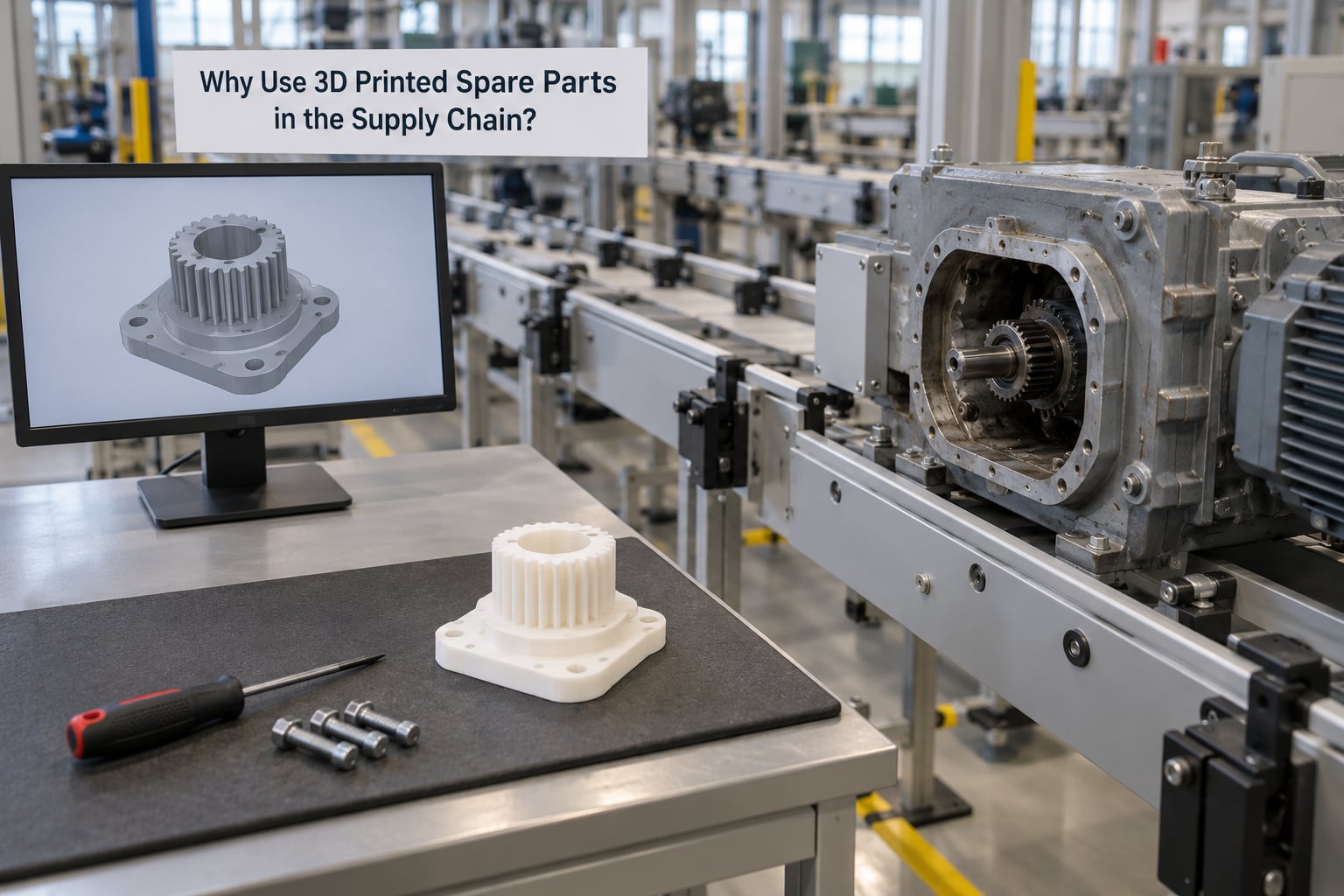
The main reason teams adopt 3D printed spare parts is downtime. A machine that stops for eight weeks waiting on a coupling is not a parts problem, it is a production problem, and additive manufacturing attacks it directly.
- Shorter lead times. Wind turbine operator Vestas reported cutting spare part lead times of five to twelve weeks down to one or two days. That is the single biggest operational gain.
- Lower inventory carrying cost. Storage, insurance, inspection cycles, and annual obsolescence reviews disappear for parts that live as files.
- Obsolescence recovery. When an original manufacturer discontinues a component and the OEM no longer supports it, an existing drawing or a scan of the old part can bring it back.
- Lower order quantities. One part instead of a batch of fifty is a real advantage for slow movers, even at a higher unit price.
- Freight and handling savings. Marine operators such as ShipParts.com, with more than 1,800 clients and 17,000 sellers on the platform, produce at the port rather than shipping a small crate across an ocean.
- Point-of-need production. Remote sites, forward operating bases, and field crews can be supplied from a nearby hub instead of a central depot.
There are limits. Additive manufacturing is not faster at everything, it is not cheaper at volume, and it does not remove the need for engineering judgement about which parts are suitable. Deloitte’s widely cited industry work puts typical lead time reductions around 70%, which is a useful planning assumption but not a promise for every part.
Which Parts Are Best Suited to 3D Printing?
Good candidates share a few traits: low demand, high consequence of being unavailable, a long or broken supply route, and geometry that is hard or expensive to machine. Screen candidates on function first and cost second.
Strong candidates
- Non-critical housings, covers, guards, brackets, clamps, and cable management parts.
- Obsolete or end-of-life components where no drawing survives and the part must be reverse engineered or scanned.
- Large, hollow, or topology-optimised parts where machining would waste most of a billet.
- Low-volume tooling, jigs, fixtures, and alignment aids used inside the plant rather than shipped to a customer.
- Custom or patient-specific components such as ducting, flow splitters, impeller shrouds, and ergonomic handles.
Poor candidates
Treat anything safety-critical, fatigue-loaded, or highly wear-exposed with caution. A printed part is not automatically unsuitable for a load-bearing role, but it needs test evidence for that specific geometry and material, and anisotropic layer direction has to be considered. Bearings, shafts, seals, and high-temperature engine components sit firmly in the conventional camp unless a qualified programme says otherwise.
Here is how the three sourcing models compare on the criteria that actually drive a maintenance decision.
| Criterion | 3D printed spare | Warehoused spare | Machined to order |
|---|---|---|---|
| Replenishment lead time | Hours to a few days | Weeks to months | Days to weeks |
| Minimum order quantity | One | Supplier pack size | One |
| Cost per unit at low volume | Moderate to high | Lowest per unit | Moderate |
| Cost per unit at high volume | Highest | Lowest | Low |
| Storage and obsolescence | File only | Carries full cost | None until ordered |
| Surface finish and tolerance | Process dependent | As manufactured | Best achievable |
| Shape freedom | Excellent | Limited by tooling | Limited by tooling |
| Qualification burden | High per part family | Handled by the OEM | Per order |
One thing worth planning for early is digitisation. If no 3D model exists for an old component, someone has to scan or reverse engineer it, and that measurement work is often the longest step in the project. Budget for it rather than discovering it halfway through.
How to Choose the Right 3D Printing Process
Process choice follows the material the part has to survive, not the machine you happen to own. Most supply chain programmes end up running two or three processes rather than one.
| Process | Typical materials | Strength and finish | Best suited to |
|---|---|---|---|
| FDM | PLA, ABS, PETG, nylon, TPU | Anisotropic; visible layer lines | Jigs, guards, cable ducts, low-load brackets |
| SLS | Nylon, TPU, polyamide | Near isotropic; grainy finish | Functional parts needing toughness and complex geometry |
| SLA / DLP | Resins | High detail; smooth; brittle unless toughened | Patterns, gauges, seals, detailed housings |
| MJF | Nylon, TPU, PP | Consistent; production-friendly | Runs of identical functional spares |
| Metal powder bed fusion | Inconel, 17-4PH stainless, maraging steel, titanium | Near isotropic; needs heat treatment | High-temperature, high-strength and aerospace applications |
| Directed energy deposition | Metals | Excellent; large parts | Repair of existing high-value components |
| Continuous fibre composite | Carbon or glass fibre in polymer | Very stiff; metal-like performance | Lightweight structural spares that replace machined aluminium |
For most plants, nylon SLS plus continuous fibre composite covers the majority of practical demand. Metal powder bed fusion is worth the qualification effort when the failure mode is heat, wear, or a safety case that will not accept a polymer.
How to Qualify 3D Printed Spare Parts for Production
Qualification is the step that separates a workshop curiosity from a part a technician is allowed to fit to a running machine. It is also where most of the cost and delay hides.
The workflow
1. Define the requirement. Write down loads, temperatures, chemical exposure, service life, and the failure consequence. A part that only holds a cable needs a fraction of the evidence a pressure-holding part needs.
2. Establish the design source. Confirm you have a legitimate, authorised model. If the original manufacturer has discontinued the part, document why reproduction is permitted, whether the drawing is licensed to you, and who approved the decision in writing.
3. Design for the process. Add fillets at internal corners, orient the part so layers carry the load, plan support removal, and check that a probe or gauge can reach every feature you need to inspect.
4. Choose and fix the material. Lock the grade, the supplier, and the lot. Then decide on post-processing: annealing, stress relief, machining of bearing seats and sealing faces, and surface treatment.
5. Build and test prototypes. Run several, test to failure where appropriate, and record the results. If you cannot access an internal test lab, a materials laboratory can do tensile and fatigue work on your geometry.
6. Define inspection. Decide in advance how conformity is judged: dimensional check against a digital twin, in-process monitoring, material certificates, or a sampling plan. Do not rely on visual inspection alone for a qualified part.
7. Document and release. The file, material spec, orientation, parameters, post-processing steps, inspection record, and change control form the part’s identity. Without those, you have not qualified a part, you have made a sample.
In regulated industries, add the compliance layer: FAA approval pathways for aircraft components, ITAR controls for defence work, ISO 9001 for the quality system, and UL 94 V-0 ratings for enclosures in electrical equipment. That layer is slow and expensive, which is exactly why it needs to be planned rather than discovered late.
How Do 3D Printed Spare Parts Affect Inventory and Lead Times?
On lead time, the documented results are large and repeatable. Nieka Systems reported an 86% reduction in lead time alongside roughly a tenth of the per-batch cost. At Fort Irwin, the US Army replaced hatch plugs that carried a three-month replenishment time and a unit cost over forty times higher with printed composite versions produced locally.
The inventory effect is more nuanced than the lead time effect. You do not remove the need for planning; you move the planning from counting physical units to managing files.
When a printed part replaces physical stock
Replace warehoused inventory when four conditions hold at once. The demand is intermittent, so holding several units ties up capital that earns nothing. The lead time is long or unreliable, which is where the downtime cost lives. The part is low risk if it fails, so a longer validation is acceptable. And the file can be controlled, because an uncontrolled CAD file is an IP problem, not a spare part.
The five components of the true cost
Cost modelling fails most often when only material is counted. Work from a five-component model, in the structure developed at the Budapest University of Technology: material, support removal, machine operation, tooling and consumables, and labour. A part with a long print time and modest material use is one of the most common modelling errors in both directions, so measure the build rather than guessing.
Compare that total against what you are replacing, not against a single printed quote. The right comparison is the cost of holding inventory: capital, space, insurance, cycle counting, and the write-off when the part finally obsoles.
What Are the Main Risks and Limitations?
Additive manufacturing does not solve everything, and programmes that skip this section tend to lose credibility internally after the first failed batch.
- Consistency between parts. The same file on two machines can produce two results, which is why machine qualification and parameter locking matter as much as the design.
- Anisotropy. Layer adhesion means a printed part is weaker across layers than along them, and the weakest direction is not always where you expect.
- Surface finish and tolerance. Fine for appearance, marginal for sealing faces and bearing fits. Plan light machining where the function demands it.
- Moisture and UV sensitivity. Nylon and many composites absorb water and lose strength outdoors unless handled correctly.
- Heat resistance. Standard polymers soften in hot service. That is the point at which metal processes or composite laminates enter the conversation.
- Post-processing capacity. Support removal, stress relief, and heat treatment are real bottlenecks, and the cost model must include the labour.
- Certification burden. Aviation, defence, and electrical approvals are the slowest part of the project, not the printing.
- IP exposure. Every file sent to a service bureau or cloud platform is an exposure point, and CAD data often carries far more value than the physical part.
- Printer capacity as a single point of failure. If a single machine or a single bureau holds your entire qualified capability, you have traded one dependency for another.
One honest irony: the printers themselves often depend on imported components, so adopting additive manufacturing does not automatically mean your supply chain is domestic.
How Can Companies Build a Reliable 3D Printing Supply Chain?
A workable programme is mostly governance rather than hardware. The machines are the easy part.
A five-step roadmap
1. Pick a pilot part deliberately. Choose something non-critical, moderately valuable, and currently slow to source. Avoid starting with a safety-critical component; the political cost of a failure there outweighs the lesson.
2. Build the business case on total cost. Include qualification effort, post-processing, and file control, not just the print. Compare against the full carrying cost of inventory, not the unit price.
3. Qualify and document. Complete the workflow above so a second team could produce the part without asking you anything.
4. Decide where production happens. In-house printers suit high-frequency, simple parts and give you the fastest iteration. A service bureau suits low volume, advanced materials, and regulated work. A distributed network suits organisations with many far-flung sites.
5. Secure capacity. Qualify a second source for anything critical to operations, and agree contractual terms covering turnaround, material certification, and file handling before you need them.
Protecting the file
Treat CAD files with the same controls you would apply to a trade secret. Use a controlled repository with access logging rather than email attachments, use NDAs with bureaus that include clauses on file retention and destruction, and keep the qualified file in your own system with the supplier holding only the released build package. Digital watermarking and registry services exist for this, but the fundamentals are unglamorous and effective.
Metrics worth tracking
Measure mean time to repair before and after, percentage of spares converted to file-based supply, the number of obsolete parts recovered, print first-time success rate, and the cost per qualified part including amortised qualification. If none of those move within two quarters, the programme is not working, and that is much better to discover on a dashboard than in an audit.
Frequently Asked Questions
Is 3D printing useful for making spare parts?
Yes, for the right parts. Additive manufacturing is strongest on low-volume, high-value components with long or broken supply routes, obsolete parts no supplier will make, and geometry that is expensive to machine. Wind turbine operator Vestas reported cutting spare part lead times from five to twelve weeks to one or two days. It is weak on high-volume items where injection moulding wins, and on parts needing proven fatigue life unless a qualification programme exists.
How do you get a spare part 3D printed?
Start by finding or creating an authorised CAD model. If the original manufacturer discontinued the part and no model survives, measure the existing part with a 3D scanner or reverse engineer it, and document that you are permitted to reproduce it. Send the model to an in-house printer or a qualified service bureau with the material spec, then define inspection and inspection records before the first production part is accepted.
What are the benefits of 3D printing for supply chain management?
The core benefits are shorter replenishment lead times, lower inventory carrying cost, recovery of obsolete parts, order quantities of one, and production at the point of need instead of at a central depot. Deloitte’s industry work puts typical lead time reductions around 70%, and Nieka Systems reported 86%. Marine operators also cut freight and handling by printing at the port rather than shipping small crates across an ocean.
Can 3D printed parts replace machined parts?
Often, yes, for non-critical and moderately loaded components. Continuous fibre-reinforced composite already replaces machined aluminium in several production programmes. The harder cases are sealing faces, bearing fits, and fatigue-loaded parts, where printed surface finish and layer anisotropy matter. A common approach is to print the rough form and machine the critical surfaces, combining material efficiency with conventional tolerance.
What materials are used for 3D printed spare parts?
Polymers cover most demand: PLA, ABS, PETG, nylon, and TPU for FDM; nylon and TPU for powder bed processes like SLS and MJF; resins for high-detail SLA parts. For demanding service, metal powder bed fusion uses Inconel, 17-4PH stainless steel, maraging steel, and titanium, while continuous carbon or glass fibre composites deliver metal-like stiffness at low weight. Match the material to temperature, load, and environment before matching it to the printer.
What are the main challenges of 3D printed spare parts?
The recurring challenges are consistency between parts, layer-direction anisotropy, surface finish and tolerance at sealing surfaces, moisture sensitivity in some polymers, and post-processing capacity for support removal and heat treatment. On the business side, qualification and certification are slow and expensive, CAD files leak when they travel to a supplier, and reliance on a single printer or bureau creates a new single point of failure.
Conclusion
Start small and pick deliberately. Identify one non-critical part with a long lead time, confirm you have a lawful design source, validate a prototype against a written requirement, and model the supply chain impact using the full five-component cost model rather than a print quote.
Additive manufacturing earns its place in a supply chain when the part is rare, the route is long, and the cost of waiting is high. Get one part qualified properly, document it so a second team could repeat it, and you will have a repeatable model for the next fifty. That is how 3D printed spare parts move from an interesting pilot to infrastructure.