The chemical resistance of common 3D printing plastics depends entirely on what the part touches. No polymer is unconditionally chemical proof: PLA holds up well against water, dilute acids and dish soap but softens in heat and is dissolved by acetone and methyl ethyl ketone; PETG tolerates oils, weak cleaners and many fuels but hazes and stress-cracks around strong solvents; nylon, polycarbonate and PPS-CF cover the demanding end. Because every rating below depends on concentration, temperature, contact time and load, the honest answer is a matrix, not a single pass-or-fail label.
That is what this guide gives you: a material-by-chemical table for the ten plastics you can realistically buy or print, the failure modes you need to recognise, and a coupon test you can run yourself before committing a part to a tank of fluid for six months.
Table of Contents
- 1Chemical Resistance of Common 3D Printing Plastics at a Glance
- 2What Does Chemical Resistance Mean for 3D Printed Parts?
- 3Five ways a chemical attack shows up
- 4Why a weak, brief exposure can still be fine
- 5Which Chemicals and Exposure Conditions Matter Most?
- 6The solvents that cause the most confusion
- 7PLA Chemical Resistance
- 8ABS and ASA Chemical Resistance
- 9PETG Chemical Resistance
- 10Nylon and Polyamide Chemical Resistance
- 11Polycarbonate, PC/ABS, and PEI Chemical Resistance
- 12TPU, PP, and Other Practical Choices
- 13How to Test Chemical Resistance Before Choosing a Material
- 14How to Choose the Right Plastic for a Chemical Contact Application
- 15Frequently Asked Questions
- 16What 3D printing plastic is most chemically resistant?
- 17Is PLA resistant to water and household cleaners?
- 18Can 3D printed parts be soaked in isopropyl alcohol?
- 19Does chemical resistance depend on the printing settings?
- 20How do I test a plastic for chemical resistance?
- 21Can I use the same plastic for food contact and chemical exposure?
- 22Conclusion
Chemical Resistance of Common 3D Printing Plastics at a Glance
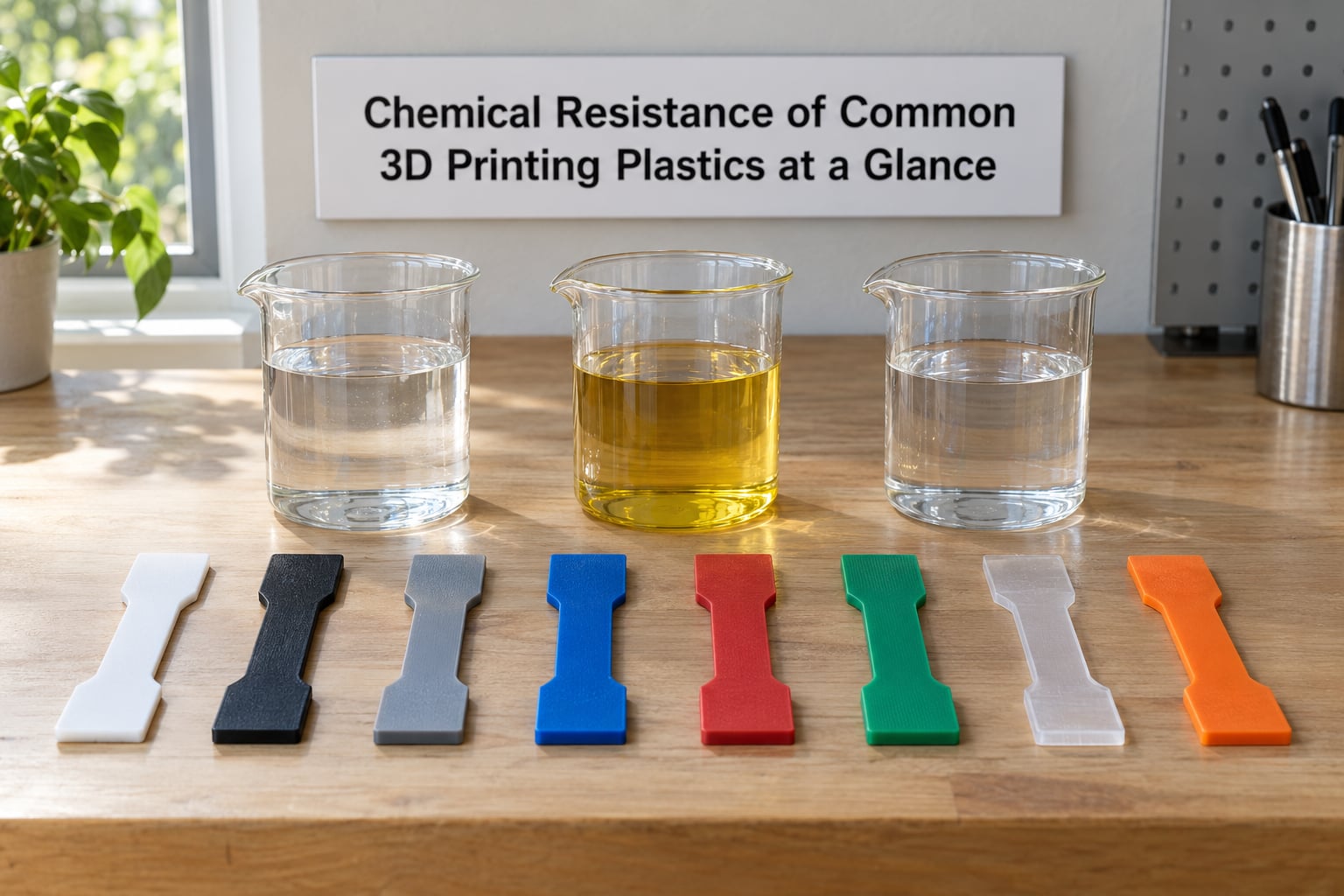
Ratings below describe short exposure at room temperature with no sustained mechanical load. They use a fixed five-point scale so the cells can be compared side by side.
- Excellent – no visible change over months at room temperature.
- Good – minor surface change or a small strength loss over long exposure.
- Fair – noticeable swelling, surface haze or gradual softening.
- Poor – rapid softening, stress cracking or loss of shape.
- Not resistant – dissolves, crazes or embrittles quickly.
| Plastic | Water | Oils and grease | Fuels (gasoline, diesel) | IPA | Acetone, MEK, chloroform | Weak acids | Weak alkalis | Strong alkalis and bleach |
|---|---|---|---|---|---|---|---|---|
| PLA | Good | Good | Fair | Good | Not resistant | Fair | Fair | Poor |
| ABS | Good | Good | Fair | Good | Not resistant | Fair | Good | Fair |
| ASA | Good | Good | Fair | Good | Not resistant | Fair | Good | Fair |
| PETG | Excellent | Excellent | Good | Good | Fair to poor | Good | Good | Fair |
| Nylon (PA6, PA12) | Fair (hygroscopic) | Excellent | Excellent | Good | Good | Fair | Good | Good |
| Polycarbonate | Fair to good | Good | Fair | Poor | Not resistant | Fair | Fair | Poor |
| PC/ABS | Good | Good | Fair | Poor | Not resistant | Fair | Good | Fair |
| TPU | Good | Good | Good | Fair | Poor | Fair | Good | Fair |
| Polypropylene (PP) | Excellent | Excellent | Good | Good | Good | Good | Excellent | Excellent |
| PEI (unreinforced or CF) | Good | Excellent | Good | Good | Good | Fair | Good | Good |
Read the table as a starting point, not a verdict. Formulation matters more than most people expect: the same polymer from two manufacturers can behave differently because of plasticisers, impact modifiers, ultraviolet stabilisers and pigment loadings.
What Does Chemical Resistance Mean for 3D Printed Parts?
Chemical resistance describes how much a material keeps its shape, stiffness and mechanical properties when it sits in contact with a specific liquid or gas. Everything below that limit is damage, and the damage comes in several recognisable forms.
Five ways a chemical attack shows up
Dissolution is the easy case: the polymer dissolves into the liquid, the way acetone liquefies an ABS print left in a sealed jar. Swelling is more common and sneakier, because the part absorbs liquid, grows slightly and softens while still holding its general shape. Softening means the material drops below its glass transition temperature and goes floppy, often without any visible chemical change at all.
Staining and hazing are surface-level effects that rarely stop a part from working but often end its usefulness in a food or cosmetic contact application. Stress cracking is the dangerous one, because the part looks fine until a load hits it and it snaps. Gradual loss of mechanical performance is the quietest failure of all, where a housing that used to clamp firmly now creeps under the same force.
Why a weak, brief exposure can still be fine
A material tolerates a weak chemical for a short time and still fails under prolonged immersion, higher temperature, concentrated concentration or sustained load. This is why a PETG part can be rinsed in isopropyl alcohol for a cleaning pass and then be destroyed by a warm acetone bath, and why a nylon bracket outdoors in cool weather can outlast the same bracket clipped inside an engine bay.
Which Chemicals and Exposure Conditions Matter Most?
Four variables decide the outcome in almost every case: what the chemical is, how strong it is, how long it sits there, and how hot it is. Add the geometry of your part and the answer stops being a material property at all.
| Exposure type | What it looks like | What it demands of the material |
|---|---|---|
| Splash | A drip, a spill, condensation, or a rinse that drains away | Any reasonable filament survives; clean the part promptly anyway |
| Intermittent contact | Gloves, drips during maintenance, a few minutes of handling | Commodity plastics such as PLA and ABS are fine |
| Repeated cycles | Daily washing, soaking, a weekly soak test, dishwasher-adjacent work | Thermoplastics with strong interlayer bonding; watch for stress crazing |
| Continuous immersion | Tank, reservoir, pipe, sealed container, permanent fuel contact | Engineering polymers only; confirm with a coupon test |
The solvents that cause the most confusion
| Solvent | Effect on common filaments |
|---|---|
| Isopropyl alcohol (70-99%) | Safe on most prints for quick cleaning; prolonged soaking hazes PETG and can craze polycarbonate |
| Acetone | Dissolves ABS and ASA (used deliberately for vapour smoothing); damages PLA, PETG, nylon, TPU and polycarbonate |
| Methyl ethyl ketone (MEK) | Aggressive ester and amide solvent; will etch and dissolve PLA and PETG, less aggressive on nylon than on polyesters |
| Chloroform | Partial dissolution of PETG surfaces; not a materials choice, only a finishing technique |
| Mineral spirits and paint thinner | Mild on ABS, ASA, nylon and PETG; can soften PLA and leave an oily film on TPU |
| Brake cleaner and aerosol paint | Contains aggressive solvents and propellant; treat any printed part as sacrificial |
Anyone who works around MEK or chloroform needs proper ventilation, a sealed vessel and no ignition source nearby. The fumes are the hazard, not the plastic. Many people have learned this the hard way on solvent-smoothing threads, and the forum consensus remains consistent: acetone for ABS and ASA, isopropyl alcohol for everything else, and a fume-aware setup for anything stronger.
Beyond chemistry, the printed part itself changes the result. Infill density controls how much liquid can sit inside the walls, print orientation decides how many layer interfaces the chemical sees, and thin walls crack where thick ones merely flex. Nylon also absorbs moisture from the air on its own, which changes both its dimensions and its long-term behaviour in water.
PLA Chemical Resistance
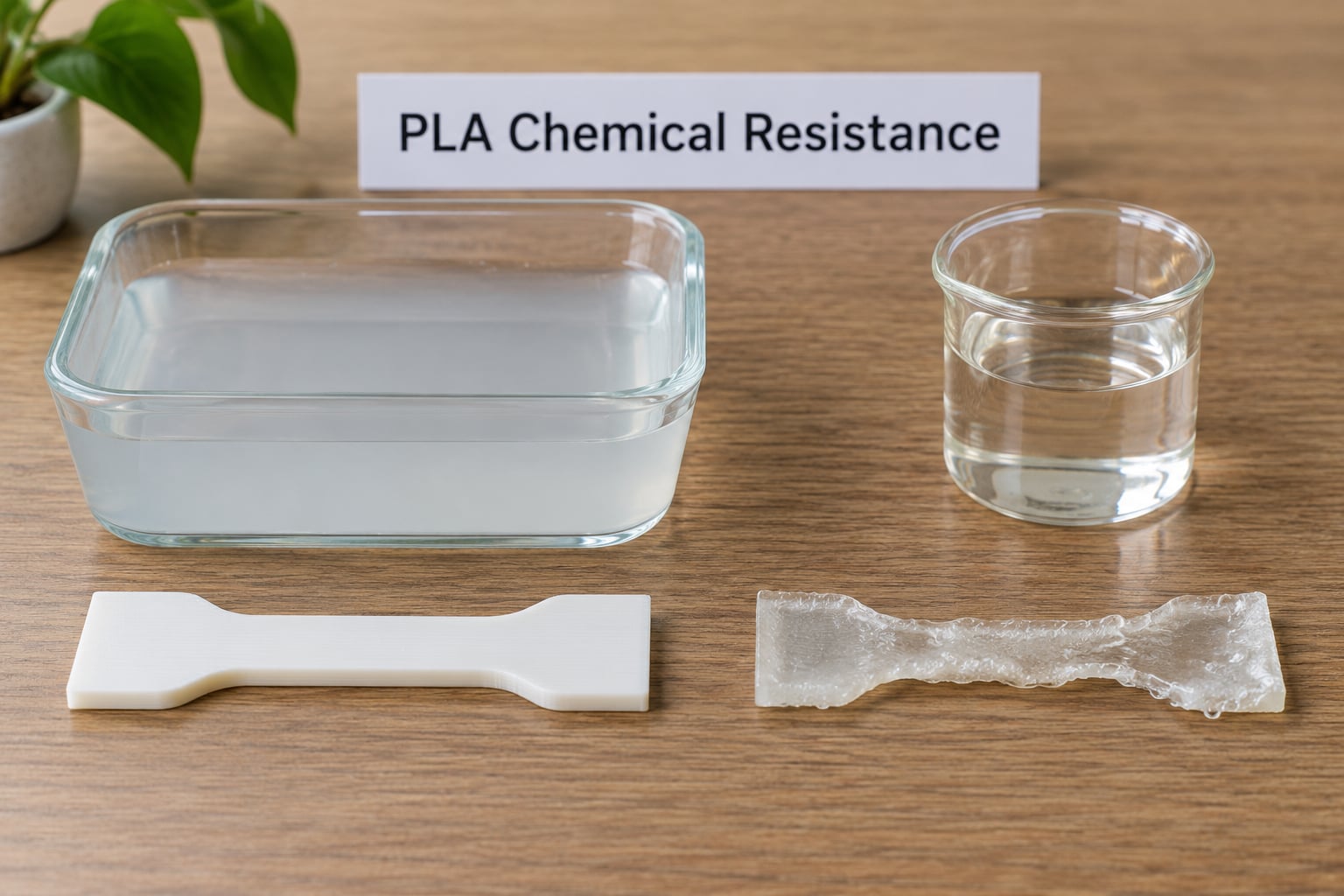
PLA chemical resistance is good against water, detergent, dish soap, diluted acids and vegetable oils. Put it into acetone, MEK, chloroform or paint thinner and it softens within seconds and dissolves within minutes.
Two other limits are worth knowing. Heat matters more than most first-time users expect, because PLA sits close to its glass transition temperature and a warm car seat or a hot workbench is enough to make a loaded part sag. And hydrolytic degradation means long-term exposure to warm water slowly breaks down the ester linkages in the polymer chain, so a wet PLA part loses strength over months even though it never dissolved.
The compostability of PLA says nothing at all about chemical resistance. Industrial composting operates at controlled heat and microbial conditions and is not a household disposal route; it is a processing method, not a durability claim.
ABS and ASA Chemical Resistance
ABS handles weak alkalis, household cleaners, oils and short fuel contact reasonably well, but the styrene in it is what makes acetone and MEK so dangerous for these prints. ASA uses the same backbone with acrylic rubber substituted in, so the chemical profile is close to ABS while the weathering and ultraviolet behaviour is far better.
That difference decides outdoor use. An ABS part left outside goes chalky, brittle and cracked as ultraviolet light breaks the butadiene rubber, while ASA survives the same exposure with far less degradation. For chemical contact specifically, the practical rule is that both are fine for splash and intermittent contact with cleaners, and neither is a candidate for continuous immersion in fuel, strong alkali or aromatic solvents.
PETG Chemical Resistance
PETG chemical resistance is the reason it became the default pick for fluid handling projects. It is effectively waterproof, handles cooking oils, hydraulic fluids and many fuels without complaint, and shrugs off household cleaners, diluted acids and weak alkalis.
The limits are solvents and heat. Isopropyl alcohol is fine for a quick clean, but a long soak leaves a haze on the surface and can craze the part. Acetone and MEK attack the ester linkages, and the higher heat deflection of PETG does not protect it from softening against warm solvents. For a printed aquarium fitting, a fluid channel or a machine guard, PETG is usually the right commodity choice; for a drum of acetone, it is not.
Nylon and Polyamide Chemical Resistance
Nylon is the material to reach for when a part lives in fuel, oil or a solvent. It has excellent resistance to gasoline, diesel, lubricants and many organic solvents, and it outperforms most commodity thermoplastics in chemical contact applications for the simple reason that its amide backbone resists the solvents that destroy polyesters.
The trade-offs are moisture and chemistry at the extremes. Nylon is hygroscopic, so it absorbs water from the air, changes dimension slightly and can end up stiffer or more brittle than the datasheet suggests if it is printed wet and sealed inside a wall. It is vulnerable to strong acids and strong oxidising agents, and to hydrolysis when it sits in hot water for a long time. Dry the filament properly, keep the print dry, and account for that when you design a thin-wall part.
Polycarbonate, PC/ABS, and PEI Chemical Resistance
Polycarbonate is the strongest of the three and the least solvent-tolerant. It performs well against weak acids, alkalis and detergents, but aromatic solvents attack it quickly, and its susceptibility to stress cracking means a part under load can fail in a solvent it would have survived if unloaded. Chlorinated cleaning products and acetone both destroy it.
PC/ABS trades some of that strength for a much better chemical profile. The ABS component brings alkalis and solvent resistance the pure polycarbonate lacks, which is why PC/ABS shows up in chemical handling and enclosure applications. It still needs an extrusion-grade verification test, because printed interfaces behave differently from injection moulded panels.
PEI, usually seen as unfilled or carbon-fibre-filled, sits at the demanding end of what a desktop machine can handle. It holds up well against oils, fuels, alkalis and many solvents, and it brings a very high heat deflection temperature. Carbon filling changes surface chemistry enough to improve handling of some chemicals and hurt others, so treat a specific grade’s data sheet as the authority rather than the PEI name.
TPU, PP, and Other Practical Choices
TPU is a flexible option with a middling chemical profile. Oils, fuels and mineral spirits are generally fine, household cleaners are fine, but ketones, esters and many aromatic solvents will swell it, and a swollen TPU part never fully recovers its original properties. Its flexibility is the reason to choose it, and the reason to test it hard: softer parts have more stressed surface area.
Polypropylene is quietly the best commodity polymer on this list. It is unaffected by water, weak alkalis, strong alkalis, bleach and most oils, and it holds up to a wide range of solvents, which is why it is used for chemical tanks and acid containers in the injection moulding world. The barrier is the printer: PP is a sticking nightmare on most desktop machines and usually needs a direct extrusion setup or a modified hot end.
For serious industrial service, PPS-CF and PEEK are the answers. PEEK is widely considered the most chemically capable material a printer can handle, surviving hot acids, solvents and fuels at temperatures far above anything commodity filament will tolerate. It also needs a heated chamber and a hardened nozzle, and the printed part demands stress-relief annealing. Decide whether that level of hardware and process control is justified before starting.
Resin parts deserve a note of their own. Standard photopolymer resins have poor chemical resistance and can crack or go brittle after months of solvent contact, while filled chemically resistant resins are formulated specifically for alkalis, acids and aggressive industrial washdowns. Ask the manufacturer which chemical family the rating covers before trusting a label that only says resistant.
How to Test Chemical Resistance Before Choosing a Material
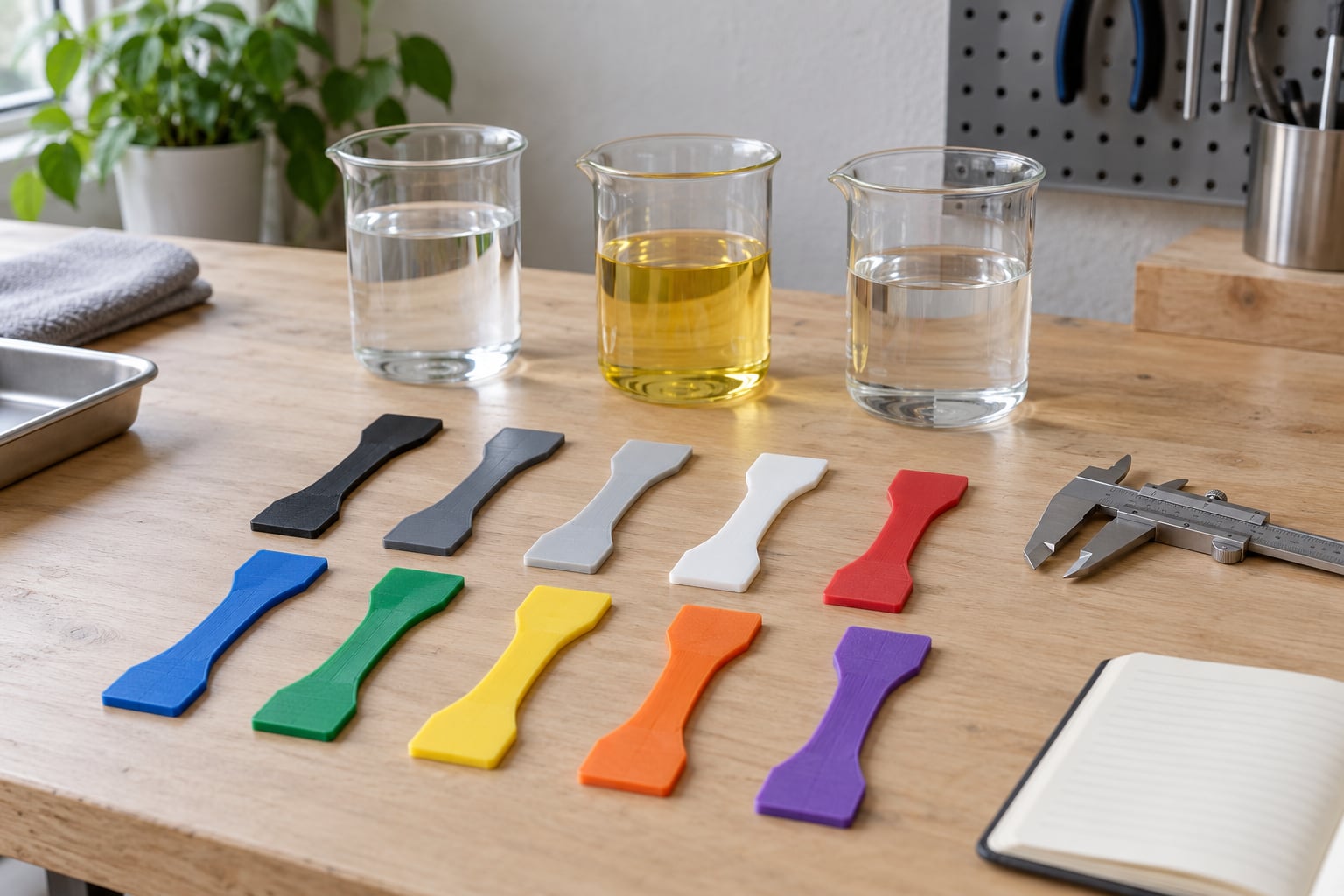
A coupon test takes an afternoon and settles the argument that datasheets cannot. Print several identical coupons of the material you plan to use, expose each to a different chemical, and compare them against an unused control.
- Print representative geometry. Use a simple flat bar or a stepped coupon with a known wall thickness, not a thin decorative shell. Real parts have edges and holes where stress concentrates.
- Document the setup. Note infill percentage, number of perimeters, layer height, print orientation and nozzle temperature. Those numbers belong next to your results, because they change the outcome.
- Measure before exposure. Record mass to 0.01 g, thickness with calipers, and a hardness or durometer reading if you have one. Also measure an unexposed control coupon and leave it in the same room.
- Expose samples separately. One chemical per jar, enough to submerge fully, at the real service temperature. Never mix unknowns together and never test more than one coupon per condition.
- Log time points. Check at 1 hour, 24 hours, 7 days and 30 days. Most catastrophic failures happen in the first minute; gradual attacks show up in the later checks.
- Inspect for the failure modes you read about. Look for discoloration, surface haze, softening, cracking, swelling in the thickness dimension, delamination along layer lines, and any loss of stiffness under light finger pressure.
- Re-measure and re-load. Compare post-exposure mass and thickness against the control. A part that looks fine but measures a millimetre thicker has swollen and is a warning sign.
- Run a loaded version too. If the part will carry a clamp, a seal or a pressure, test a coupon under that load. Chemical attack under stress is where unstressed tests lie to you.
Wear gloves and eye protection, work in a ventilated space, and label every jar. Do not mix cleaning chemicals in a printed part to see what happens; the fumes can be genuinely dangerous, and a failed container plus a failed print is a bad afternoon.
How to Choose the Right Plastic for a Chemical Contact Application
Start from the exposure, not the material. List the chemical, its concentration, the temperature, how long it stays in contact and whether the part carries a load, then move down the list until one material survives all five.
For splash contact with cleaners, PLA and ABS are enough. For continuous water contact such as aquariums or fluid channels, PETG is the sensible commodity pick. For fuels, oils and solvents, use nylon. For strong alkalis and bleach, PP and PEI are the strongest options available to most makers. For elevated temperature plus aggressive chemistry, budget for PPS-CF or PEEK and the equipment to print them.
Pick the least complicated material that passes the actual exposure conditions. Engineers habitually overspec, which means harder nozzles and extra drying, and for a jig that only sees dish soap once a week that trade rarely pays. When the environment is unknown or the chemical is exotic, ask the supplier for the technical data sheet and safety data sheet, then confirm with your own coupon test.
One last distinction worth keeping straight: chemical resistance is not food safety. A material can happily survive a strong alkali and still be a poor choice for anything you will eat or drink, because that is a question of extractables, additives and certification, not of how the plastic reacts to a solvent.
Frequently Asked Questions
What 3D printing plastic is most chemically resistant?
Among materials a desktop printer can handle, PEEK and PPS-CF cover the broadest range of acids, alkalis, fuels and solvents, and nylon is the strongest choice for oils and fuels on ordinary hardware. Polypropylene resists weak and strong alkalis, bleach and water unusually well. The real answer depends on the specific chemical, its concentration, the temperature and how long contact lasts, so test a coupon rather than trusting a general ranking.
Is PLA resistant to water and household cleaners?
Yes, for the most part. PLA handles water, dish soap, detergent and diluted weak acids without visible damage, which makes it fine for splash contact and light cleaning. It softens in heat, degrades slowly in warm water over months, and dissolves quickly in acetone, MEK and chloroform. Treat it as a short-term, room-temperature material and move up to PETG for anything that sits in water.
Can 3D printed parts be soaked in isopropyl alcohol?
For most filaments, a quick wipe or a short rinse is fine. Prolonged soaking is a different story: PETG develops surface haze and can stress-craze, and polycarbonate is more susceptible still. Acetone is the real hazard, since it dissolves ABS and ASA on purpose and attacks PLA, PETG, nylon and TPU. Keep isopropyl alcohol contact brief and use it for cleaning, not for finishing.
Does chemical resistance depend on the printing settings?
It does, more than most charts admit. Infill density controls how much liquid sits inside the walls, print orientation determines how many layer interfaces the chemical can reach, and thin walls crack where thick ones flex. Layer adhesion is the weak point in an FDM part, so a chemical that only weakens the interface will fail the print long before it would affect an injection moulded panel of the same material.
How do I test a plastic for chemical resistance?
Print identical coupons, measure mass and thickness, then immerse one per chemical at your real service temperature. Record the settings and infill so the results are repeatable, and keep an unexposed control coupon in the same conditions. Check at one hour, one day, one week and one month for haze, softening, cracking, swelling and delamination, and repeat the test under load if the part will be clamped or sealed.
Can I use the same plastic for food contact and chemical exposure?
Not automatically. Chemical resistance asks whether the plastic dissolves, swells or softens; food safety asks what migrates out of it into something you eat or drink. A plastic can pass a soaking test in soap and still be unsuitable for food contact because of additives or pigments. Look for published food-contact compliance documentation, keep surfaces smooth and uncracked, and avoid printing food-contact parts in a printer you also use with engineering materials.
Conclusion
Start by naming four things precisely: the chemical, its concentration, the temperature and the exposure duration. With those fixed, the choice is usually obvious – PETG for water and cleaners, nylon for fuels and oils, PP or PEI for alkalis, PEEK when the temperature is high and the chemistry is severe.
Then print a coupon, expose it for the length of time the part will actually serve, and look for haze, softening, cracking and swelling. Chemical resistance depends on the part, the print settings and the service environment, not just on the name on the spool, and a test that takes an afternoon is cheaper than a part that fails in month two.