Short answer: choose selective laser melting (SLM) when you need fine features, tight tolerances, smoother as-built surfaces or a broad material palette. Choose electron beam melting (EBM) when the part is titanium, cobalt-chrome or a nickel superalloy, when it is large, or when you want low residual stress straight out of the machine.
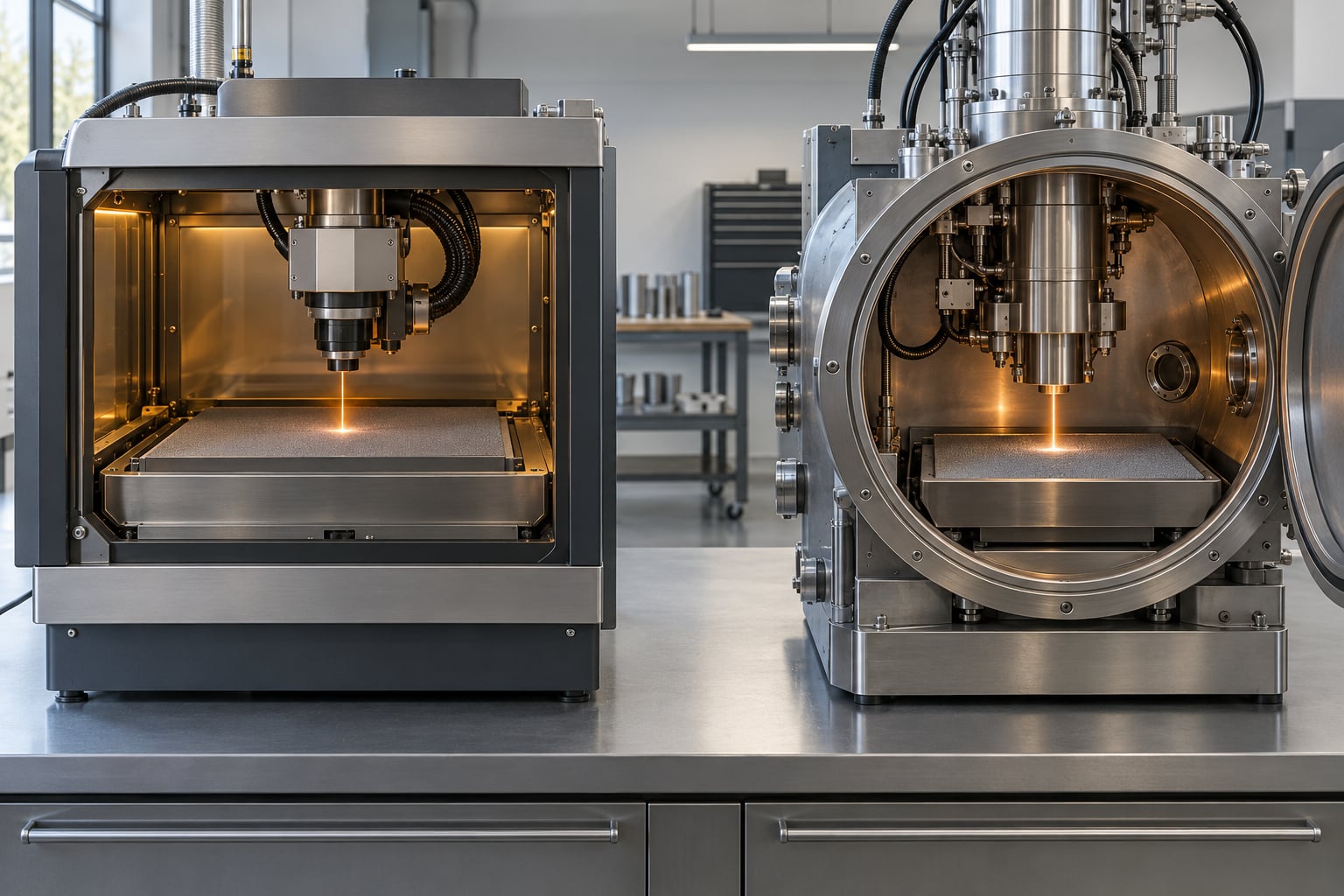
Both are powder bed fusion processes. A recoater spreads a thin layer of metal powder, an energy source melts the cross-section defined by your CAD model, and the layer bonds to the one below. That shared skeleton is why the two get confused so often, and why most vendor pages do a poor job comparing them head to head.
The real differences sit in the energy source, the chamber atmosphere and how hot the powder bed is kept. Those three choices cascade into everything downstream: which alloys you can run, how the microstructure forms, whether the part arrives stressed or relatively relaxed, how much machining sits between the machine and the finished component, and what a part actually costs to produce.
Below is a process-selection guide rather than a marketing page. I have pulled the parameters that actually change your decision out of the machine specifications and published research, including Bertsch and colleagues’ 2022 paper on the critical differences between the two processes, which is still the most useful single reference on this topic.
Table of Contents
- 1Selective Laser Melting vs Electron Beam Melting at a Glance
- 2How the Two Processes Work
- 3Selective Laser Melting vs Electron Beam Melting: Core Process Differences
- 4Materials and Mechanical Properties
- 5Titanium and Other Alloy Families
- 6Surface Finish, Dimensional Accuracy, and Post-Processing
- 7Build Speed, Equipment Cost, and Production Economics
- 8Where Each Process Performs Best
- 9Which Should You Choose?
- 10Frequently Asked Questions
- 11Is electron beam melting always faster than selective laser melting?
- 12Which process is better for titanium medical implants?
- 13Can the same metal powder be used for both SLM and EBM?
- 14Does EBM eliminate the need for machining or heat treatment?
- 15Can an existing SLM-designed part be made on an EBM machine without redesign?
- 16Conclusion: Choose by Requirements, Not Hype
Selective Laser Melting vs Electron Beam Melting at a Glance
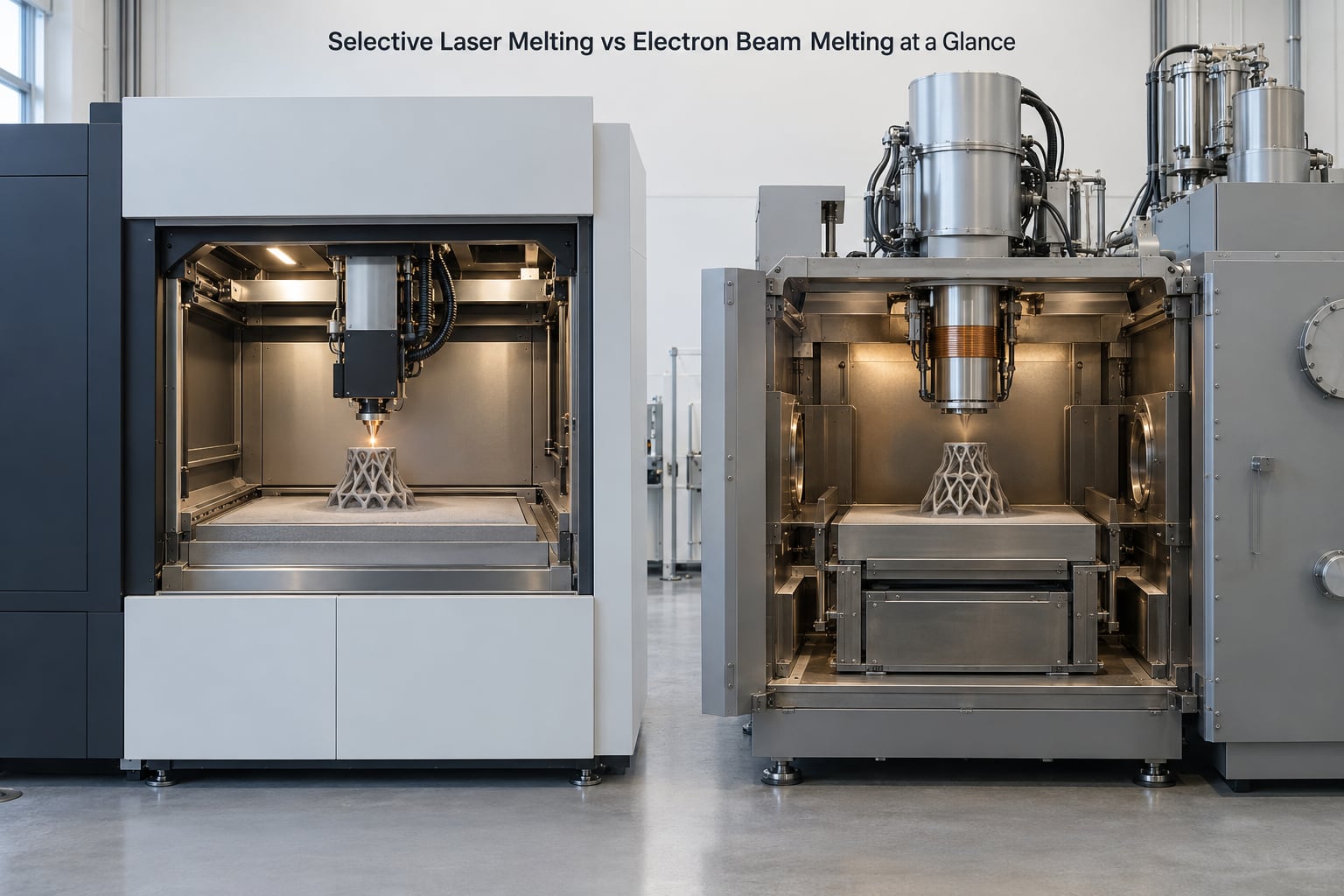
| Parameter | Selective laser melting (SLM) | Electron beam melting (EBM) |
|---|---|---|
| Energy source | Fibre laser, typically in the 200 W to 1,000 W class | Electron beam gun, typically accelerated at around 60 kV |
| Chamber atmosphere | Inert gas, argon or nitrogen, held at near ambient pressure | High vacuum, below roughly 10^-4 mbar |
| Build plate temperature | Platform-dependent; some systems preheat, many run cooler | Typically held at 600 to 700 degrees Celsius |
| Layer thickness | Finer layers, giving better vertical feature resolution | Commonly 0.05 to 0.10 mm |
| Cooling rate | Fast, in the range of 10^3 to 10^5 K/s in the melt pool | Slower solidification due to the preheated bed |
| Grain structure | Fine, often columnar, with visible anisotropy between build directions | Coarser, more epitaxial growth across layers and near-isotropic properties |
| Residual stress as built | Often significant; stress relief and HIP are routine steps | Low, because the hot bed lets the part relax while it builds |
| Solidification cracking | Real risk in crack-sensitive alloys such as AlSi10Mg and superalloys | Mitigated by high preheat; strong track record with Ti-6Al-4V and CoCr |
| As-built surface finish | Smoother; often usable on non-critical faces | Rougher; usually blasted, tumbled or machined on mating surfaces |
| Material constraint | Very reflective and highly conductive alloys such as copper are awkward | Powder must conduct electricity; insulators and many ceramics are out |
| Typical build volume | Small desktop units through large industrial platforms | Larger frames, constrained by the vacuum chamber |
| Productivity | Slower layer by layer, more parts nested per plate | Faster volumetric fusion and faster solid-state cooling of the build |
| Capital and staffing profile | Wider vendor range, smaller machines available, easier to staff | Higher capital outlay, specialist vacuum and powder handling skills |
Read that table as a set of linked facts rather than isolated specs. The vacuum and the 600 to 700 degree Celsius preheat are not two separate features. They are the same engineering decision, and they produce the low residual stress, the coarser grain structure and the strong titanium pedigree that define EBM.
How the Two Processes Work
Both processes run a repeated cycle: lay powder, melt the slice, drop the platform, repeat. The sequence is simple enough that operators find it familiar, and it is the reason layer-by-layer metal fusion gets treated as one technology when it is really a family. Selective laser melting vs electron beam melting is, at that level, a comparison of two heat sources rather than two different workflows.
Selective laser melting, also written laser powder bed fusion or LB-PBF, uses a focused fibre laser to melt the powder in an inert gas atmosphere. A full melt is the point. The powder is not sintered, it is liquefied and re-solidified, which is what gives metal parts their density and their cast-like microstructure.
Electron beam melting, or EB-PBF, uses a beam of electrons accelerated to roughly 60 kV and focused onto the powder bed. It runs inside a vacuum chamber below about 10^-4 mbar, with the whole build plate held at a high preheat temperature.
One piece of housekeeping before going further. Electron beam melting has nothing to do with electron beam machining. Machining is subtractive: a focused beam vaporises material from a solid workpiece to cut holes and profiles. Melting is additive: the beam consolidates loose powder into a solid part. Searchers mix these up constantly, so if you have read that a laser is also used for subtractive work, that is a different machine doing a different job.
Selective Laser Melting vs Electron Beam Melting: Core Process Differences
The laser and the electron beam both scan a pattern and both deliver enormous energy density into a small spot, but they behave very differently once the beam is generated.
An electron beam travels through the chamber as a stream of charged particles. Air molecules deflect it, which is the physical reason the chamber must be a hard vacuum rather than a simple argon flush. The same vacuum also removes oxygen and hydrogen almost entirely, so oxidation during the melt is a much smaller concern than it is in a gas-filled machine.
Because the electron is charged, the beam can also be steered fast and precisely with electromagnetic deflection coils. That gives EBM machines their characteristic multi-beam and contour scanning behaviour, where the beam sweeps around a part outline rather than only crossing in straight hatch lines.
Thermal behaviour is the other big divergence. In SLM, most heat leaves through the top surface by radiation and convection into the gas, so the top of the part cools fast while the layer just beneath it stays hot. In EBM, the entire powder bed is already at 600 to 700 degrees Celsius, so the whole part sits in a warm thermal environment and gradients between hot top and cold substrate are far smaller.
That single change explains most of what follows: lower residual stress, coarser grain growth, less solidification cracking, and a longer but less stressful thermal cycle.
Materials and Mechanical Properties
Alloy choice is where the two processes separate most sharply, and it is not a marketing decision. It is a physics decision about how a powder responds to energy and to temperature.
| Alloy family | SLM | EBM |
|---|---|---|
| Ti-6Al-4V | Routine and well characterised | Routine, with the longest qualification history of any alloy |
| CoCr (cobalt-chrome) | Widely used for implants and dental work | Well established, particularly for orthopaedic applications |
| Nickel superalloys, including Inconel 718 | Broad range supported | Well supported, valued for hot-section parts |
| Maraging steel | Supported | A natural fit; the alloy is designed to tolerate the high build temperature |
| 316L and maraging stainless steels | Routine | Routine |
| Aluminium alloys, such as AlSi10Mg | Widely used | Possible but less common; cracking and powder flow need careful development |
| Copper alloys | Difficult; reflectivity and thermal conductivity fight the laser | Better suited, because the beam heats conductive powder readily |
| Refractory alloys | Supported on some platforms | Support varies by machine and parameter development |
| Insulators and ceramics | Limited options, machine specific | Not viable; the powder cannot carry the current needed to deflect the beam |
Titanium and Other Alloy Families
Titanium is the clearest case, and it is worth explaining why practitioners keep asking about it. Titanium is crack-sensitive during solidification, and its broad processing window closes quickly as you remove heat from the build.
On an EBM machine the bed is already near the alloy’s beta transus range while it solidifies. The thermal gradients that drive solidification cracking in laser-built titanium are largely removed, so the process can run crack-free and produces a coarser microstructure with properties close to wrought material. That reliability history, accumulated over more than two decades of clinical use in orthopaedics, is the practical reason titanium is so associated with EBM.
The conductivity rule is the one nobody states plainly enough. An electron beam is steered by electromagnetic fields, which means the powder bed must carry enough electrical current to let the beam follow its path. Insulators simply cannot be processed this way, and alloys at the low end of the conductivity range need dedicated parameter development on a specific machine.
For steel, aluminium and nickel alloys the gap narrows, and supplier qualification matters more than the broad SLM-versus-EBM label. A qualified powder lot, a validated parameter set and a proven machine in your own facility will outperform a theoretically better process you cannot qualify on schedule.
On mechanical properties, both processes deliver near-full density parts with columnar grain structures that grow across layers. The difference is scale and consistency. SLM gives finer, faster-solidified grains, which can leave measurable anisotropy between the build direction and the transverse directions. EBM gives coarser grains and slower cooling, which produces a more uniform, more nearly isotropic structure but at the cost of as-built surface roughness and feature detail.
Surface Finish, Dimensional Accuracy, and Post-Processing
SLM generally wins on as-built surface finish and on small features, and that advantage is real. Fine supports, small holes and thin walls survive the process where they would be lost in a rougher, less precise build.
The general expectation reverses more often than vendors admit. Machine configuration, powder particle size distribution, scan strategy and part orientation all shape the as-built result. A well-oriented part in a well-tuned EBM machine can beat a badly oriented part in a laser machine, and powder that has been reused through many cycles spreads differently from virgin powder.
Trapped powder is a genuine design constraint. SLM handles narrower internal channels and finer lattices because the layer thickness and recoater behaviour suit it. An EBM part with the same internal geometry retains more powder, and removing it from a sealed cavity takes longer and takes more care.
Compare the post-processing chain stage by stage, because this is where the economics actually differ:
| Stage | Typical SLM part | Typical EBM part |
|---|---|---|
| Support removal | Supports needed for overhangs; removal is manual and fiddly on complex parts | Fewer supports, and easier removal on gentler geometries |
| Powder removal | Standard practice for internal channels | More powder retained in coarser channels |
| Stress relief | Routinely required before removal from the plate | Largely handled by the 600 degree Celsius in-situ hold during the build |
| Hot isostatic pressing | Common for fatigue-critical aerospace parts | Used selectively; more often for full densification or fatigue improvement |
| Heat treatment | Alloy-specific post-build treatment often specified | Alloy-specific treatment still needed, but the starting stress state is gentler |
| Machining | Needed on toleranced faces, threads and sealing surfaces | Needed on toleranced faces, and roughness makes it more likely |
| Surface finishing | Blasting, tumbling or polishing, depending on function | Blasting and machining as standard; polishing for implantable surfaces |
That table is the commercial difference in one place. A laser-built part with an in-situ stress relief machine may skip a furnace cycle, and an EBM part with a rough surface still pays for machining either way. Neither process removes the post-processing tail; they just push it to different places.
Build Speed, Equipment Cost, and Production Economics
On raw build rate, electron beam melting is usually ahead. Its layer time is competitive and its solid-state cooling stage is fast, which means the machine is back on the next job sooner. SLM’s advantage shows up in a different place: more parts nested onto a single plate, so a slow layer is amortised across a full build.
This is where the “SLM vs EBM is faster” argument falls apart. Comparing selective laser melting vs electron beam melting on headline build rate alone tells you very little. Build rate is not the same as parts per hour. Layer count, part height, nesting density, powder change time, support time, cooldown, unload and post-processing queue time all land in the real number, and the winner flips depending on which of those your part is worst at.
A worked way to think about it: a 120 mm tall part is roughly 1200 layers at a 0.1 mm layer thickness, and around 3000 layers at a 0.04 mm layer thickness. Same part, same machine type, very different clock time. Whichever process you choose, geometry drives more of your schedule than the machine’s headline rate does.
On cost, resist the temptation to quote a single number. It changes constantly with machine size, build volume, geographic market and supplier, and any figure you find will be out of date within months. What you can reason about is the shape of the cost.
For SLM the capital entry points are wide. Small machines suit universities, prototyping shops and small production cells; larger industrial platforms carry more build volume and more nesting. Operating costs centre on argon or nitrogen consumption, powder, machine utilisation and the labour content of support removal and finishing.
For EBM the capital commitment is larger and sits with a short list of suppliers, with GE Arcam’s machines being the best known. Running one means recruiting for vacuum systems, beam control and high-temperature powder handling, and the build plate preheat cycle adds time to every single job regardless of how fast the beam moves.
Powder economics deserve more attention than they usually get. Both processes depend on powder reuse, but the reuse limit, the number of cycles a lot will survive and the point at which particle size distribution degrades all differ between them. A production facility that plans powder cycles properly can change its cost per part noticeably, and it is a question worth asking a supplier before signing.
The supplier list is worth naming, because most comparisons do not. Electron beam melting is dominated by GE Arcam and its Arcam Q20 class of machines. Selective laser melting is far more fragmented, with EOS, SLM Solutions, Eplus3D, 3D Systems, Nikon and Markforged all selling into the segment.
That fragmentation is not a marketing footnote. A wide supplier base means more choice on price, more available service engineers and, for smaller systems, far easier access to an entry machine. It also means far less cross-compatibility: a parameter set qualified on one platform rarely transfers cleanly to another.
Where Each Process Performs Best
Orthopaedics is EBM’s home ground. Titanium stems, hip cups and spinal components built in a hot vacuum with a stress-relieved as-built condition have a clinical and regulatory history that most other metal AM routes cannot match, and the surface treatment and fatigue behaviour of EBM titanium are well documented.
Aerospace goes further back to EBM. Hot-section turbine and compressor parts, fuel nozzles and combustor hardware in titanium and nickel alloys were the original commercial reason the technology existed, and the preheat keeps cracking off the critical path.
SLM takes the parts where geometry rules the day. Conformal cooling channels in mould inserts and injection tooling, lightweight topology-optimised brackets and hinges, fine lattices for implants, and small complex assemblies where hundreds of features have to survive unmachined.
Energy applications sit across both. Heat exchangers and pressure components in stainless steel and nickel alloys suit SLM’s material breadth and precision. Larger structural energy parts, where size and material certification dominate, suit EBM.
Automotive and motorsport sit where iteration speed matters most. SLM delivers design changes in days rather than months, which is worth more than throughput in a development programme.
And then there is the answer that is neither. Very large parts, one-off low-volume work and heavy conductive sections are often better served by directed energy deposition, which handles bigger volumes than any powder bed, or by casting and machining, which beat both on cost at volume. Choosing a powder bed process because it is fashionable is an expensive way to learn nothing.
Which Should You Choose?
Start from the material, then the geometry, then the qualification requirement. Those three questions resolve most cases in about ten minutes.
Choose EBM when the part is titanium, cobalt-chrome or a nickel superalloy; when it is large enough that build volume and a short cycle time dominate; when hot cracking or oxidation would otherwise force heavy post-processing; when low residual stress in the as-built condition is a design requirement; or when a qualified supplier ecosystem already exists for that alloy.
Choose SLM when the part has fine features, thin walls or small holes; when dimensional tolerance and surface finish must be good without machining; when the part contains internal channels and lattices; when the material is aluminium, stainless or a copper alloy; when the part is small enough that nesting many per plate works in your favour; or when your team needs access to a smaller, cheaper machine it can actually staff and maintain.
Choose neither when the part is too large for a powder bed, when volume production makes casting or machining cheaper, or when the alloy is not conductive enough for an electron beam and not one you want to develop for laser.
The decision checklist, in order: name the alloy and its qualification history, measure the part envelope against available build volume, count layers at your layer thickness, list the post-processing stages the tolerance demands, confirm which supplier can support the machine near you, and only then compare cost. Reversing that order is how teams end up quoting a process they cannot finish the part in.
Frequently Asked Questions
Is electron beam melting always faster than selective laser melting?
No. EBM usually wins on volumetric fusion rate and on fast solid-state cooling, but total lead time is driven by layer count, part height, nesting, powder changes and the post-processing queue. A tall part with fine layer thickness on a laser machine can take longer than a shorter part on an EBM machine, and the reverse is just as common.
Which process is better for titanium medical implants?
EBM has the longer clinical and regulatory history in orthopaedics, and its 600 to 700 degree Celsius build temperature makes cracking far less likely, which matters for fatigue-critical components. SLM gives better surface finish and finer surface features. The right answer depends on whether your implant geometry needs fine details or whether you want the most established titanium qualification route.
Can the same metal powder be used for both SLM and EBM?
Often, yes. The same alloy powder lot can feed both machines, but the powder specification, reuse cycle limit and particle size distribution requirements are not identical. A lot qualified for one process is not automatically qualified for the other, and powder that has run several cycles in one machine may spread differently in the other.
Does EBM eliminate the need for machining or heat treatment?
It reduces some steps but does not remove them. The hot build chamber provides in-situ stress relief, so a separate stress-relief furnace cycle is often unnecessary. Machining is still needed on toleranced faces and sealing surfaces, and alloy-specific heat treatment is still specified for many parts. Only the roughest, least critical components come off the machine fully finished.
Can an existing SLM-designed part be made on an EBM machine without redesign?
Rarely without some change. Coarser layers and rougher as-built surfaces mean features that were drawn tight for laser melting may not hold, and support and channel geometry usually needs rethinking. When comparing selective laser melting vs electron beam melting for an existing part, budget a short design review rather than assuming the model transfers unchanged.
Conclusion: Choose by Requirements, Not Hype
SLM and EBM differ far less in the basic act of fusing metal layer by layer than the marketing suggests. They differ in operating environment, thermal behaviour, material ecosystem and the shape of the production economics, and those differences are what should drive your decision.
Begin with four inputs: your alloy and its qualification history, the part envelope and feature detail, the fatigue and tolerance requirements, and your annual volume. Work through them in that order and the choice usually makes itself. EBM for hot titanium and big nickel parts, SLM for fine geometry and material breadth, and something other than a powder bed when neither fits.
Useful reading if you want the detail behind these numbers: Bertsch and colleagues’ 2022 paper on critical differences between electron beam melted and laser powder bed fusion parts, Gokuldoss, Kolla and Eckert’s 2017 process selection guidelines in Materials, and Gradl and colleagues’ 2022 work on reliable process selection for aerospace components.